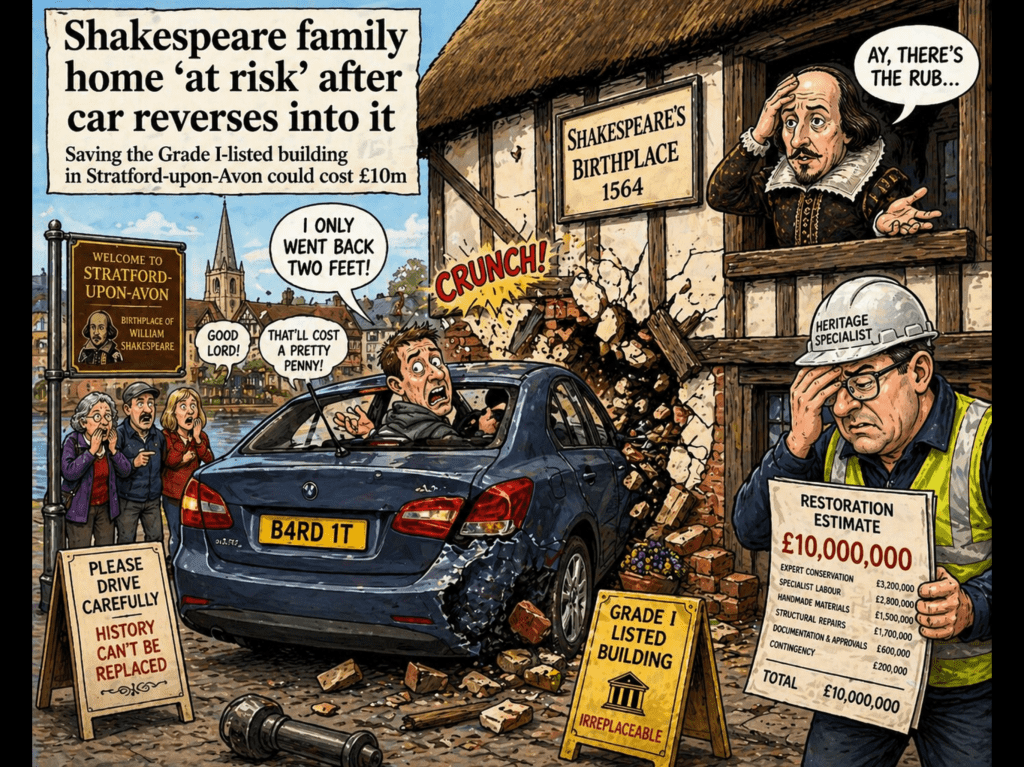
In a plot twist even the Bard himself might have rejected as too on the nose, a car has reversed straight into the historic home of William Shakespeare—because apparently, even 400-year-old literary landmarks aren’t safe from modern-day parking disasters.
Now, the Grade I-listed building in Stratford-upon-Avon faces a repair bill that could soar to a jaw-dropping £10 million. All from what might be the most expensive “oops” since someone first decided to rewrite Romeo and Juliet with a happy ending.
🎭 Much Ado About… Reversing?
Picture it: centuries of history, carefully preserved timber, walls that have outlived empires… defeated by a three-point turn gone rogue.
This isn’t just any house—it’s the house. The birthplace of arguably the greatest playwright in history. A cultural shrine. A literary pilgrimage site.
And now? Briefly reimagined as a drive-thru.
One can only imagine Shakespeare himself narrating the moment:
“Alas, poor wall! I knew it, Horatio… until Dave in a Vauxhall Astra misjudged reverse.”
🧱 When Heritage Meets Horsepower
Grade I-listed means exceptionally important. It’s the architectural equivalent of putting something in a glass case and whispering around it.
Which makes the incident all the more surreal. You don’t just fix this with a bit of filler and a YouTube tutorial. This is specialist restoration, conservation experts, heritage approvals—and apparently, a budget that rivals a small blockbuster film.
Because when you dent history, you don’t just repair it—you negotiate with it.
💸 The £10 Million Bump
Let’s put that into perspective:
- A minor car mishap
- Meets a building older than most countries
- Results in a repair bill that could fund several actual houses
Suddenly, insurance claims feel a bit more… theatrical.
And somewhere, an adjuster is staring into the void wondering how to categorise “collision with national treasure.”
🪶 The Fragility of Forever
There’s something oddly poetic about it, though.
We treat these places as permanent. Untouchable. Immune to the chaos of modern life. But all it takes is one moment—one lapse, one misjudged movement—and suddenly history feels… fragile.
Not lost, but shaken.
A reminder that preservation isn’t passive. It’s constant, careful, and occasionally at the mercy of someone who thought they had more space behind them than they actually did.
🔥Challenges🔥
Is this just an unfortunate accident—or a wake-up call about how we protect our history?
Should landmarks like this have stronger physical protections, or is this just one of those absurd, unavoidable moments where modern life crashes into the past—literally?
Drop your thoughts, your jokes, or your best Shakespearean one-liners in the blog comments. 💬🔥
👇 Like, share, and comment—because if we can’t laugh at a £10 million parking mistake, what can we do?
The sharpest wit and most savage takes will be featured in the next issue of the magazine. 🎯📝


 Chameleon Magazine
Leave a comment