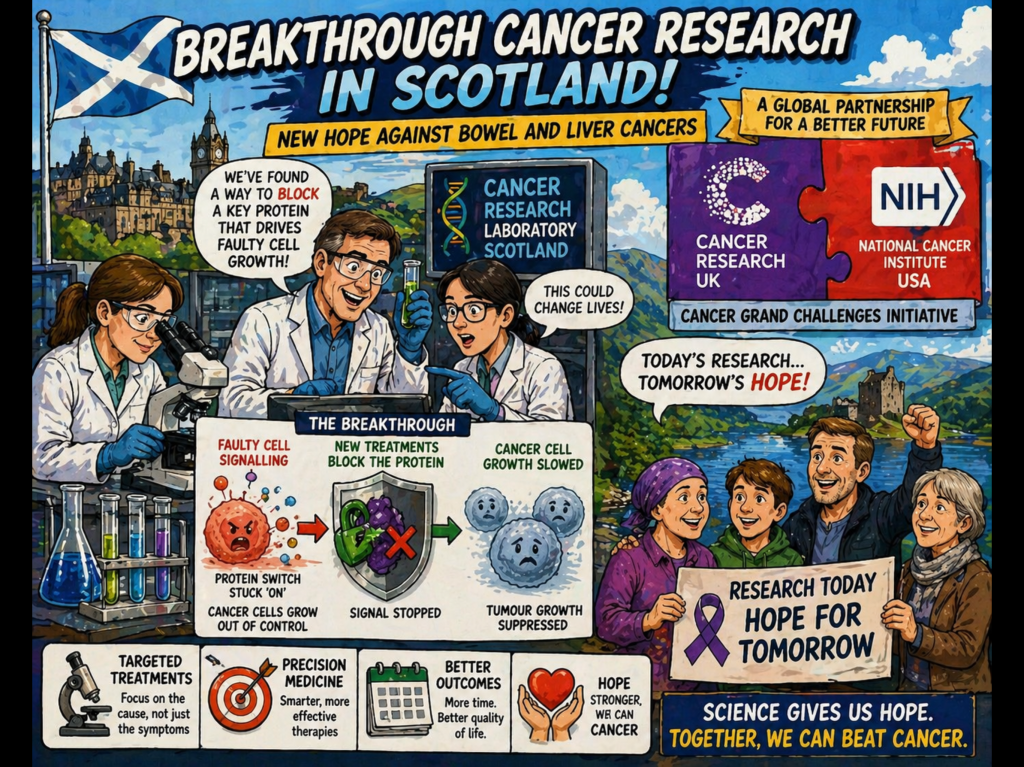
In a world where “breakthrough” gets thrown around like confetti, this one might actually deserve a second look. Researchers in Scotland have found a way to slow down bowel and liver cancers by blocking a protein that basically tells rogue cells to keep multiplying like they’re on a caffeine binge.
Funded by the heavyweight duo of Cancer Research UK and the US National Cancer Institute, this isn’t just lab chatter—it’s part of the global Cancer Grand Challenges initiative. Big brains. Big money. Big expectations.
🧬 The Protein Plot Twist
So what’s the magic trick here?
Scientists have zeroed in on a protein involved in faulty cell signalling—the biological equivalent of a broken traffic light stuck on green. Cells just keep going… and going… and going… straight into tumour territory.
Now? They’ve figured out how to block it. 🚫
Which means:
- Slower tumour growth
- Potential new treatments
- A genuine shift from “manage” to possibly “control”
Sounds impressive. Because it is.
But before we start planning the victory parade, let’s remember—this is science, not a Netflix finale. There are still trials, timelines, and a long road between “promising” and “available on the NHS.”
🧪 Hope… With a Side of Reality
We’ve been here before. Headlines scream breakthrough, then quietly whisper “more research needed” six months later.
That doesn’t mean this isn’t significant—it is. But cancer research moves in inches, not leaps. And every inch matters.
Still, targeting the mechanism of growth—not just the symptoms—is where real progress lives. This isn’t just treating cancer. It’s trying to outsmart it.
And frankly, it’s about time.
🌍 Global Brains, Local Impact
There’s something quietly powerful about this coming out of Scotland. Not Silicon Valley. Not some secret underground lab in a Bond film. Just serious scientists doing serious work that could ripple worldwide.
Because cancer doesn’t care about borders—and neither does good research.
⚖️ The Bigger Question
If this works—and that’s still an “if”—it raises a bigger issue:
Why does it take so long for breakthroughs to reach the people who need them?
Funding? Regulation? Systems moving slower than the diseases they’re fighting?
Because hope delayed can feel a lot like hope denied.
🔥Challenges🔥
Is this the kind of breakthrough we’ve been waiting for—or another headline that fades before it reaches patients?
Should more funding be poured into this kind of targeted research, or are we still spreading efforts too thin?
And here’s the real one: how do we make sure discoveries like this don’t sit in labs while people wait?
Drop your thoughts, your scepticism, or your optimism in the blog comments. 💬🔥
👇 Like, share, and comment—because breakthroughs only matter if people are talking about them.
The sharpest insights and strongest opinions will be featured in the next issue of the magazine. 🎯📝


 Chameleon Magazine
Leave a comment