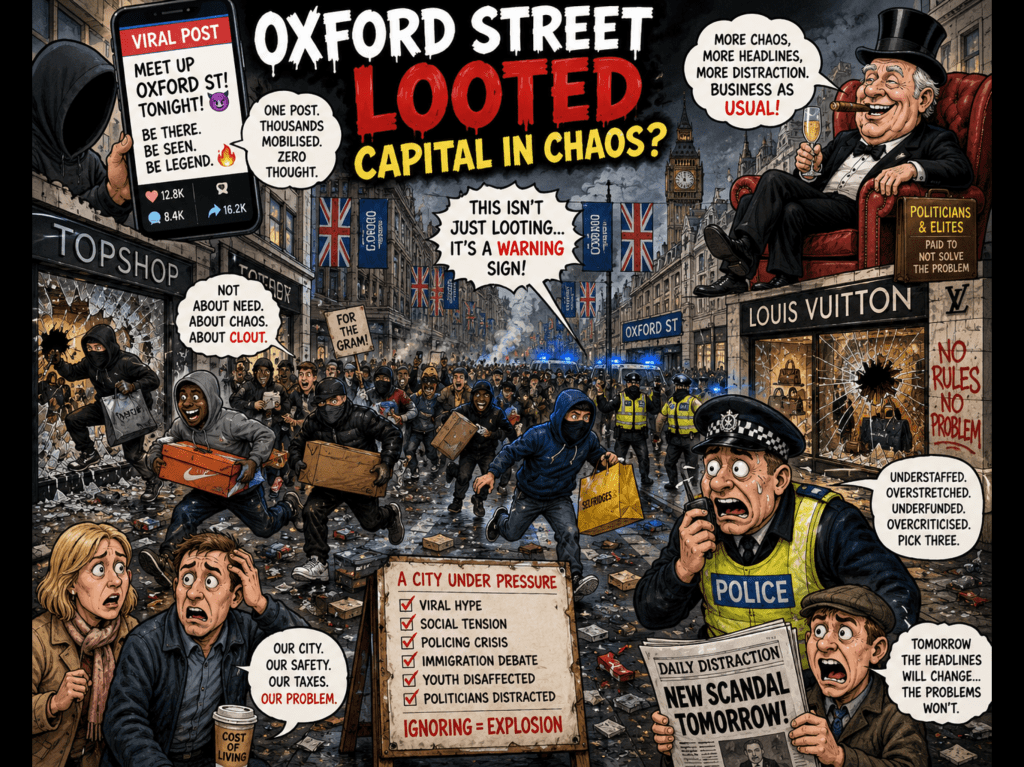
London’s glittering shopping artery turned into a live-action warning label this week as Oxford Street descended into chaos after viral social media hype triggered mass disruption, panic, and alleged looting scenes. Shops slammed shutters down, police scrambled across the West End, and tourists probably wondered whether they’d accidentally booked a holiday in Gotham City.
But beneath the screaming headlines and doom-scroll hysteria lies something uglier—and more complicated. This wasn’t just about crime. It was about a city running on pressure fumes: overcrowding, social tension, performative online chaos, stretched policing, and a digital culture where clout is now apparently worth risking arrest for. 📉🔥
Of course, the internet immediately split into two camps:
One side screaming “civilisation collapse!” while the other insisted it was merely “youthful energy” with a side order of smashed storefronts. As usual, reality sits somewhere between the hashtags and the hysteria.
⚡ TikTok Mayhem Meets a City Already Running on Empty
Oxford Street has become the perfect symbol of modern Britain: luxury shops guarded by exhausted staff, tourists filming everything for content, police juggling impossible workloads, and politicians acting shocked that years of pressure eventually produce explosions.
And yes, people are going to raise uncomfortable questions about immigration, integration, policing, poverty, and social cohesion. That debate is unavoidable now. But blaming every act of disorder on one single issue is the political equivalent of diagnosing a collapsing house as “probably just the curtains.” 🏚️🤹♂️
The truth? Modern cities are becoming pressure cookers.
Social media can summon thousands of bored, angry, opportunistic, or thrill-seeking people within hours. One viral post now has more mobilising power than entire political movements did twenty years ago. That’s not just a policing problem—it’s a civilisation software update nobody tested properly before launch. 📲💥
Meanwhile, ordinary Londoners are stuck in the middle watching billion-pound retail districts transform into flash mobs with sirens. Businesses lose money, workers feel unsafe, and the public gets treated to another round of politicians shouting rehearsed slogans while pretending everything is either perfectly fine… or literally the end of Britain.
Spoiler: it’s neither.
But it is a warning sign.
Because when trust in institutions drops, policing feels overstretched, communities become fragmented, and online chaos becomes entertainment, incidents like this stop feeling shocking and start feeling… scheduled. 🕒🚔
🔥Challenges🔥
Here’s the uncomfortable question nobody can meme away:
What kind of cities are we building when a rumour online can shut down one of Europe’s most famous shopping streets within hours? 🤔
Was this just opportunistic chaos fuelled by social media?
Or are we watching the early symptoms of deeper fractures politicians are too terrified—or too incompetent—to confront honestly?
Drop your take in the BLOG comments, not just the social media echo chamber. 💬🔥
Do tougher policing and stricter immigration controls solve this?
Or is this about a wider collapse in trust, identity, consequences, and social stability?
👇 Comment, like, and share if you think modern cities are becoming one viral post away from meltdown.
The sharpest comments, hottest takes, and most savage observations will be featured in the next issue of the magazine. 🎯📝


Leave a comment