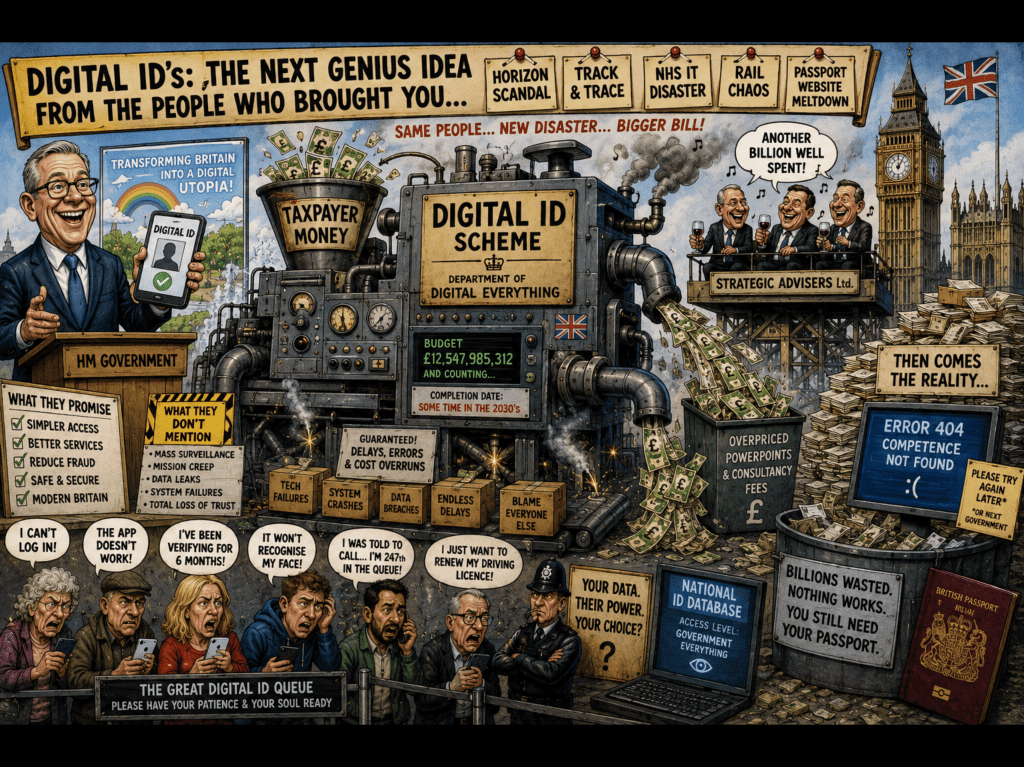
💳🔥💸Ah yes, Britain’s latest grand technological adventure:
digital IDs.
Because nothing says “efficient modern governance” quite like handing Westminster another gigantic IT project while the public quietly remembers:
- Horizon,
- Track and Trace,
- NHS databases,
- delayed rail systems,
- and government websites that collapse the moment three people attempt to renew a passport simultaneously. 💻💀
And now we’re told:
“Trust us. This time the massive state-run digital infrastructure will definitely work perfectly.”
The nation collectively responds:
“Oh dear God.” 🇬🇧😐
💰 The Great British Tradition: Spending £12 Billion to Invent a Worse Version of an App
You can already see how this unfolds.
Stage 1:
Government announces “world-leading digital transformation.” 📢✨
Stage 2:
Consultants appear carrying PowerPoints worth more than small islands. 📊💷
Stage 3:
Three separate departments accidentally build incompatible systems.
Stage 4:
Someone discovers the software only works on alternate Tuesdays if Chrome is updated and Mercury isn’t in retrograde. 🌍💀
Stage 5:
Taxpayers receive a final bill roughly equivalent to funding a moon landing.
And after ten years, the public still can’t log in because the verification text got sent to a Nokia they owned in 2011. 📱🔥
🏛️ “Convenience” Is Always the Sales Pitch
Supporters say digital IDs will:
- simplify services,
- reduce fraud,
- improve access,
- and modernise government.
And fair enough — in theory, some form of secure digital identity probably is inevitable in the modern world.
But the problem is trust.
Britain doesn’t lack technology.
It lacks confidence that the people running the technology are remotely competent enough to build it without turning the country into a national customer support queue. ☎️😵
👀 The Public Fear Isn’t Just Cost — It’s Control
This is where the debate gets explosive.
Because many people hear “digital ID” and immediately think:
- surveillance,
- mission creep,
- data leaks,
- system failures,
- and government departments accidentally emailing personal records to Dave from Swindon. 📧💀
Even people open to modernisation start worrying when politicians insist:
“There’s absolutely nothing to fear.”
Which, historically, is usually the exact moment everyone should begin fearing everything.
🔧 Britain’s IT History Does Not Inspire Calm
That’s the deeper comedy here.
Westminster behaves as though it’s launching a sleek Scandinavian digital future while the public remembers trying to use a council website that still looks like it was designed during the Crimean War. 🖥️⚰️
The fear isn’t technology itself.
The fear is giving a notoriously inefficient political system:
- enormous budgets,
- vague timelines,
- emergency powers,
- and a national database
all at the same time.
Because Britain doesn’t just build bureaucracy anymore.
It industrialises it.
🔥Challenges🔥
Would digital IDs genuinely modernise Britain — or become another catastrophic government IT money pit? 💳💸
And do people trust Westminster enough to safely manage massive digital identity systems without waste, failure, or mission creep?
Drop your thoughts in the blog comments. 💬🔥
👇 Like, comment, and share if the phrase “government IT project” immediately fills you with financial dread.
The sharpest comments and funniest predictions may feature in the next magazine issue. 📰⚡


Leave a comment