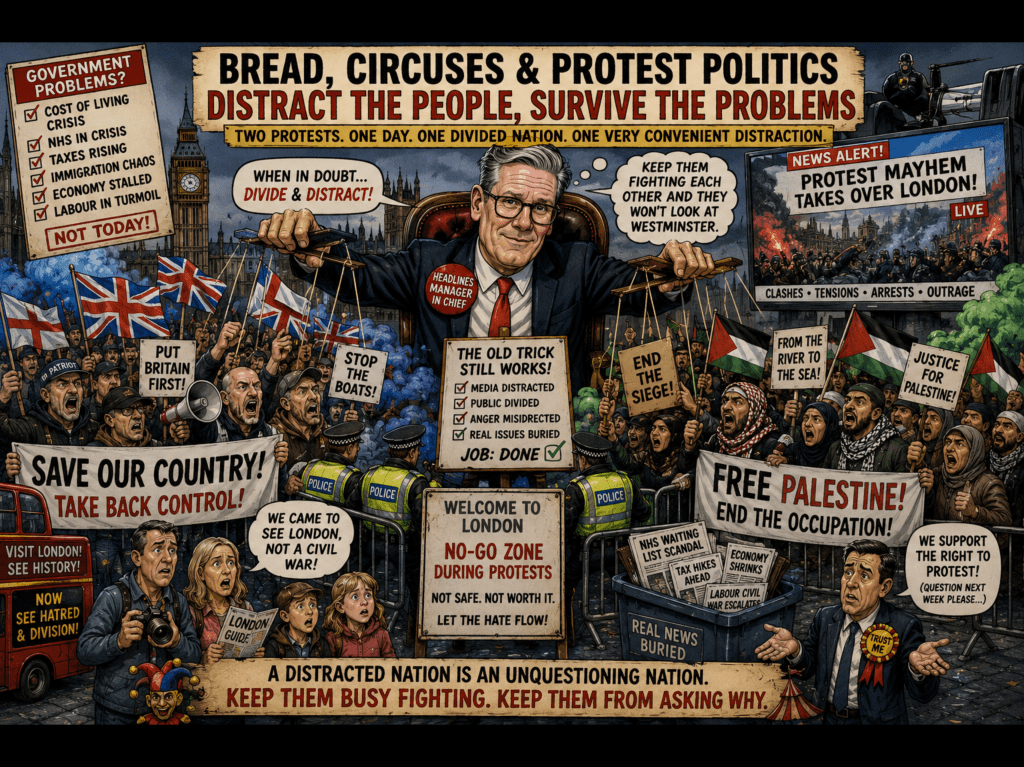
Whenever governments hit turbulence, public attention mysteriously finds somewhere else to land. One week it’s inflation, migration, housing, NHS waiting lists, strikes, taxes, or internal party chaos dominating the headlines — the next it’s wall-to-wall footage of rival protesters screaming across police barriers while every broadcaster in Britain suddenly transforms into a rolling national stress simulator. 📺🚨
So naturally people start asking uncomfortable questions:
Is this simply democracy unfolding naturally… or has Westminster discovered that public division makes an extremely convenient smoke screen? 🃏
Because history has shown one thing repeatedly:
Nothing buries political embarrassment faster than public conflict. ⚔️
🏛️ Divide, Distract, Repeat
Now to be fair, there’s no public evidence Keir Starmer personally “allowed” protests to collide purely as a distraction tactic. London policing and protest permissions involve legal rights, operational decisions, public order law, and logistical realities far beyond one man sitting in Downing Street stroking a white cat plotting headline management. 🐈⬛📰
But politically? The optics are hard to ignore.
When media coverage becomes dominated by:
- clashes in central London 🚔
- outrage clips online 📱
- flags, chanting, arrests and confrontation 🔥
- endless panel debates about “community tensions” 🎙️
…it leaves very little oxygen for difficult conversations about the economy, taxes, public services, immigration pressures, or unpopular government decisions.
And politicians across all parties know this instinctively:
A frightened, angry, emotionally exhausted population rarely focuses on spreadsheets and policy failures. 📉
🎪 The Oldest Trick in Politics
The Romans called it “bread and circuses.”
Modern politics upgraded it to:
“fear, outrage, and rolling live coverage.” 🍿📺
Because once society starts arguing horizontally — neighbour vs neighbour, protester vs counter-protester, left vs right, flag vs flag — people stop looking vertically at the institutions managing the chaos in the first place.
And whether intentional or accidental, governments often benefit when public anger is redirected away from Westminster and into the streets themselves.
Meanwhile:
- living costs stay brutal 💸
- infrastructure declines 🏚️
- trust collapses 📉
- and politicians appear on television urging “calm” while the capital resembles a permanently stressed pressure cooker.
The danger is that eventually nobody trusts anybody anymore:
Not government.
Not media.
Not police.
Not each other. ⚠️
And once a country reaches that stage, restoring unity becomes far harder than exploiting division ever was.
🔥Challenges🔥
Do you think modern governments quietly benefit from public division and protest chaos distracting attention from their failures? Or is this simply the unavoidable reality of a free society under pressure? 🤔🔥
Drop your thoughts in the blog comments — not just social media where nuance goes to die in 280 characters. We want honest debate, sharp arguments, and uncomfortable truths. 💬⚡
👇 Hit comment, hit like, hit share.
Is Britain managing tension… or politically surviving through it? 🇬🇧🔥
The strongest comments and most thought-provoking takes will be featured in the next issue of the magazine. 📝⚡
Chameleon News


Leave a Reply