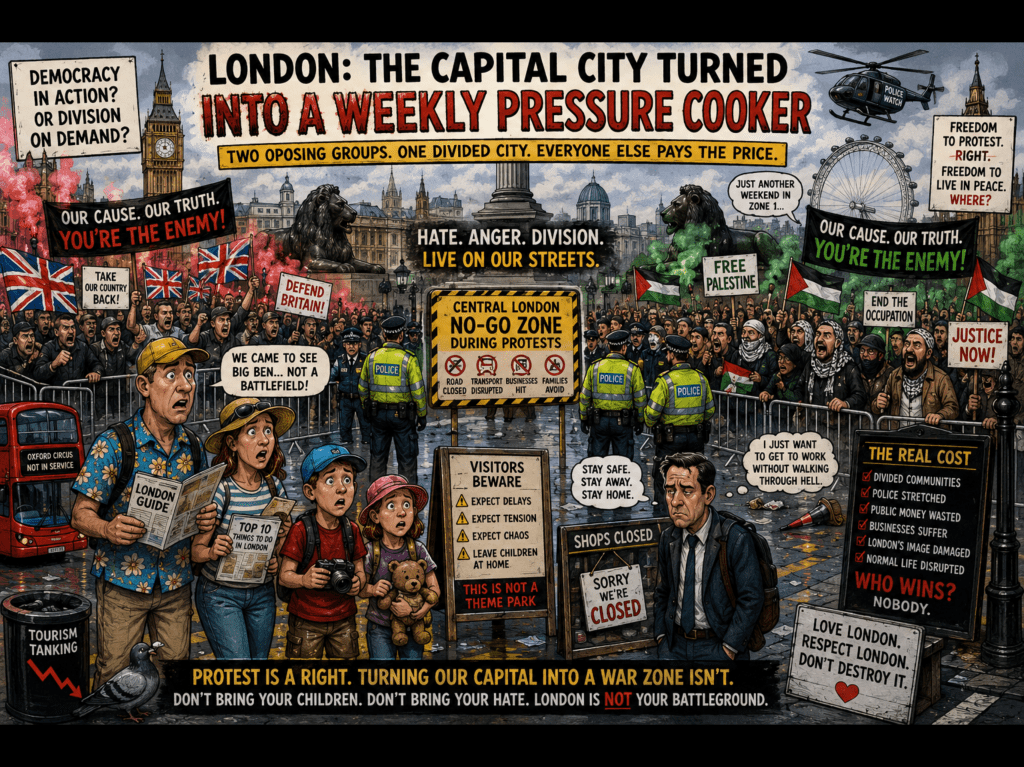
London used to sell itself as a postcard to the world — red buses, black cabs, museums, theatre, history, and a sense that despite its chaos, it somehow still worked. Now during major opposing protests, entire parts of the capital can start to resemble a live-action warning label for social collapse. 🏙️⚠️
Tourists arrive expecting Buckingham Palace and afternoon tea, then find roads blocked, helicopters circling overhead, masked crowds screaming at each other, police stretched across junctions, and social media flooded with clips designed to inflame everyone further. Welcome to Britain’s newest spectator sport: ideological cage fighting in Zone 1. 🎭📱
And ordinary Londoners? Many simply avoid central London entirely during these events. Parents think twice before bringing children into the city. Businesses shut early. Visitors wonder whether they accidentally booked a holiday inside a geopolitical argument.
🪧🔥 Protest or Permanent Atmosphere of Division?
The government insists allowing both groups to march is democracy in action — and legally, peaceful protest absolutely matters in a free society. But when every demonstration begins to feel like two hostile football firms meeting under police supervision, the atmosphere changes completely. 🚔
The tension becomes the event itself.
People no longer see “a protest.”
They see:
- transport disruption 🚇
- aggressive chanting 📢
- viral confrontation clips 🎥
- political tribalism ☠️
- fear that one spark could turn everything ugly 🔥
And the saddest part? Most normal people standing in the middle of it all don’t even feel represented by either extreme. They just want to move through their own city without feeling like they’ve wandered into a live-streamed civil breakdown.
Meanwhile politicians posture from television studios pretending “community cohesion” is flourishing while police officers spend entire weekends separating furious groups with metal barriers and fluorescent jackets. 🧱👮
🎪 The Global Image Problem Nobody Wants to Admit
Here’s the uncomfortable reality:
Visitors notice this.
Families notice this.
Businesses notice this.
When central London repeatedly appears online as a battleground of anger, flags, insults, arrests, and intimidation, it damages the image of the city itself. 🌍📉
People begin asking:
“Is this safe?”
“Should we avoid that area?”
“Is London becoming unstable?”
And once a city gains the reputation of being permanently tense, divided, and unpredictable, rebuilding public confidence becomes much harder than politicians think.
A capital city cannot endlessly function as a symbolic battlefield for every global conflict while expecting ordinary life to continue untouched.
🔥Challenges🔥
At what point does democratic protest stop feeling like free expression and start feeling like permanent social fracture? Can London remain open, tolerant, and safe while becoming increasingly consumed by rival demonstrations and political hostility? 🤔🔥
Drop your thoughts in the blog comments — not just the endless shouting pits of social media. We want serious opinions, difficult questions, and honest debate about what London is becoming. 💬⚡
👇 Hit comment, hit like, hit share.
Is this democracy working… or social cohesion failing in real time? 🏙️🔥
The sharpest comments and strongest arguments will be featured in the next issue of the magazine. 📝🇬🇧
Chameleon News


Leave a comment