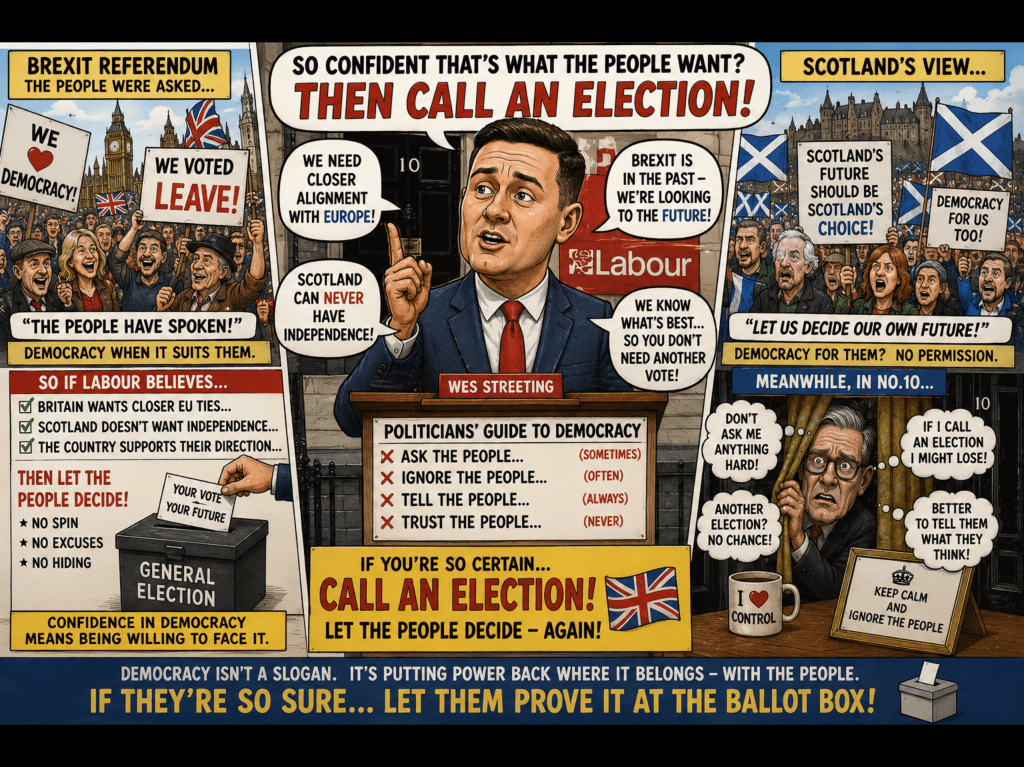
Modern British politics has developed a fascinating little habit:
politicians constantly tell the public what they supposedly think… while becoming strangely nervous whenever voters are asked directly. 🎭📺
Now Wes Streeting talks openly about steering Britain back towards Europe despite Brexit being decided in a national referendum. At the same time, Scotland is repeatedly told independence is permanently off the table regardless of how many Scots vote for parties supporting it.
And that raises a very uncomfortable question:
If Westminster politicians are so absolutely certain the British people support this direction… why not test it in a general election? 🤔⚖️
🏛️ “Trust Us… But Don’t Vote On It”
This is the contradiction driving frustration across Britain and especially Scotland.
Brexit happened because politicians told the public:
“The people must decide.”
But now?
Suddenly Westminster increasingly behaves as though public opinion only matters when it produces establishment-approved outcomes. ⚠️
If Labour genuinely believes:
- Britain wants closer EU alignment 🇪🇺
- Scotland has no appetite for independence 🏴
- Westminster’s direction reflects public opinion 📊
…then why not go to the country openly and seek a fresh democratic mandate?
Not vague slogans.
Not carefully massaged interviews.
Not “read between the lines” politics.
A clear election.
A clear argument.
A clear vote. 🗳️
Because confidence in democracy means being willing to let the public answer difficult questions — not endlessly explaining why the public should stop asking them.
🇬🇧 The Growing Westminster Arrogance Problem
For many people, the real issue is not even Europe anymore.
It’s the attitude.
That sense Westminster increasingly sees itself as the permanent referee of which democratic choices are acceptable and which are inconvenient.
Brexit?
“The people have spoken.”
Scottish independence?
“Now isn’t the time.”
Calls for another vote?
“Dangerous.”
Questions about sovereignty?
“Divisive.”
At some point people stop hearing leadership and start hearing political gatekeeping. 🚪⚡
And nowhere is that frustration stronger than Scotland — where many voters already feel repeatedly overruled on major constitutional decisions despite voting differently from England on issue after issue.
🏴 Democracy Cannot Be Selective
This is the principle many Scots keep returning to:
If Westminster politicians can revisit Britain’s relationship with Europe, then Scotland must surely retain the right to revisit its relationship with Westminster.
Otherwise democracy starts looking less like a right and more like a subscription service controlled from London. 💷🔒
And if Labour truly believes the country backs its direction, there’s a very simple solution:
Call an election.
Put the argument honestly to the people.
And let democracy decide.
Because confidence in public support should never fear the ballot box. 🗳️🔥
🔥Challenges🔥
If Westminster politicians are confident Britain supports closer EU ties and rejects Scottish independence, should they seek a fresh democratic mandate through another general election? Or has modern politics become too afraid of what voters might actually say? 🤔⚡
Drop your thoughts in the blog comments — not just the social media trenches where every constitutional debate turns into digital warfare by lunchtime. 💬🔥
👇 Hit comment, hit like, hit share.
If they’re so certain… why not ask the people again? 🗳️🏛️
The strongest comments and boldest arguments will be featured in the next issue of the magazine. 📝🔥
Chameleon News


Leave a Reply