🎓🤖💥For generations, society sold young people the same polished fairy tale:
Study hard.
Pass exams.
Get the degree.
Join the system.
Climb the ladder.
Retire quietly.
That was the contract. 📜
And for decades, universities sat at the centre of it all like medieval castles guarding the bridge to adulthood. Want opportunity? Pay the toll. Want status? Collect the certificates. Want survival? Better hope you can afford tuition fees the size of a small mortgage.
Then Artificial Intelligence arrived with a laptop, an internet connection, and absolutely no respect for the old gatekeepers. ⚡
And suddenly the entire system started wobbling like a drunk headmaster at a parents’ evening.
🎓 The Great Knowledge Heist Nobody Is Ready For
The panic around AI in schools is almost adorable.
Teachers are debating plagiarism policies while the economic foundations beneath education are quietly being bulldozed in real time. 🚜💀
People keep asking:
“Should students use AI for homework?”
That question is already obsolete.
The real question is:
What happens when knowledge itself is no longer scarce?
Because that was the true power universities held for centuries. Not intelligence. Not wisdom. Access.
If you wanted expertise, you had to go through them.
The institution was the bottleneck.
The lecturer was the gatekeeper.
The textbook was sacred scripture.
Now?
A teenager in a bedsit can ask AI:
- how to build a business,
- launch a website,
- automate customer support,
- write ad campaigns,
- analyse markets,
- learn coding,
- create products,
- and scale operations,
all before a university student finishes arguing with Student Finance England over missing paperwork. 🧾🔥
That is not a small disruption.
That is economic dynamite.
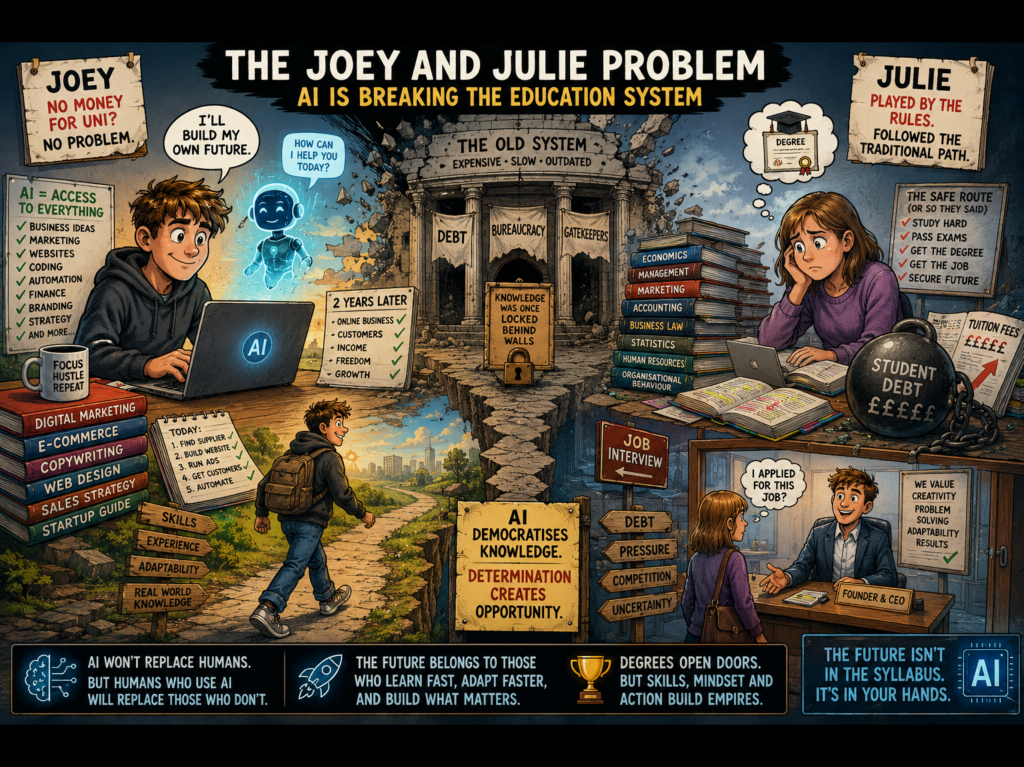
💻 Joey vs Julie: The New Class Divide
Joey cannot afford university.
No trust fund.
No family connections.
No polished LinkedIn profile featuring “aspiring thought leader” nonsense.
But Joey has hunger. And now he has AI.
So while institutions lecture him about “academic integrity,” Joey is learning practical survival skills in real time:
- selling,
- building,
- negotiating,
- automating,
- adapting.
He learns by doing.
By failing.
By fixing problems immediately.
Meanwhile Julie does everything “correctly.”
She obeys the system flawlessly. 🏅
Years of essays.
Years of exams.
Years of debt.
Years of delayed adulthood.
She graduates proudly holding a certificate that cost tens of thousands of pounds and most of her twenties.
Then comes the uncomfortable possibility nobody wants to say out loud:
Julie may eventually apply for a job at Joey’s company.
And that possibility terrifies the establishment because it exposes a brutal truth:
credentials are losing their monopoly over opportunity.
🏛️ Universities Are Facing Their Napster Moment
This is the part institutions still refuse to confront.
AI is doing to knowledge what the internet did to music. 🎵⚠️
Once upon a time:
- studios controlled distribution,
- labels controlled discovery,
- gatekeepers controlled careers.
Then technology blew the walls apart.
Now universities are staring at the same existential threat.
Because when AI can explain concepts instantly, personalise learning, simulate tutors, generate examples, answer questions 24/7, and help people execute ideas immediately…
the value proposition changes dramatically.
People will begin asking dangerous questions:
- Why am I paying £60,000 for information?
- Why am I memorising facts AI retrieves instantly?
- Why does a degree take four years to prove capability?
- Why are employers still filtering humans using industrial-age systems?
And once society starts asking those questions at scale, the old model starts sweating heavily. 😬💸
🧠 The Future Belongs to Hybrid Thinkers
This does not mean education becomes useless.
Far from it.
You still want:
- surgeons who understand anatomy,
- engineers who understand physics,
- pilots who can function under pressure,
- scientists who understand causality,
- lawyers who understand consequences.
Real expertise still matters enormously.
But AI changes which human traits become economically valuable.
Memorisation declines in value.
Adaptability rises.
Execution rises.
Judgment rises.
Creativity rises.
Communication rises.
Problem-solving rises.
The winners will not simply be “the smartest people.”
They will be the people who know how to combine:
🧠 human reasoning
⚡ AI acceleration
🎯 focused execution
🔧 practical adaptability
That combination is terrifyingly powerful.
🔥 The Most Dangerous Person in the Future May Be a Motivated Beginner
This is the truly revolutionary part.
AI does not only empower elites.
It empowers determined outsiders.
A poor kid with discipline and curiosity now has access to:
- tutoring,
- business guidance,
- technical support,
- coding help,
- writing assistance,
- strategic advice,
- and learning resources,
at near-zero cost.
Historically, that level of support was reserved for the wealthy. 💰
Now it sits inside a browser window.
And somewhere right now, while committees hold emergency meetings about plagiarism policies and essay formatting…
millions of Joeys are already building businesses, learning skills, generating income, and bypassing systems that once locked them out entirely.
That is the real disruption.
Not cheating.
Not homework.
Not ChatGPT writing history essays.
This is a redistribution of opportunity itself. 🌍⚡
🔥Challenges0🔥
So here’s the uncomfortable question nobody in the education system wants to answer:
If AI can teach, guide, explain, assist, and accelerate faster than traditional institutions… what exactly are students paying for now? 🎓💣
Is the future still about qualifications?
Or is it about adaptability, leverage, and execution?
Drop your thoughts in the blog comments. Are universities evolving — or slowly becoming blockbuster video stores in the age of Netflix? 🍿🔥
👇 Comment, like, and share this with someone still pretending AI is “just a cheating tool.”
The best comments and hottest debates will be featured in the next issue of the magazine. 📝⚡


Leave a Reply