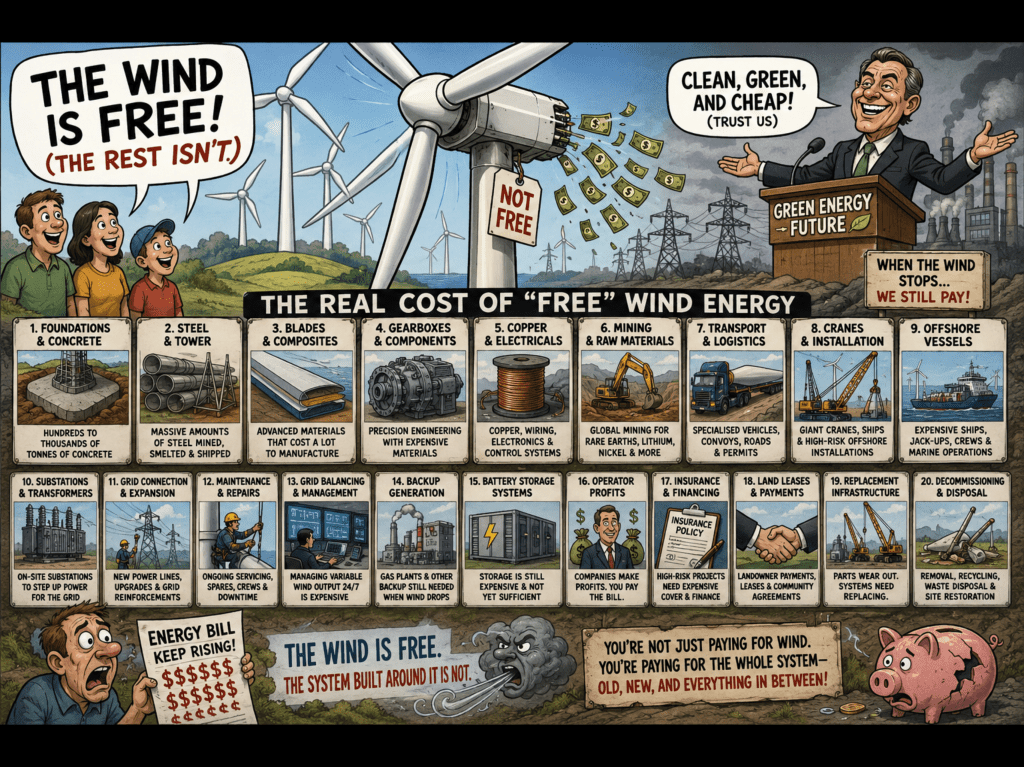
For over a decade, politicians, corporations, and eco-marketing departments have repeated the same hypnotic slogan like a sacred chant at a climate cult retreat:
“The wind is free.” 🌍✨
Well congratulations. So is sunlight. So is rain. So is gravity.
That does not magically mean harvesting them at industrial scale becomes cheap.
What the public has actually witnessed is not the discovery of “free energy,” but the birth of one of the largest infrastructure spending operations in modern history — wrapped in white paint and moral superiority. 🏗️⚡
The modern wind turbine is sold like some elegant eco-swan gliding across the horizon.
In reality, it’s a 900-foot industrial tax vacuum made of steel, copper, composites, concrete, rare earth minerals, financial leverage, and permanent maintenance contracts.
🏗️ The Giant Green Money Machine
People see a turbine spinning lazily on a hill and imagine nature itself is charging their phone.
What they do not see:
- The colossal concrete foundations buried underground 🪨
- The mining operations ripping materials from across the globe ⛏️
- The diesel-powered ships transporting offshore components 🚢
- The cranes taller than skyscrapers 🚧
- The transmission upgrades needed to connect remote wind farms 🔌
- The backup gas plants waiting for calm weather 🔥
- The battery systems that still aren’t remotely sufficient at scale 🔋
- The maintenance crews servicing machines in brutal offshore conditions 🌊
And perhaps most importantly…
…the endless river of subsidies, guaranteed pricing schemes, environmental credits, taxpayer guarantees, and financial engineering surrounding the entire industry. 💰📈
The wind itself may indeed be free.
But the system built around it behaves less like environmental salvation and more like a permanent industrial subscription service.
🌪️ “Cheap Energy” That Somehow Never Lowers Bills
Here comes the awkward question governments hate hearing:
“If wind power is now the cheapest energy ever created… why are ordinary people still being financially strangled by energy bills?” 🤔💸
Because consumers are not merely paying for electricity anymore.
They are paying for:
- the old grid,
- the new grid,
- backup generation,
- balancing systems,
- storage expansion,
- infrastructure duplication,
- decommissioning liabilities,
- insurance risks,
- investor returns,
- and political promises that were marketed as “cost-saving transitions.”
In other words:
The public is funding two energy systems simultaneously. ⚡⚡
One system keeps civilisation alive when the weather fails.
The other is being built at staggering scale in the name of the future.
And every layer carries another invoice.
🛠️ The Fantasy of “Energy Nirvana”
Somewhere along the way, public discussion drifted from engineering reality into near-religious storytelling.
People were encouraged to imagine a utopian future where turbines eventually “pay for themselves” and society enters an era of nearly free electricity. 🌈⚡
But industrial systems do not work like Netflix subscriptions that suddenly become free after Episode 10.
Turbines age.
Gearboxes fail.
Blades degrade.
Saltwater corrodes offshore installations.
Grids require constant balancing.
Infrastructure must be replaced.
And after 20–30 years, entire fleets eventually need dismantling or rebuilding.
There is no magical point where costs vanish into the wind.
Only politicians vanish when the bills arrive. 🏃♂️💨
⚖️ Reality Is More Complicated Than Slogans
None of this means wind power is useless.
None of this means fossil fuels are environmentally harmless.
And none of this means renewable energy cannot play a major role in future systems.
But honesty matters. 🧠
Because the current public conversation often sounds less like engineering and more like a children’s cartoon narrated by investment bankers.
The truth is far less romantic:
Modern energy transitions are colossal industrial undertakings filled with trade-offs, contradictions, geopolitical dependencies, environmental costs, and massive financial interests.
The wind is free.
The monetisation of the wind is not. 🌬️💷
Have governments oversold the dream of “cheap green energy”?
Are consumers being told the full truth about the real costs of rebuilding the energy system?
Or is this simply the unavoidable price of moving away from fossil fuels?
Drop your thoughts directly into the blog comments — not just social media drive-bys. 💬⚡
Bring facts. Bring fury. Bring sarcasm. Bring receipts.
👇 Like, share, and comment if you’re tired of slogans replacing honest debate.
The sharpest comments, hottest takes, and best reader burns may be featured in the next issue of the magazine. 📰🔥
Chameleon News


Leave a Reply