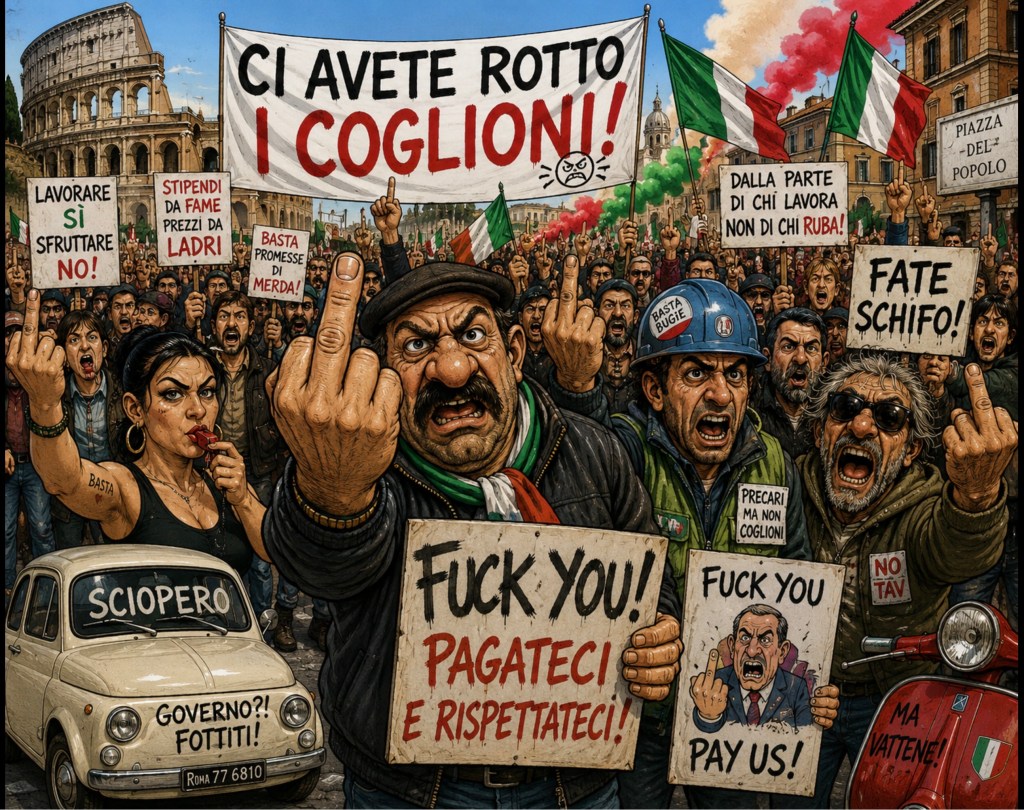
From delayed trains to shuttered schools and factory walkouts, Italy has once again reminded the world that when pressure builds, Italians don’t quietly “circle back via email.” They shut the country down with flair, espresso in hand, and a union banner flapping dramatically in the wind. ☕✊
Over the last year, the country has been hit by wave after wave of strikes tied to layoffs, rising costs, transport chaos, government cuts, and geopolitical fury. One week it’s luxury workers at Kering walking out over restructuring plans, the next it’s buses, trains, ports, schools, and rail lines grinding to a halt because half the nation collectively decided they’ve had enough. 🚉💥
🎭 “Bella Ciao” But Make It Payroll Disputes
Italy doesn’t do mild inconvenience. It does theatrical civic exhaustion.
While other countries politely complain online and refresh LinkedIn in despair, Italy unleashes coordinated national strikes like a Renaissance flash mob with legal representation. Entire transport systems freeze. Ports stall. Public services wobble. Somewhere, a furious commuter waves a train ticket like it’s evidence in a corruption trial. 🚂📉
And honestly? None of this came out of nowhere.
You’ve got inflation chewing through wages faster than tourists devour gelato in Rome. Energy costs climbing. Automation threatening jobs. Public frustration with Brussels simmering in the background. Add wars, migration tensions, stagnant pay, and political distrust into the pot and suddenly the whole country starts sounding like a pressure cooker with a megaphone. 📢🔥
Even luxury fashion workers — the people stitching handbags that cost more than a used Fiat — are now walking off the job over restructuring fears. That’s when you know the mood has shifted from “economic concern” to “continental existential crisis.” 👜⚠️
And let’s not forget Italy’s glorious historical tradition of industrial unrest. This is the homeland of the legendary “Hot Autumn” strikes of 1969–70, where workers basically invented the modern art form of making governments sweat publicly. Compared to that era, modern strikes almost feel culturally nostalgic. 🇮🇹🪧
🚦Europe’s Most Stylish Gridlock
The real irony? Italy somehow manages to make national dysfunction look cinematic.
A rail strike in another country feels annoying. In Italy it feels like the opening scene of an Oscar-winning political drama. Someone’s grandmother is yelling. A Vespa is parked illegally. A union spokesperson is passionately explaining capitalism’s collapse while standing beside a delayed regional train to Naples. 🎬🚦
Meanwhile tourists stare helplessly at cancelled departures wondering whether “sciopero” means “minor delay” or “the complete collapse of civilisation until further notice.” Spoiler: usually the second one.
🔥Challenges🔥
At what point does constant disruption become a warning sign the political class can’t ignore? Are these strikes a justified revolt against economic pressure — or proof Europe’s systems are creaking under too many crises at once? 🤔💣
Drop your take in the blog comments. Rage about delayed trains. Defend organised labour. Roast politicians. Or explain why every major European crisis somehow ends with commuters stranded beside a vending machine eating stale crisps. 💬🚉
👇 Comment, like, and share if you’ve ever been personally defeated by public transport, inflation, or a government spokesperson saying “the situation is under control.”
The best comments, rants, and truth bombs will be featured in the next issue of the magazine. 📝🔥
Chameleon News


Leave a Reply