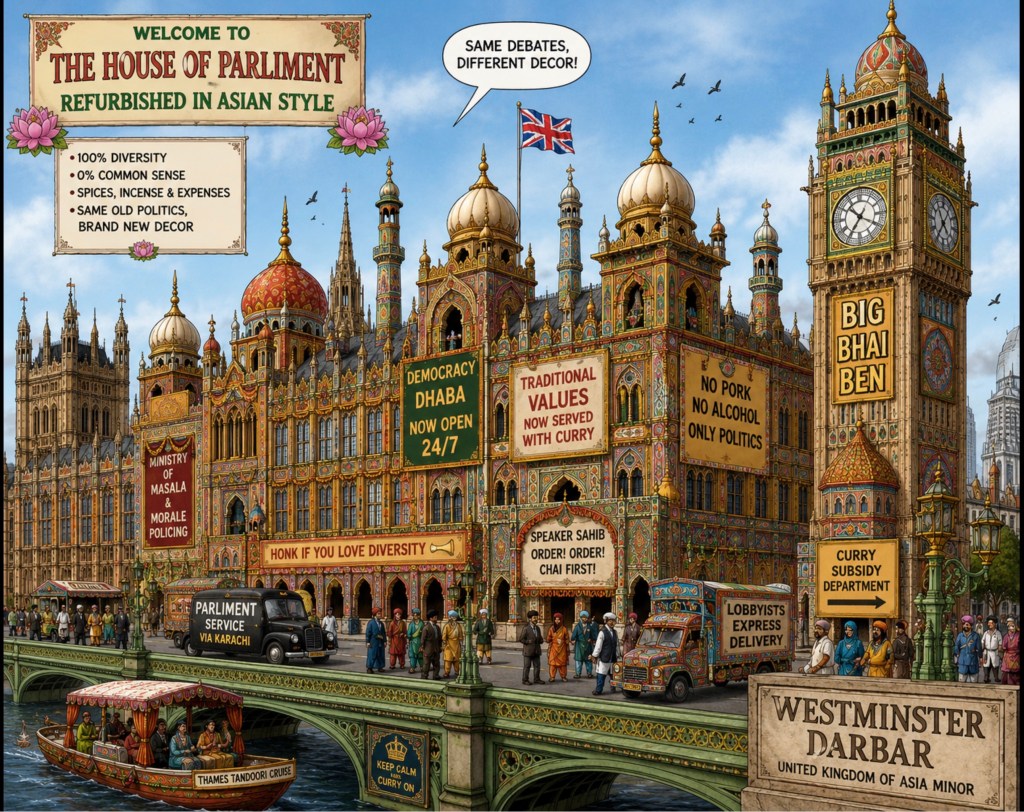
For many British people, the frustration isn’t about hating other cultures — it’s about the feeling that their own culture, traditions, and identity are constantly expected to apologise for existing in the country they built. 🏴☕🏡
That’s where a lot of tension comes from.
When people see entire shopping centres, neighbourhoods, or public spaces becoming heavily shaped around imported cultural norms, some feel enrichment and diversity. Others feel like they’re slowly becoming strangers in places that once felt unmistakably British. And whether people agree with that feeling or not, dismissing it outright usually makes the divide worse, not better. ⚡
🏬 Bradford’s Latest Contribution to British Retail: The Indoor Bazaar Experience™ 🇬🇧🛍️
And now Bradford has unveiled an Asian shopping centre — because apparently what British retail was truly missing wasn’t lower prices, free parking, or functioning town centres… but a full sensory bombardment of neon signs, dessert counters, gold jewellery displays, incense clouds, and three separate sales pitches before you’ve even found the escalator. 📱💨😂
Supporters call it “cultural vibrancy.”
Critics call it “speed-running retail exhaustion.”
Still, underneath the jokes sits a more serious debate. Many British people look at developments like this and quietly wonder whether multiculturalism was originally presented as:
“Come and become part of Britain”
or:
“Britain itself will slowly become a patchwork of imported cultural enclaves sharing the same postcode.” 🤔
That doesn’t mean communities shouldn’t build businesses, invest locally, or celebrate their heritage. Of course they should. But it also explains why some locals feel uneasy when entire public spaces increasingly resemble the countries migrants supposedly left behind in search of a different life.
And perhaps that’s the contradiction unsettling so many people:
Britain is repeatedly told to celebrate every cultural transformation while often feeling uncomfortable expressing pride in its own traditions at the same time. 🇬🇧🔥
🏴 “Integration” Was Supposed to Work Both Ways
Most ordinary British people never objected to people arriving, working hard, contributing, and becoming part of society. Britain itself was built through trade, migration, industry, and cultural exchange.
But many now ask:
“At what point does multiculturalism stop meaning shared society and start meaning parallel societies living beside each other?” 🤷♂️
That question gets labelled everything from “concern” to “bigotry” depending on who’s shouting online that day. Meanwhile the average person is simply looking around their town wondering:
- what changed,
- how fast it changed,
- and whether anyone in power is even allowed to discuss it honestly anymore. 🎭
And yes — British people are entitled to care about preserving British culture in Britain. That should not be treated as some shocking or extremist concept. Every country on Earth protects its identity, language, customs, and social norms to some degree. 🇬🇧📚
The challenge is balancing:
- openness without cultural erasure,
- diversity without fragmentation,
- and integration without demanding either side completely abandon who they are.
Because if communities stop feeling connected by common values, shared expectations, and mutual respect, politics quickly turns into resentment management. 📉🔥
🔥 The Real Debate Is About Confidence, Not Hatred 🔥
A confident country should be able to welcome newcomers while still unapologetically valuing its own traditions, humour, customs, history, and social expectations.
People don’t want endless lectures telling them they must celebrate every cultural change while quietly pretending their own discomfort is illegitimate. Equally, most people also don’t want hostility or division between communities who live side by side every day.
What they want is honesty:
- honest discussion,
- honest integration,
- honest expectations,
- and a society where British identity isn’t treated like an embarrassing historical inconvenience. 🇬🇧⚖️
👇 What do you think — has Britain found the right balance between multiculturalism and national identity, or are people increasingly feeling disconnected from the country they grew up in? Drop your thoughts in the blog comments. 💬🔥
👍 Like, share, and join the debate — respectfully, passionately, and honestly.
The strongest comments and sharpest observations may be featured in the next issue of the magazine. 📰⚡
Chameleon News


Leave a comment