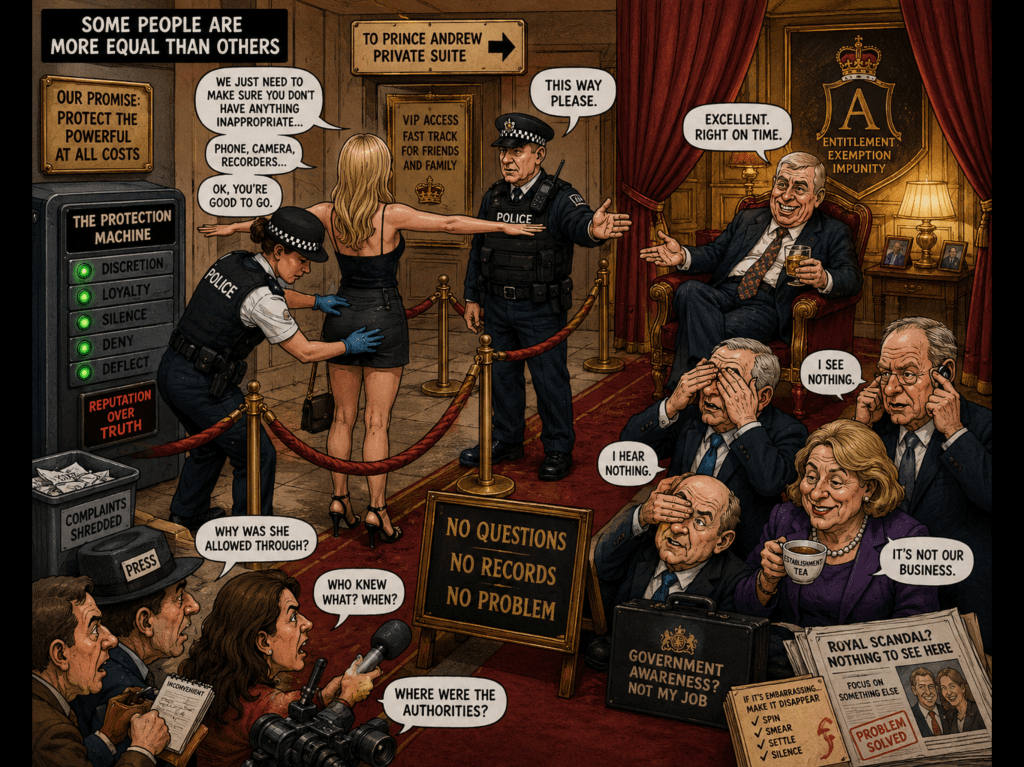
When allegations swirl around powerful figures, the public is usually told to “trust the process.” But here’s the uncomfortable problem: people do trust the process… until the process starts looking suspiciously selective. 🕵️♂️⚖️
If someone as high-profile as Prince Andrew — a man surrounded for years by elite security, palace staff, chauffeurs, aides, police protection, and institutional oversight — is facing scrutiny over alleged misconduct, then naturally people begin asking a much larger question:
Who else knew what was going on?
Because powerful individuals rarely operate inside a vacuum. Palaces aren’t isolated caves in the mountains. They are heavily managed ecosystems of protection, reputation control, and silence maintenance. 🏰📵
🧱 The Fortress of Plausible Deniability
The public is often expected to believe an extraordinary chain of coincidences:
that nobody noticed,
nobody questioned,
nobody raised alarms,
and nobody in authority connected the dots.
All while taxpayers funded layers of security and infrastructure around these figures. 💷🚔
That’s where public frustration explodes. Not simply at the allegations themselves, but at the wider machinery surrounding them. If there were constant protection officers, official travel arrangements, intelligence briefings, or institutional awareness, then people inevitably start wondering whether the investigation should go beyond one individual and look at the culture of protection surrounding elite power itself.
And that’s the real nerve being touched here:
not just individual accountability,
but systemic accountability. ⚡🏛️
Because ordinary people know full well that if they behaved suspiciously under constant supervision, authorities would not suddenly develop selective blindness and memory loss.
Yet whenever the wealthy and connected are involved, the public somehow gets served the same reheated explanation:
“Mistakes were made.”
“Lessons will be learned.”
“Nobody could have known.”
Even when half the country is staring at the situation thinking:
“Really?” 😑📉
🎭 When Institutions Protect Themselves First
The deeper concern for many isn’t just whether misconduct occurred — it’s whether institutions instinctively protect reputation before truth. That’s what damages public trust far more than any single scandal.
Because once people believe there’s one rulebook for elites and another for everyone else, cynicism becomes inevitable. 🔥
And cynicism spreads fast when powerful networks appear more interested in damage control than transparency.
🔥Challenges🔥
Should investigations stop at individuals, or should they also examine the institutions, officials, and systems that enabled silence or protection around them? 🤔⚖️
At what point does “we didn’t know” stop sounding believable when entire security structures surrounded the people involved?
Drop your thoughts in the blog comments — not just the social media echo chamber. We want sharp analysis, uncomfortable questions, and fearless debate. 💬🔥
👇 Comment, like, and share if you think accountability should apply upward — not just downward.
The best comments will be featured in the next issue of the magazine. 📝🎯


Leave a comment