🇬🇧🔥Every time another horrifying headline explodes across the country — a repeat offender released early, another violent crime committed, another grieving family asking “why?” — the same simmering question boils over again:
Who actually answers when the system gets it catastrophically wrong? 🤔⚖️
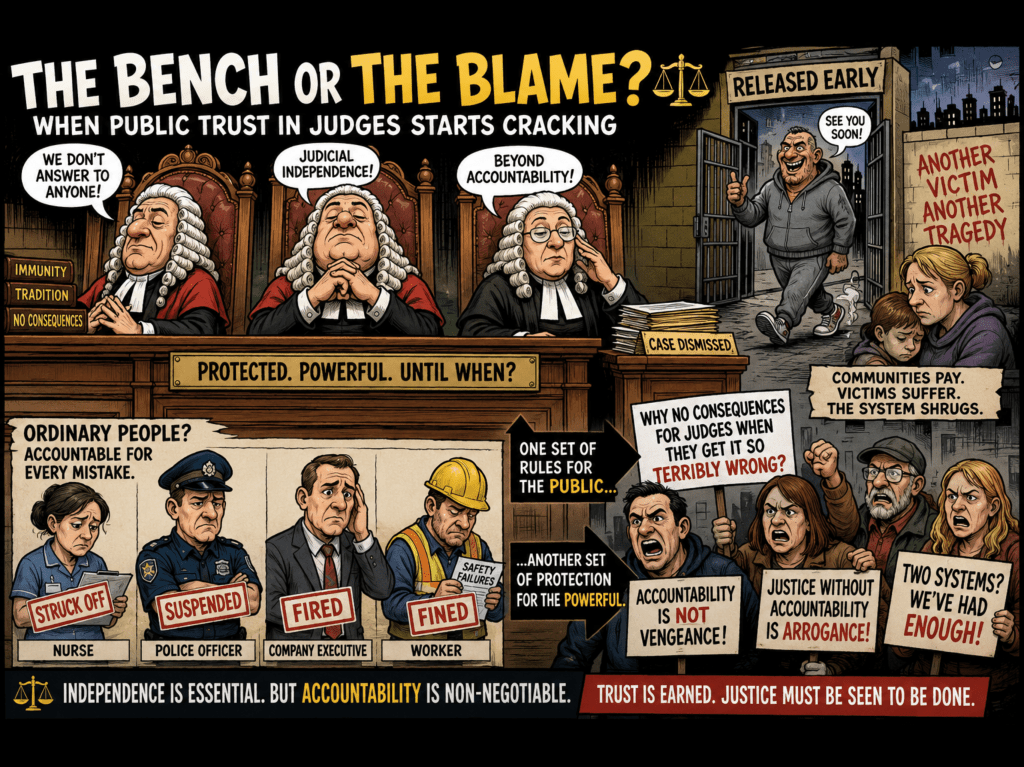
Because in modern Britain, if a nurse makes repeated dangerous mistakes, they can lose their licence. If a police officer abuses power, there’s public outrage and investigation. If a company executive wrecks a business, shareholders demand heads roll. 💥
But when judicial decisions appear to end in disaster, many ordinary people look at the courts and see something that feels untouchable. A protected institution wrapped in centuries-old ceremony, legal insulation, and enough procedural language to make accountability vanish into a fog of Latin phrases and powdered wigs. 🎭📜
🧑⚖️ Robes, Reverence, and the “Too Important to Question” Problem
Judges are granted enormous authority because society needs neutral arbiters of the law. In theory, they are guardians of fairness — immune from mob fury, political tantrums, and tabloid hysteria. ⚖️🛡️
And yes, there’s logic behind protecting judicial independence.
A judge terrified of personal punishment might stop judging fairly altogether. Imagine every sentencing hearing becoming a career-protection exercise:
“Maximum sentence for everyone, just in case.” 🚔📈
That’s not justice. That’s institutional panic.
But the public frustration doesn’t come from nowhere either.
Because when dangerous offenders repeatedly cycle through the system and innocent people suffer the consequences, many citizens no longer hear the phrase “judicial independence” — they hear:
“Power without consequences.” 🔥
And that perception is political dynamite.
🏛️ The Real Crisis Isn’t Just Crime — It’s Confidence
The justice system doesn’t survive on gavels and oak-panelled courtrooms alone. It survives because the public believes the rules apply equally to everyone. ⚖️
The moment people start believing there’s one system for ordinary citizens and another protected ecosystem for institutional elites, trust begins collapsing brick by brick. 🧱📉
That’s why calls for reform are growing louder:
- mandatory reviews after catastrophic reoffending cases,
- greater transparency around sentencing decisions,
- stronger disciplinary powers for persistent judicial failures,
- and clearer explanations to the public when controversial rulings happen. 📂🔥
Because silence breeds suspicion.
And nothing fuels public anger faster than the appearance of a system investigating itself behind closed doors while victims are left answering reporters outside crime scenes. 🎥🚨
🎭 Britain’s Dangerous Balancing Act
The truth nobody likes admitting is this:
A justice system ruled entirely by fear becomes authoritarian.
A justice system immune from scrutiny becomes arrogant.
Somewhere between vengeance and accountability lies the balance democracies are supposed to protect. ⚖️🔥
But Britain increasingly feels like a country stuck between public fury and institutional defensiveness — where every new tragedy widens the gulf between the courtroom and the street.
And once public trust in justice cracks badly enough, repairing it becomes far harder than writing another sentencing guideline. 📉🇬🇧
🔥Challenges🔥
Should judges face tougher personal consequences when catastrophic decisions go wrong?
Would stronger oversight restore faith in the courts — or turn justice into fear-driven theatre?
And when innocent people pay the price for systemic failures, who should ultimately answer to the public? 💬⚖️
👇 Drop your thoughts in the blog comments.
Like, share, and challenge the conversation if you believe accountability should apply to every institution — even the ones wearing robes. 🚪🔥
The sharpest comments, fiercest arguments, and boldest takes could appear in the next magazine issue. 📝🎯
Chameleon News


Leave a comment