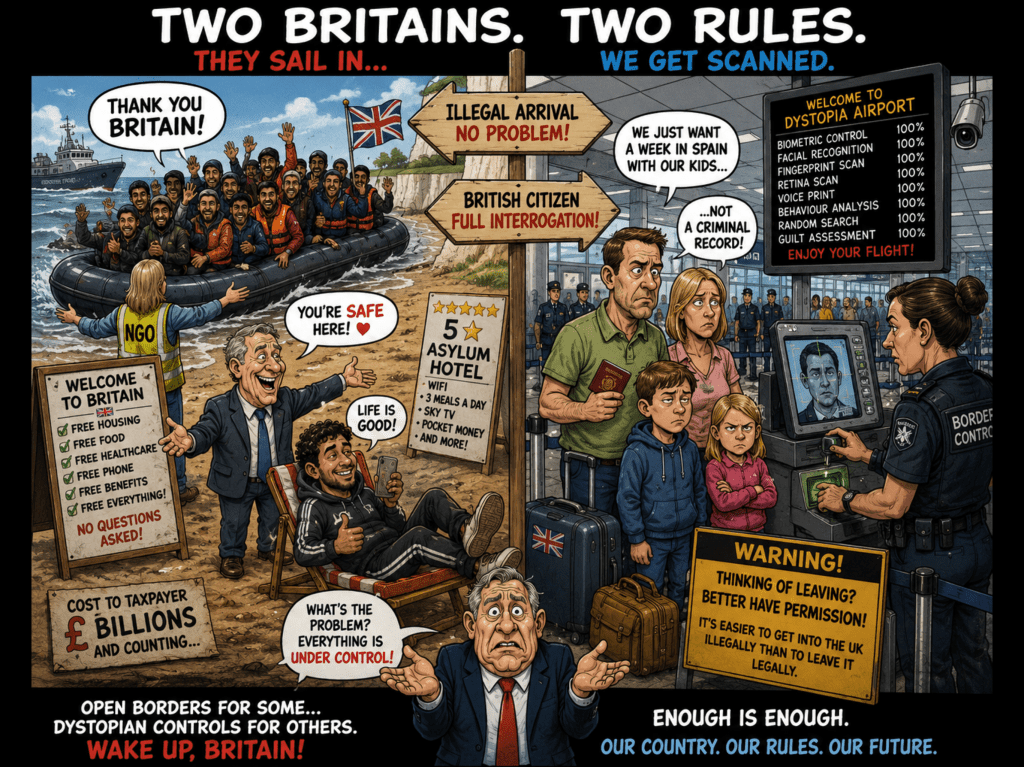
There is something deeply strange happening in Britain.
On one side of the Channel, small boats continue arriving on our shores carrying migrants who have crossed multiple countries before reaching the UK. The public is told the government is doing everything possible to stop it. Yet the numbers keep coming, the hotels keep filling, and the taxpayer keeps receiving the bill.
On the other side of the equation sits the ordinary British citizen.
The person who has worked, paid taxes, followed the rules, and simply wants to take the family to Spain for a week without feeling like they’ve accidentally wandered into the opening scene of a dystopian science fiction film.
Fingerprints.
Facial recognition.
Biometric scans.
Digital permissions.
Electronic travel authorisations.
Identity checks layered on top of identity checks.
You half expect a machine to demand a DNA sample before allowing you to buy a Toblerone in Duty Free.
The contrast is what infuriates people.
It isn’t simply immigration.
It is the perception of two completely different standards being applied simultaneously.
The government appears powerless when dealing with those entering the country illegally, yet increasingly enthusiastic when introducing new layers of bureaucracy for the people already here.
For many voters, it feels like the easiest person for the state to control is the law-abiding citizen.
After all, they’re the ones who fill out the forms.
They’re the ones who stand in queues.
They’re the ones who follow instructions.
The criminals ignore the rules.
The traffickers exploit the loopholes.
The illegal entrants take their chances.
Meanwhile, Dave from Doncaster gets scanned three times before boarding a flight to Benidorm.
The official explanation is always security.
The official explanation is always safety.
The official explanation is always efficiency.
Yet somehow every new system seems to make life more complicated for the people already obeying the law.
And then comes the question nobody in Westminster seems willing to answer.
If Britain genuinely believes illegal migration is a crisis, why does it appear so difficult to secure agreements with neighbouring countries to return people who have no legal right to remain?
Voters watch ministers hold press conferences, announce plans, unveil strategies, launch initiatives and promise crackdowns.
Then they switch on the news six months later and discover that very little has changed.
The boats are still arriving.
The costs are still rising.
The promises are still being repeated.
At some point, frustration becomes inevitable.
Not because people oppose immigration itself.
Not because they lack compassion.
But because they expect governments to enforce the laws they already have.
That is the bargain.
Citizens fund the state.
The state provides security, order and effective administration.
When that bargain starts to look one-sided, trust begins to disappear.
And trust, once lost, is much harder to recover than a misplaced passport.
Perhaps the most damaging aspect of all is the growing feeling that ordinary people are being treated as the problem.
The taxpayer becomes the suspect.
The traveller becomes the risk.
The citizen becomes the inconvenience.
While the state struggles to deal with challenges that most voters assumed it was created to handle.
That perception may not tell the whole story.
But politically, perception matters.
Because once a population starts believing there is one rule for those who follow the law and another for everyone else, confidence in the system begins to erode.
And no amount of biometric scanners can detect that.
🔥 Challenges 🔥
Do you believe Britain has lost control of its borders, or is the issue being exaggerated for political gain?
Are increasing travel checks a necessary security measure, or are law-abiding citizens being subjected to ever more intrusive monitoring while larger problems remain unresolved?
Join the debate in the blog comments.
👇 Like, comment and share.
🏆 The best comments will be featured in the next issue of the magazine.


Leave a Reply