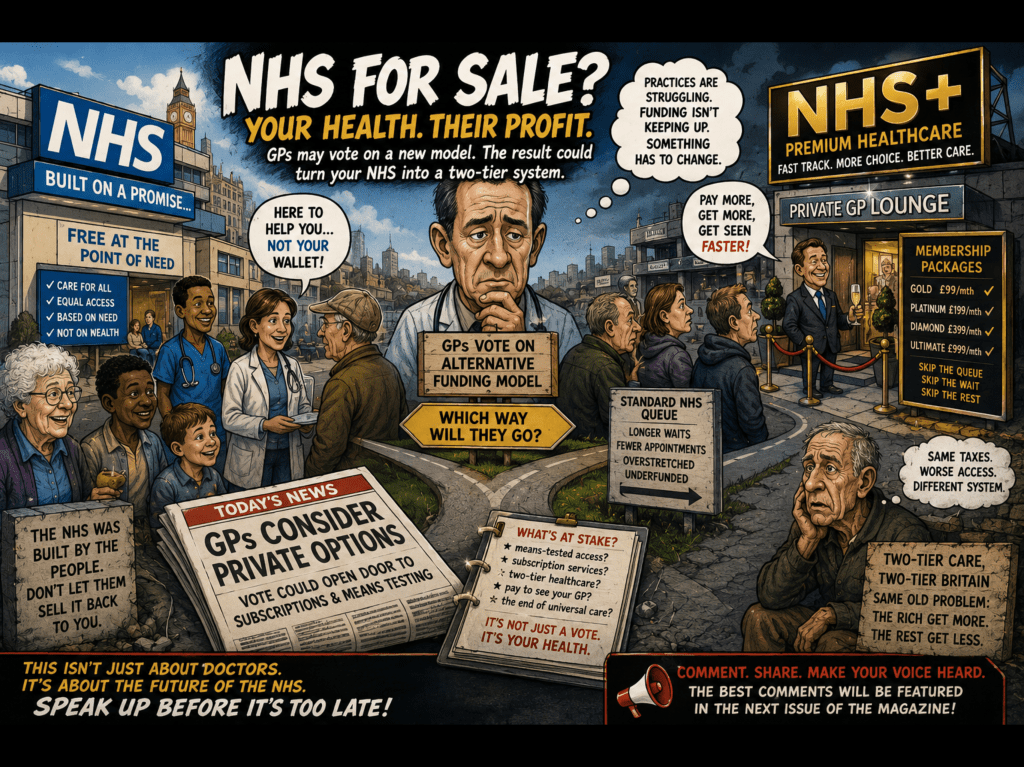
There was a time when the National Health Service was simple.
You got sick.
You saw a doctor.
You received treatment.
You went home.
No monthly membership. No platinum package. No premium tier. No “upgrade to continue breathing” button blinking in the corner of your screen.
Now, as GP leaders debate alternative funding models amid mounting financial pressure, many patients are beginning to wonder whether the NHS is slowly being transformed from a public service into a business opportunity.
And that’s where the alarm bells start ringing.
Not because doctors are villains. Far from it.
Most GPs are exhausted, overworked, underfunded, and trapped inside a system that politicians have spent years stretching beyond its limits. They didn’t create this crisis.
But when the proposed solution starts sounding suspiciously like a subscription service, people are entitled to ask a few uncomfortable questions.
The public was promised a healthcare service free at the point of use.
Not NHS+.
Not Healthflix.
Not Prime Healthcare with same-day delivery for premium members.
Yet here we are.
The argument from supporters is straightforward enough. Practices are struggling. Costs are rising. Demand is exploding. Something has to change.
Fair point.
The problem is that once healthcare begins drifting toward a pay-to-access model, even partially, the entire philosophy of the NHS starts to shift.
Healthcare stops being a right.
It becomes a product.
And products come with customers.
Customers come with pricing structures.
Pricing structures come with tiers.
And tiers come with winners and losers.
It’s a slippery slope that always begins with the same reassuring words:
“Only a small change.”
History is littered with examples of temporary measures becoming permanent features.
The public has heard this story before.
A small charge here.
A modest fee there.
An optional premium service over there.
Then one day everyone wakes up and discovers they’ve accidentally subscribed to something they never ordered.
The deeper issue is trust.
For decades, politicians of every stripe have stood in front of cameras declaring their unwavering love for the NHS. They hug it during elections. They wrap themselves in it during campaigns. They treat it like the Crown Jewels whenever public opinion polls appear.
Then somehow, year after year, the service ends up with more patients, more pressure, more bureaucracy, and fewer resources.
It’s a remarkable magic trick.
Declare your devotion while quietly testing its survival limits.
The result is a public increasingly suspicious that the long-term goal isn’t fixing the NHS at all.
It’s managing its decline until privatisation begins to look like the only available answer.
That’s the genius of the strategy.
If you starve a service long enough, eventually people stop asking why it’s failing and start asking whether it deserves saving.
The conversation shifts.
The problem becomes the patient.
The waiting list.
The demand.
The ageing population.
Anything except the decisions that created the crisis.
Meanwhile, ordinary people are left wondering whether their future healthcare depends on medical need or disposable income.
Because that’s the question lurking behind every discussion about alternative models.
If two people need the same treatment, but only one can afford to pay extra, what happens next?
The answer tells you everything about the future of the NHS.
This debate isn’t really about contracts.
It isn’t about funding formulas.
It isn’t about management structures.
It’s about whether Britain still believes healthcare should be available according to need rather than wealth.
Once that principle is weakened, even slightly, rebuilding it becomes infinitely harder.
The NHS was founded on a radical idea.
That illness should not be a business opportunity.
The moment we start forgetting that, we may discover that the greatest threat to the NHS wasn’t a dramatic act of privatisation.
It was a thousand small compromises sold as common sense.
And by the time people realise what’s happening, the subscription button may already be live.
🔥 Challenges 🔥
Should healthcare remain completely free at the point of use no matter the cost?
Or has chronic underfunding pushed the NHS toward a future where some form of paid access is inevitable?
Join the debate in the blog comments. We want your solutions, your frustrations, and your predictions for the future of British healthcare.
👇 Like, comment, and share.
🏆 The best comments will be featured in the next issue of the magazine.


 Chameleon Magazine
Leave a comment