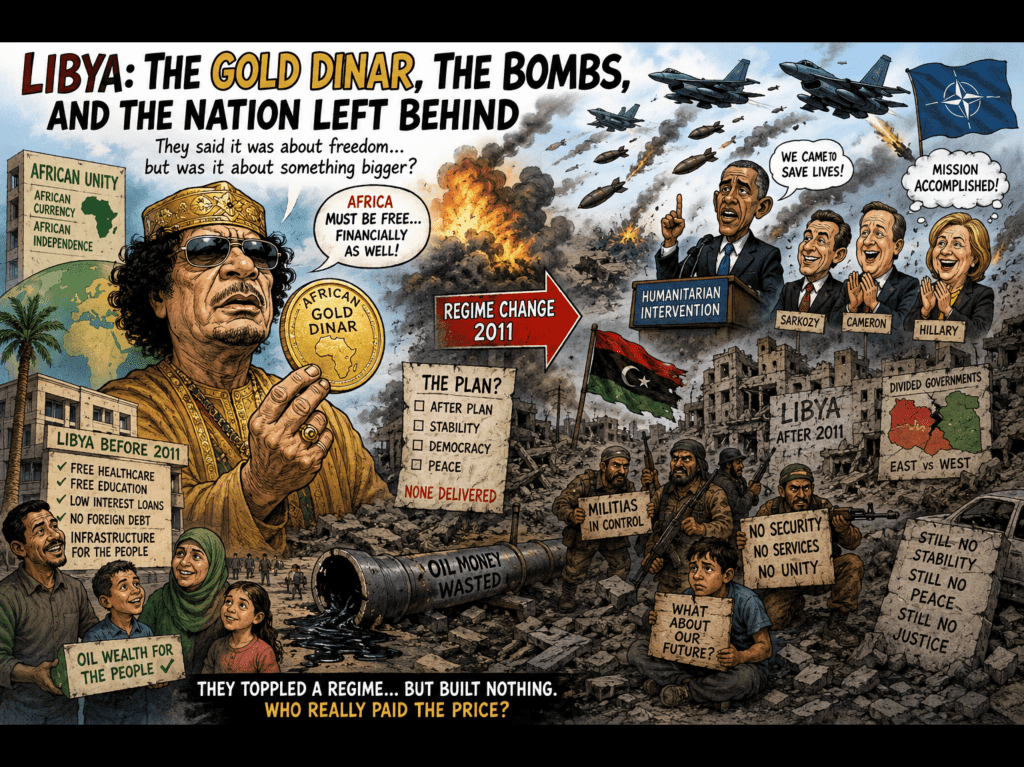
History is often written by the winners. The trouble comes when nobody can quite agree who actually won.
When Muammar Gaddafi was dragged from a drainage pipe and killed in October 2011, Western leaders celebrated the end of a dictatorship. Television screens filled with triumphant headlines. Politicians spoke of freedom, democracy, and a brighter future for Libya. The message was clear: a tyrant had fallen, and a grateful nation would soon rise from the ashes.
Fifteen years later, that promise feels less like a prediction and more like a sales pitch that came with no refund policy.
Before his downfall, Gaddafi had become one of the most controversial figures in global politics. To his critics, he was an authoritarian ruler who crushed opposition and concentrated power around himself and his allies. To his supporters, he was a fiercely independent leader who used Libya’s oil wealth to fund housing, healthcare, education, and infrastructure while resisting foreign influence.
The truth, as is often the case, sits somewhere between the slogans.
Yet one aspect of Gaddafi’s vision continues to fascinate people long after his death: the proposed gold-backed African dinar.
At a time when much of the world’s trade revolved around the US dollar and European financial systems, Gaddafi argued that African nations should consider an alternative. Why, he asked, should resource-rich countries continue selling their oil, minerals, and commodities through financial structures controlled elsewhere? Why not create a currency backed by gold and controlled by Africa itself?
It was an ambitious idea. Some would say unrealistic. Others would say revolutionary.
What nobody disputes is that it challenged established financial norms.
This is where the story becomes clouded by speculation, suspicion, and conspiracy theories. Many people believe the gold dinar was the real reason powerful nations wanted Gaddafi removed. According to this argument, his plans threatened global financial interests and made him a target.
The evidence for that claim remains thin.
What we do know is that governments rarely make foreign policy decisions based on a single issue. Military interventions are almost always driven by a mixture of strategic interests, security concerns, political calculations, economic factors, and public narratives. Reducing Libya’s entire tragedy to one currency proposal oversimplifies a far more complex story.
However, dismissing questions about economic interests entirely would be equally naïve.
Throughout history, powerful nations have consistently protected trade routes, energy supplies, financial influence, and geopolitical leverage. To pretend otherwise would require ignoring centuries of international politics.
The uncomfortable reality is that nobody needs a secret conspiracy when open strategic interests already exist.
What makes Libya such a painful case study is not simply the removal of Gaddafi. It is what followed.
The intervention succeeded in achieving its immediate objective. The regime collapsed. The leader was gone.
But what came next?
Instead of a smooth transition to stability and democracy, Libya descended into years of factional conflict, rival governments, armed militias, and political paralysis. The institutions that might have held the country together proved weaker than many had imagined. As power fragmented, ordinary Libyans paid the price.
This is the question that continues to haunt the entire episode.
If the goal was to improve the lives of Libyan citizens, how should success be measured?
By the overthrow of a leader?
Or by the condition of the country left behind?
Too often, discussions about Libya become trapped between two extremes. One side portrays Gaddafi as an untouchable villain whose removal justified any consequence. The other paints him as a flawless victim of foreign aggression.
Neither version survives serious scrutiny.
A mature discussion requires acknowledging two truths simultaneously.
Gaddafi’s government had significant flaws and serious human rights concerns.
And the intervention that removed him produced consequences that many of its architects either failed to anticipate or failed to adequately prepare for.
Those truths are not contradictory.
In fact, they are essential to understanding what happened.
Perhaps the greatest lesson of Libya is that removing a government is far easier than rebuilding a nation. Military campaigns can destroy institutions in months. Replacing them with stable alternatives can take generations.
The gold dinar may never have become reality. The grand vision of an economically independent Africa may never have moved beyond aspiration. But the questions that surrounded those ideas remain relevant today.
Who controls global finance?
Who benefits from the existing system?
And who pays the price when powerful nations decide another country’s future requires intervention?
Libya remains a reminder that history does not end when the statues fall.
Sometimes that is merely where the real story begins.
🔥 Challenges 🔥
Do you believe Libya is better off today than it was before 2011?
Was the intervention a necessary act of humanitarian protection, or a catastrophic example of foreign powers underestimating the consequences of regime change?
Join the debate in the blog comments and tell us where you stand. The strongest arguments, sharpest insights, and most thought-provoking responses could be featured in the next issue of the magazine. 💬⚡
👇 Like, comment, and share if you believe difficult questions deserve honest discussion.
The best comments will be featured in the magazine. 🏆📝


Leave a Reply