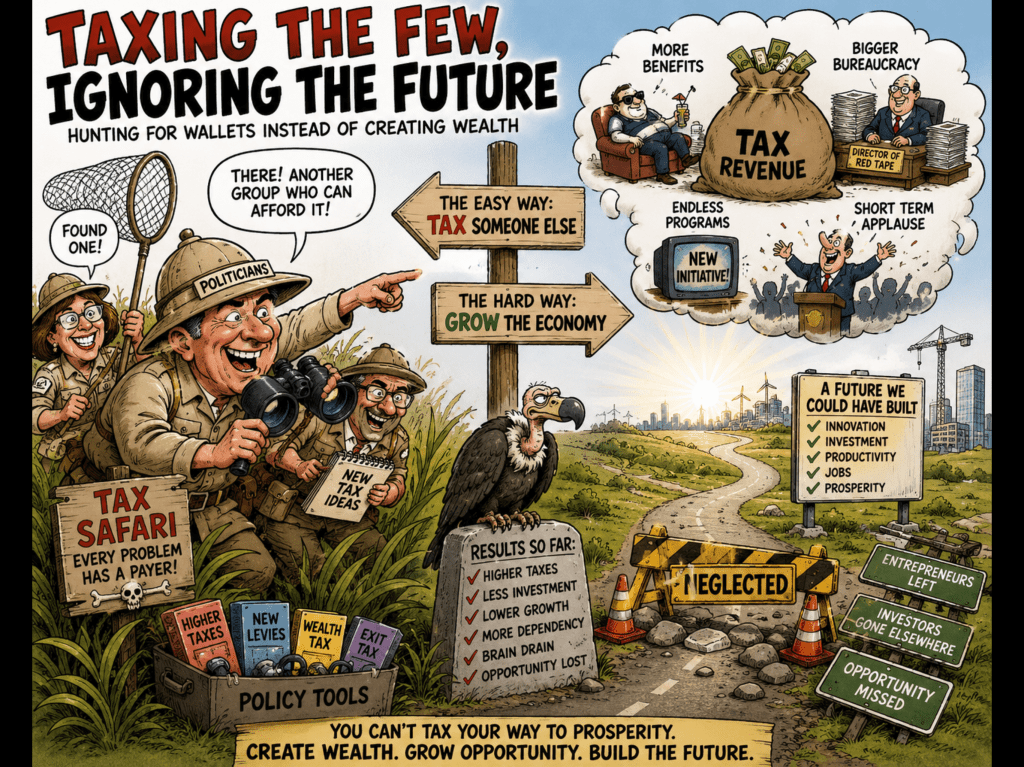
💷🎯A growing strain of political thinking seems obsessed with one question: “Who can we tax next?” rather than “How can we grow the economy?” Instead of focusing on innovation, investment, productivity, and wealth creation, the conversation often circles back to identifying another group of people to foot the bill for an ever-expanding list of promises. 🏦📈➡️📉
🕵️♂️ The Great Wallet Safari Begins Again
Some politicians approach economic policy like contestants on a game show called “Find the Rich Person.” The challenge is simple: locate a taxpayer, point dramatically, and announce that every funding problem can be solved by emptying their pockets. 🎤💰
The theory sounds wonderfully simple. Need more benefits? Tax someone. Need another programme? Tax someone else. Need to plug a budget hole? Congratulations—you’ve unlocked the bonus round of taxation. 🎰📋
The awkward part arrives when reality crashes the party. Wealth doesn’t magically appear because a government spots it. Businesses invest where opportunities exist. Entrepreneurs take risks when rewards justify them. Workers prosper when economies grow. Yet somehow these boring details are often treated like the vegetables nobody wants to eat at the economic dinner table. 🥦😴
Instead, the debate becomes an endless treasure hunt for “the next group who can afford it.” The danger is that eventually the treasure map runs out of Xs while growth, investment, and competitiveness quietly pack their bags and head elsewhere. ✈️📦
A nation cannot tax its way into prosperity any more than a farmer can harvest crops he never planted. At some point, creating wealth has to become as fashionable as redistributing it. 🌱💡
🔥Challenges🔥
Here’s the question nobody seems eager to answer: should governments focus first on expanding the economic pie, or simply arguing over how to divide the existing slices? 🍰🤔
If wealth creation falls behind wealth redistribution, what happens when there are fewer successful businesses, investors, and workers generating the revenue in the first place?
Drop your thoughts in the blog comments. Tell us whether modern politics spends too much time searching for taxpayers and not enough time creating prosperity. 💬⚡
👇 Like, comment, and share if you’re tired of economic debates that start with taxation and end before growth is even mentioned.
🏆 The best comments will be featured in the next issue of the magazine.


 Chameleon Magazine
Leave a comment