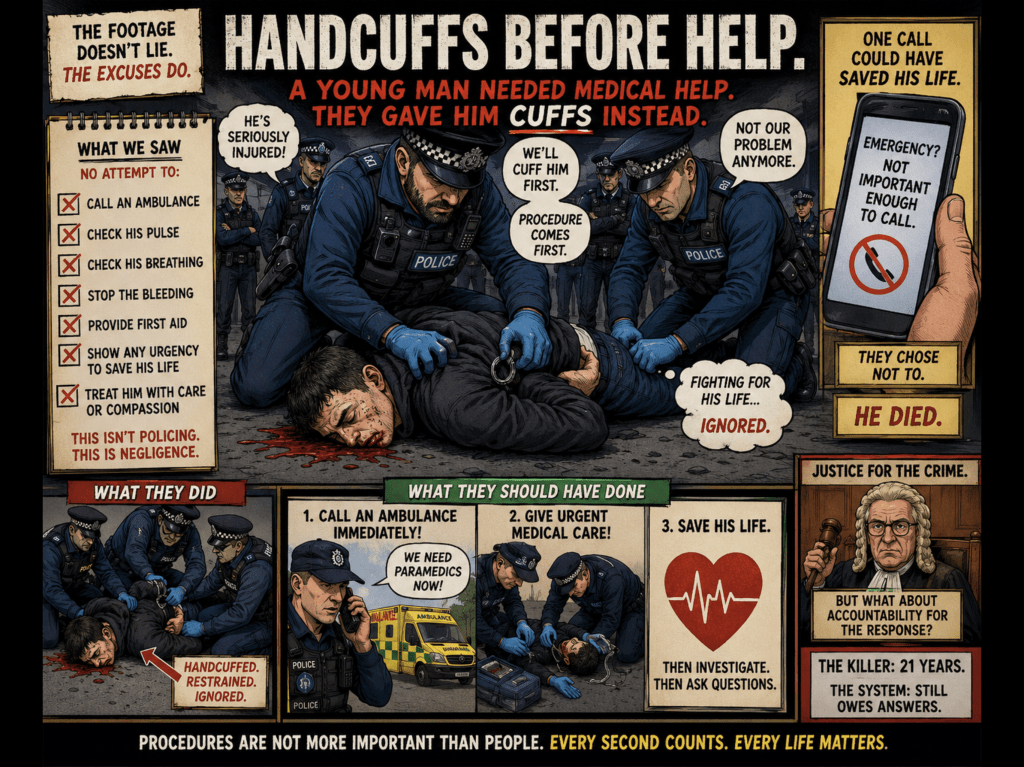
🚔💔A young man is dead. The killer has been convicted and sentenced to 21 years behind bars. The criminal justice system has spoken.
But for many who have watched the released footage, one question refuses to go away:
Why wasn’t saving his life the first priority? 🚑
🚨 A Dying Young Man Needed Help — Not Bureaucracy
The most disturbing part of this tragedy isn’t simply the horrific violence that took place.
It’s what happened afterwards.
Viewers watching the footage have been left stunned by what they saw in the crucial moments following the attack. A young man suffering catastrophic injuries appeared to need urgent medical intervention, yet what many people expected to see—a desperate race to preserve life—seemed absent.
Instead, the images have fuelled anger, frustration and disbelief.
Because ordinary people don’t need specialist training to understand one basic principle:
When somebody is bleeding, injured, and fighting for their life, every second matters. ⏳💔
The public are repeatedly told that emergency response protocols exist to protect life above all else.
So when footage appears to show opportunities for faster medical intervention, people naturally ask difficult questions.
Questions that politicians, police leaders and public officials cannot simply dismiss as social media noise.
This isn’t about scoring political points.
It’s about accountability.
It’s about whether the systems designed to protect the public acted with the urgency the situation demanded.
And it’s about whether lessons will actually be learned, or whether another family will one day find themselves asking exactly the same questions.
Because once a life is gone, explanations offer little comfort.
Families are left with memories.
The public are left with doubts.
And trust becomes another casualty. 📉
⚖️ Justice for the Crime Doesn’t End Questions About the Response
The sentencing of the offender provides justice for the act itself.
But justice for a crime and scrutiny of the response are not the same thing.
People can accept the court’s verdict while still demanding answers about the actions of those present in the aftermath.
If procedures were followed correctly, the public deserves to know.
If mistakes were made, the public deserves to know that too.
Transparency isn’t an attack on public servants.
It’s how confidence in public institutions is maintained.
🔥Challenges🔥
After watching the released footage, do you believe enough was done to prioritise the preservation of life?
Should emergency medical intervention always take precedence whenever someone is suffering life-threatening injuries?
And most importantly, what changes would you make to ensure that no family is left wondering whether more could have been done?
Join the debate in the blog comments. 💬🔥
👇 Like, comment and share if you believe every second counts when a life is hanging in the balance.
🏆 The strongest comments and most thoughtful contributions will be featured in the next issue of the magazine.


Leave a comment