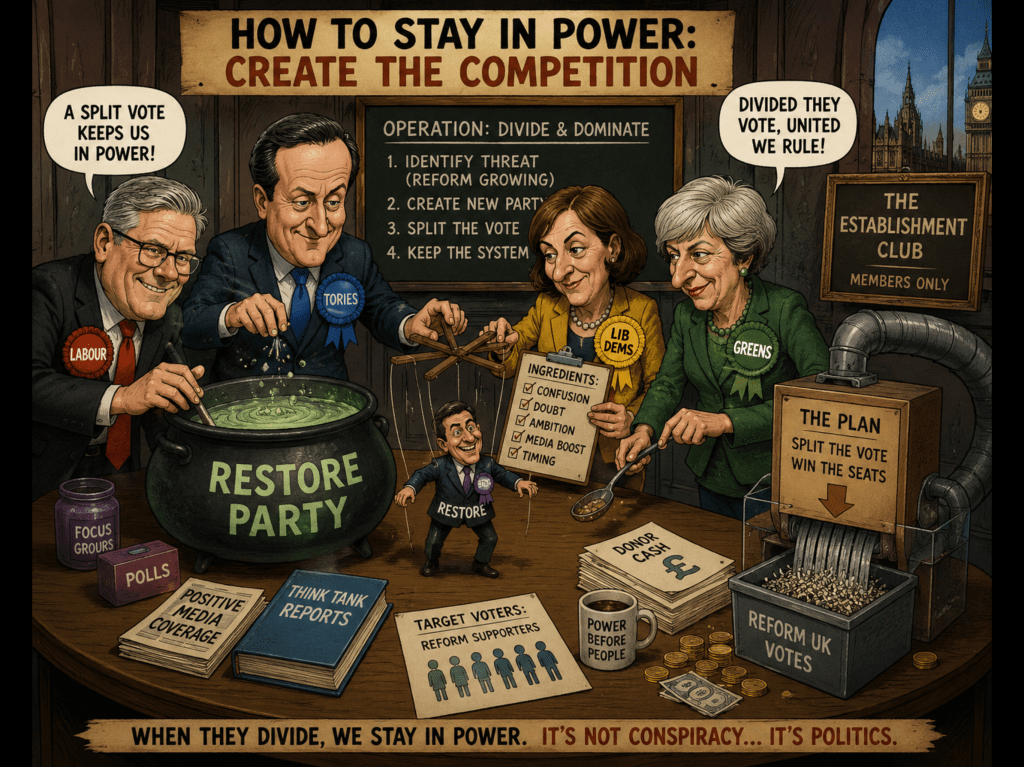
Politics has a remarkable habit of producing new parties at exactly the moment they become most useful.
That is why many supporters of Reform UK are asking a perfectly reasonable question:
Why has Restore appeared now? 🤔
Officially, Restore is presented as a new political movement born out of disagreement with Reform’s leadership. Its supporters argue that it offers a stronger, clearer alternative for voters frustrated with the direction of the country.
Perhaps that is true.
But politics is not simply about intentions.
It is about consequences.
🗳️ The First Past the Post Problem Nobody Wants to Talk About
The consequence of Restore’s arrival is obvious.
It creates a rival for many of the same voters Reform has spent years attracting.
Whether intentional or not, the result is the same: a movement that was beginning to gather momentum now finds itself competing against another party fishing in exactly the same electoral pond. 🎣
Under proportional representation, that might not matter very much.
But Britain doesn’t have proportional representation.
Britain has First Past the Post.
And First Past the Post is ruthless.
It rewards unity.
It punishes division.
It allows parties with concentrated support to win seats while parties with millions of votes can find themselves locked out of power.
That is why political fragmentation matters.
Not because it proves some grand conspiracy.
Not because shadowy figures are necessarily pulling strings behind the scenes.
But because anyone who understands British elections understands what happens when voters seeking change are split between competing alternatives.
The establishment doesn’t need to defeat them.
The system often does the job for them. 🎯
For decades Britain has effectively been governed by a political pendulum.
Labour takes power and moves policy one way.
The Conservatives take power and move it back the other.
The faces change.
The slogans change.
The promises change.
Yet somehow the same two parties continue taking turns managing the same machine. 🔄
Reform’s growth represented a genuine threat to that arrangement.
For the first time in years, a political movement appeared capable of attracting large numbers of voters who felt abandoned by both major parties.
It gained support despite media hostility rather than because of media approval.
It forced conversations many in Westminster would rather avoid.
Then, just as momentum appeared to be growing, another movement emerged targeting many of the same voters.
Again, perhaps that is entirely genuine.
Perhaps Restore is exactly what it claims to be.
But political observers are entitled to ask a simple question.
Who benefits?
Under First Past the Post, the answer is often surprisingly straightforward.
When challengers divide, the established parties rarely suffer.
When insurgent movements fragment, Westminster breathes easier.
And when voters split between competing alternatives, the result can be exactly what Britain has experienced for generations:
Labour wins seats.
The Conservatives win seats.
The cycle continues. 🎠
No conspiracy required.
No secret meetings.
No hidden master plan.
Just the cold electoral mathematics of a voting system that rewards concentration and punishes fragmentation.
⚡ The Question That Matters
Perhaps Restore strengthens the movement for change.
Perhaps it attracts new voters and broadens the appeal of political reform.
Perhaps it becomes a powerful force in its own right.
But supporters of Reform are entitled to ask whether now is really the moment for division.
Because history shows that political establishments rarely fear opposition that is united.
They fear opposition that is organised.
Focused.
Growing.
And capable of breaking through the barriers that have protected the same parties for decades.
Restore may well be a genuine movement.
The question voters must answer is whether its arrival strengthens the challenge to the political establishment…
Or strengthens the electoral system that has protected it for so long. 🏛️
🔥 Challenges 🔥
Here’s the challenge.
Do you believe Restore strengthens the movement for political change?
Or does First Past the Post mean that splitting anti-establishment support simply makes it easier for the same parties to remain in power?
Tell us what you think in the blog comments below. 💬👇
Is Restore the future—or is Britain watching another example of division arriving at exactly the wrong time?
👍 Like. 💬 Comment. 🔄 Share.
The best comments, strongest arguments, and sharpest observations will be featured in the next issue of the magazine. 🏆📝


 Chameleon Magazine
Leave a comment