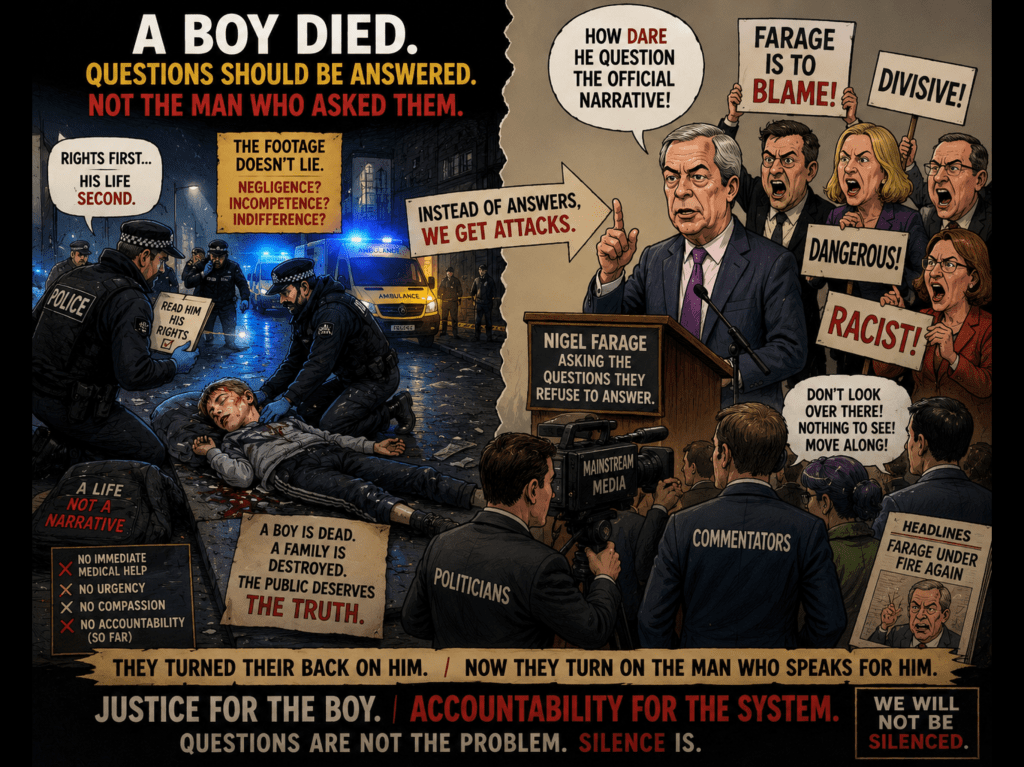
While politicians, commentators and activists rush to condemn Nigel Farage for asking questions, many ordinary people are asking a different one:
Why are so many people more interested in attacking those raising concerns than addressing what happened to the boy lying on the ground? 🤔
🚨 The Footage That Refuses to Go Away
The public has seen the footage.
The public has heard the arguments.
And the public can make up its own mind.
What many people find deeply troubling is not simply the incident itself, but the response that followed.
A young boy lost his life.
Yet instead of a national demand for complete transparency, much of the political and media establishment appears focused on policing the debate surrounding his death.
Questions are immediately dismissed.
Concerns are labelled.
Those seeking answers are criticised.
And anyone who refuses to accept the official narrative is treated as the problem. 🎭
That is why the criticism of Nigel Farage has struck a nerve with many voters.
Whether people support Farage politically or not is irrelevant.
The issue is whether legitimate questions are allowed to be asked when a child dies following an encounter with authorities.
Surely that should not be controversial.
⚖️ Questions Are Not Crimes
People watching the footage have raised concerns about what they believe they can see.
They question decisions made at the scene.
They question whether priorities were correct.
They question whether sufficient urgency was shown towards a seriously injured boy.
These are questions.
Questions are not crimes.
Questions are not extremism.
Questions are not racism.
Questions are how accountability begins.
Yet some appear more determined to identify who should be condemned for asking questions than who should be answering them. 📢
🏛️ Trust Is Earned Through Transparency
The public’s trust is not restored by telling people to stop asking questions.
It is restored by providing clear answers.
If procedures were followed correctly, show the evidence.
If mistakes were made, acknowledge them.
If lessons need to be learned, learn them.
What many people see today is not confidence from those in authority.
It is defensiveness.
And defensiveness only fuels suspicion.
The more people feel their concerns are being dismissed, the more determined they become to seek answers elsewhere.
🔥 Challenges 🔥
A boy is dead.
His family deserves answers.
The public deserves transparency.
And nobody should be condemned simply for asking whether everything that should have been done was done.
Do you believe legitimate questions are being unfairly dismissed?
Or do you think the public response has been justified?
Join the discussion in the blog comments below. 💬👇
👍 Like. 💬 Comment. 🔄 Share.
The best comments and strongest arguments will be featured in the next issue of the magazine. 🏆📝


 Chameleon Magazine
Leave a comment