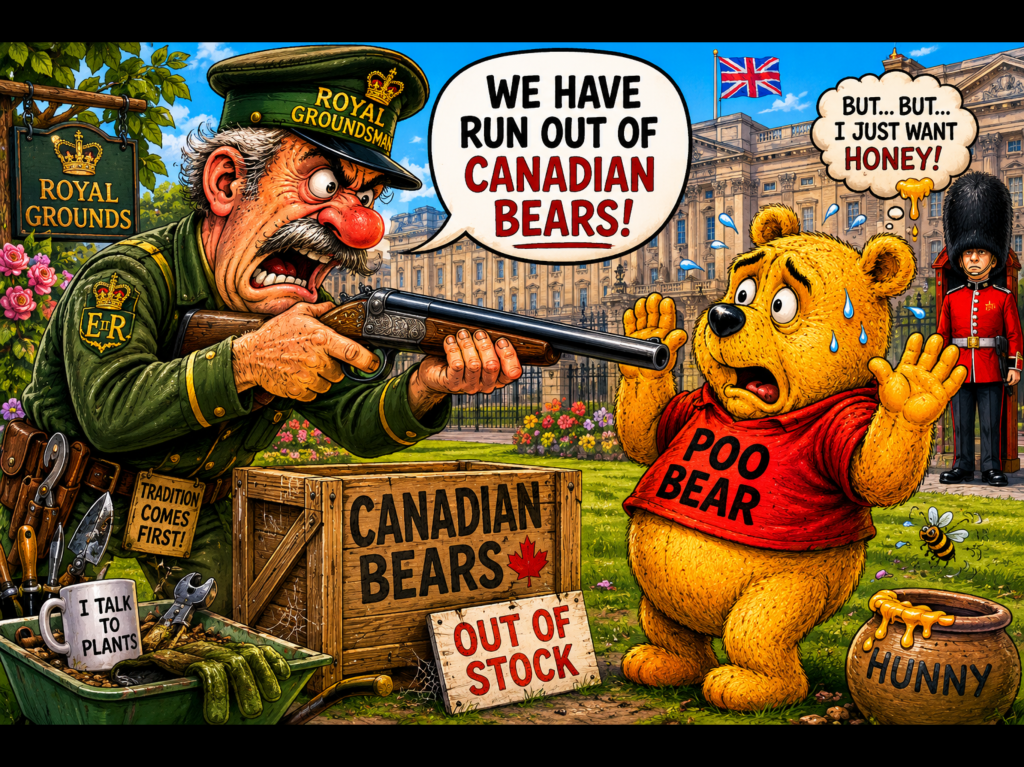
The modern royal family has spent years carefully cultivating an image of environmental stewardship. Trees are planted, speeches are delivered, sustainability is celebrated, and every public appearance seems wrapped in a comforting message about protecting nature for future generations. 🌳🌍
Yet sitting proudly atop the heads of the King’s Guards is a reminder that some animals apparently enjoy a more privileged status than others.
Because while we’re encouraged to adore Winnie-the-Pooh, cuddle toy bears, support wildlife charities, and teach children that every creature deserves care and respect, the Canadian black bear somehow finds itself excluded from the royal PR brochure. 🐻
🎭 The Curious Case of the Favourite Bear
Pooh Bear gets the red-carpet treatment.
He’s featured in children’s stories, celebrated as a symbol of kindness, innocence, friendship, and gentle living. Royals happily pose alongside beloved bear characters, embracing the warm, fuzzy image that bears bring to public life. Cameras click. Headlines smile. Everyone leaves feeling good.
The Canadian bear, meanwhile, gets a rather different invitation.
Not to a conservation conference.
Not to a royal garden party.
Not to a wildlife awareness campaign.
Instead, its contribution to royal tradition is measured in inches of ceremonial headwear.
It’s a fascinating contradiction. On Monday, we’re told to cherish wildlife. On Tuesday, we’re shown symbols of tradition that depend upon wildlife being viewed as a resource rather than something to be protected.
The message seems to be:
“Love bears. Respect bears. Protect bears. Just not those bears.” 🤷♂️
And that’s where the public relations machine starts looking less like environmental leadership and more like environmental theatre.
🎪 When Tradition Meets Modern Messaging
Supporters of the bearskin caps argue that they’re part of history, military heritage, and national identity.
Fair enough.
But if environmental responsibility is truly a core value, shouldn’t traditions be examined through the same lens that ordinary citizens are expected to apply to their own lives?
After all, the public is constantly encouraged to make sacrifices for sustainability:
- Drive less 🚲
- Fly less ✈️
- Consume less 🛒
- Waste less ♻️
- Think about the impact on wildlife 🦊
Yet when questions arise about ceremonial bearskins, suddenly tradition becomes a protective force field against scrutiny.
It’s remarkable how often environmental principles are presented as universal right up until they become inconvenient.
🧸 The Great Bear Hierarchy
Perhaps what we’re witnessing is the emergence of a new conservation ranking system.
Tier One Bears: Pooh Bear, Paddington, teddy bears, bears in children’s books, bears in fundraising campaigns.
Tier Two Bears: Actual bears.
The fictional bears receive affection, merchandise, television specials, and heartfelt speeches.
The real bears receive a starring role in a centuries-old costume department.
One might imagine the confusion if the bears themselves were consulted.
“You love bears?”
“Absolutely.”
“You protect bears?”
“Of course.”
“Wonderful. What happens next?”
“Well… some of you become ceremonial hats.”
Awkward silence. 🐻😐
🔥 Challenges 🔥
Can environmental leadership coexist with traditions that rely on animal products? Is this a reasonable preservation of history, or an example of one rule for the public and another for institutions?
More importantly, why do fictional bears seem to enjoy stronger protection than the real thing?
Drop your thoughts, outrage, sarcasm, or defence of tradition in the blog comments. We want to hear both sides of the debate. 💬🔥
👇 Comment, like, and share. Should the bearskin tradition continue, evolve, or be retired altogether?
The best comments, arguments, and most devastating one-liners will be featured in the next issue of the magazine. 🎯📝


 Chameleon Magazine
Leave a comment