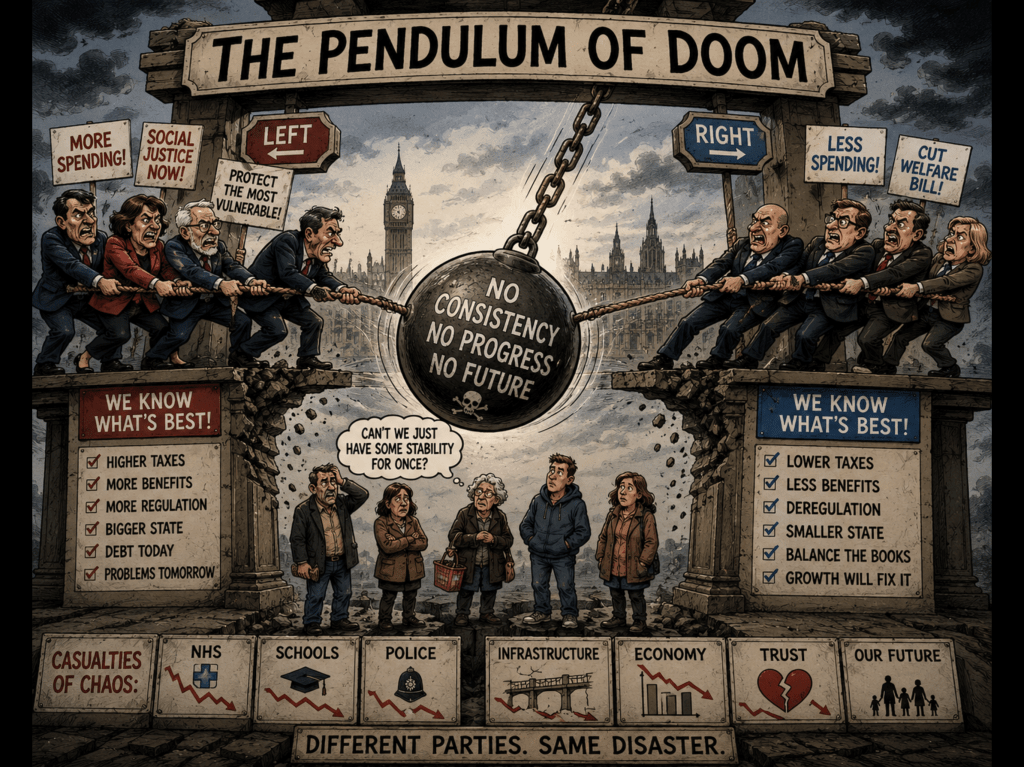
Every election promises change.
Every manifesto promises reform.
Every new Prime Minister arrives at Downing Street declaring that this time things will be different.
Yet after decades of political promises, Britain appears trapped in a cycle where governments spend more time undoing each other’s work than actually improving the country.
Take almost any major policy. One government introduces it, the next government reviews it, a third government weakens it, and a fourth promises to bring it back. The political pendulum swings endlessly from one side to the other while the public stands in the middle wondering whether anyone has a long-term plan.
The triple lock is just one example. Introduced to protect pensioners, defended by some politicians, criticised by others, and constantly debated depending on who happens to occupy the Treasury benches. The argument never really ends because the objective is no longer stability. The objective is winning the next election.
The same pattern can be seen across welfare, housing, taxation, energy, immigration and public spending. Governments arrive with grand ambitions only to discover that they can’t even persuade their own MPs to support them. Ministers brief against colleagues, backbenchers organise rebellions, factions emerge and suddenly the focus shifts from governing the country to managing internal disputes.
That raises a simple question. If political parties cannot maintain unity within their own ranks, why should voters trust them to reform complex systems that affect millions of lives?
The welfare debate provides a perfect illustration. Before any meaningful discussion about reform can take place, politicians are already arguing amongst themselves. One group demands greater spending, another demands restraint, while others attempt to occupy a middle ground that satisfies nobody. By the time the dust settles, the original proposal has often been diluted beyond recognition.
This isn’t really a welfare problem. It’s a government problem.
The public is repeatedly told that difficult decisions are necessary. Politicians explain that the country faces serious challenges and that reform cannot be avoided forever. Yet when the moment arrives to make those difficult decisions, many seem more concerned about upsetting colleagues than solving problems.
The result is paralysis disguised as progress.
Britain doesn’t lack ideas. It lacks consistency.
Businesses struggle to invest because policies change with every government. Public services struggle to plan because funding priorities constantly shift. Citizens struggle to trust politicians because today’s promise often becomes tomorrow’s U-turn.
Imagine trying to run a business where the management team changes direction every few years and spends half its time dismantling projects started by its predecessors. Shareholders would revolt. Customers would leave. Yet somehow this has become accepted as normal in modern politics.
Perhaps the biggest reform Britain needs is not welfare reform, tax reform or pension reform.
Perhaps it is government reform itself.
Perhaps major national policies should require broader agreement that survives election cycles. Perhaps politicians should be encouraged to build lasting solutions instead of temporary victories. Perhaps Parliament should focus less on scoring points and more on finding common ground.
Because until governments can demonstrate that they are capable of working together, maintaining a consistent direction and putting long-term national interests ahead of short-term political advantage, the same problems will continue to return under different headlines.
The pendulum will keep swinging.
The arguments will keep repeating.
And the public will keep paying the price.
🔥 Challenges 🔥
Are you tired of watching governments reverse each other’s policies every few years? Should major reforms require broader political agreement so they survive changes of government? Or is political disagreement simply part of democracy?
Join the debate in the blog comments below. 💬
👍 Like, 🔄 Share, and leave your thoughts.
The best comments will be featured in the next issue of the magazine. 📝


 Chameleon Magazine
Leave a comment