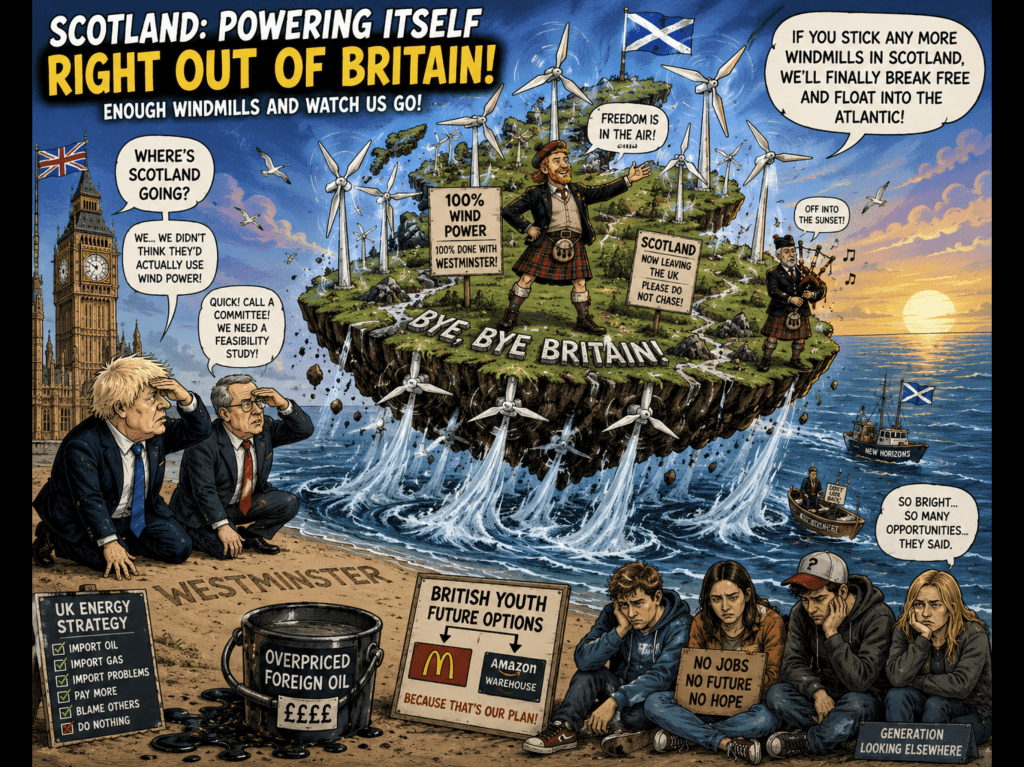
As tensions continue to rattle global energy markets and potential disruption in the Strait of Hormuz keeps traders on edge, oil prices are once again threatening to rise. Every spike sends fresh shockwaves through economies already burdened by high living costs, expensive energy bills and sluggish growth.
Yet here in Britain, the response often seems straightforward.
Do nothing, wait, import more, pay more, repeat.
While politicians talk about energy security, Britain remains heavily reliant on energy sources beyond its control. Wars, regional conflicts, shipping disruptions and decisions made thousands of miles away can directly affect what British families pay to heat their homes and fuel their cars.
The question many voters are asking is simple: why leave our own resources untapped while sending billions overseas to buy the same product from someone else?
⚡ The Land of Missed Opportunities
Britain was once an energy powerhouse.
The North Sea fuelled economic growth, created skilled jobs and generated substantial tax revenues. Entire communities grew around industries that offered careers, apprenticeships and long-term prospects.
Today, many of those communities are being told their future lies elsewhere.
The problem is that “elsewhere” often feels unclear.
Young people are promised opportunity, yet many struggle to see where it exists. House prices are increasingly out of reach, rents keep rising, and many entry-level jobs offer limited prospects for building lasting wealth.
For many families, secure skilled employment feels more distant than ever, and frustration is growing.
People question why Britain imports expensive energy while limiting development at home, why engineering jobs are disappearing despite deep technical expertise, and why creating another consultation can seem easier than creating another career.
🌬️ Wind Farms, Targets and Reality
Supporters of renewable energy argue, reasonably, that Britain must reduce dependence on fossil fuels and build a cleaner energy future.
Critics respond that renewables alone cannot yet provide the reliability, storage capacity and industrial power a modern economy requires.
This is where the debate intensifies.
While governments announce ambitious targets, most people care more about affordable bills and meaningful job opportunities for their children.
The public is generally less interested in slogans than results.
And when energy costs rise again, patience wears thin.
As for Scotland, critics joke that if many more wind turbines are installed north of the border, their combined weight might finally snap Scotland free from the mainland and send it drifting gently into the Atlantic. 🌊😂
At least then it would enjoy an abundant supply of offshore wind.
🏛️ A Question of Priorities
Perhaps the real issue isn’t oil.
Perhaps it’s confidence.
Confidence that Britain still believes it can build.
Confidence that it still values engineers, tradespeople and industrial workers.
Confidence that the next generation can aspire to more than simply getting by.
A country that led the Industrial Revolution should not struggle to explain its industrial future.
Young people want opportunity.
Communities want investment.
Workers want careers with prospects.
And taxpayers want to know why Britain keeps sending larger sums overseas while debating whether to use resources on its own doorstep.
That conversation is unlikely to disappear anytime soon—especially if oil prices keep climbing.
🔥 Challenges 🔥
Should Britain increase domestic oil and gas production while continuing to invest in renewables?
Can the country achieve energy security without relying heavily on imported fuel?
And which industries should create the next generation of skilled jobs for Britain’s youth?
Drop your thoughts in the comments below. 💬👇
👍 Like, 🔄 Share and join the debate.
The best comments will be featured in the next issue of the magazine. 📝🏆


 Chameleon Magazine
Leave a comment