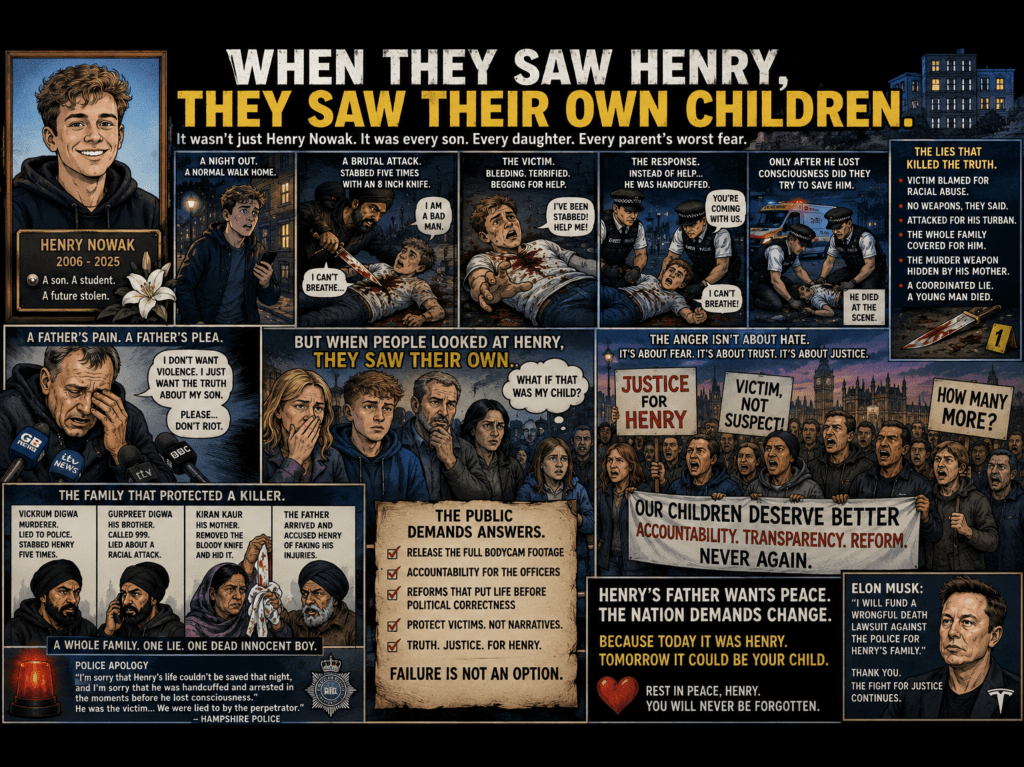
The anger surrounding the death of Henry Nowak isn’t really about politics. It isn’t even about immigration.
It’s about fear.
The kind of fear that reaches into every family home, sits down at the kitchen table, and asks a question nobody ever wants to hear:
“What if that had been my son?”
Henry was eighteen years old. A teenager standing at the threshold of adulthood, with all the hopes, ambitions and opportunities that come with it. He wasn’t a statistic. He wasn’t a political talking point. He wasn’t a hashtag.
He was somebody’s child.
And perhaps that’s why this story has struck such a deep nerve across Britain.
When Henry’s father appeals for calm and asks people not to riot, most people understand and respect that. No grieving parent wants to see more suffering. No decent person wants violence carried out in the name of a son who has already lost his life.
But while people may respect his wishes, they cannot simply switch off the emotions that this case has unleashed.
Because what horrifies people isn’t just that Henry died.
It’s the thought that, in his final moments, he appears not to have been treated as the victim.
That is the image that has lodged itself in the public consciousness.
A young man lying wounded. A young man saying he had been been stabbed. A young man struggling to breathe.
And people cannot stop imagining their own child in that position.
Parents who have never heard of Southampton suddenly picture their own son returning from a night out. Mothers imagine receiving a phone call in the middle of the night. Fathers picture standing in a hospital corridor praying for good news that never arrives.
The details almost become secondary.
Because once people emotionally place their own child into that situation, the story stops being about Henry alone.
It becomes about every family.
Trust in institutions is a fragile thing. It takes decades to build and only moments to destroy. Most people understand that police officers perform difficult jobs under enormous pressure. Most people accept that mistakes happen.
What they struggle to accept is the possibility that obvious reality can be overlooked.
The public does not expect perfection from those in authority.
It expects basic judgment.
It expects that a person suffering catastrophic injuries will be recognised as someone needing immediate help.
It expects that common sense will prevail over confusion, assumptions or competing narratives.
Whether fairly or unfairly, many people have come away from this case believing that common sense failed.
That perception matters.
Because public confidence is not measured by official statements, press conferences or carefully worded apologies.
It is measured by whether ordinary people believe that, if disaster struck their own family, they would be treated fairly.
Right now, many are asking themselves uncomfortable questions.
Would my child have been believed?
Would my child have been helped?
Would somebody have listened?
Those questions are what continue to drive public anger.
Not hatred.
Not vengeance.
Not calls for disorder.
Fear.
Fear that what happened to Henry could happen to somebody else.
Fear that systems designed to protect can sometimes fail.
Fear that institutions may have lost sight of their most basic responsibility.
And perhaps that is why this case refuses to fade from public discussion.
Because Britain didn’t just see Henry Nowak.
Britain saw its own sons and daughters.
And once people see that, they can never unsee it.
🔥 Challenges 🔥
Do you believe public trust in institutions has been damaged by cases like this? Should greater transparency be required whenever serious questions are raised about official conduct? And what changes would restore confidence that victims will always be treated first and foremost as victims?
Join the conversation in the comments below. 💬👇
👍 Like, 🔄 Share, and let your voice be heard.
The most thoughtful comments will be featured in the next issue of the magazine. 📝🏆


 Chameleon Magazine
Leave a comment