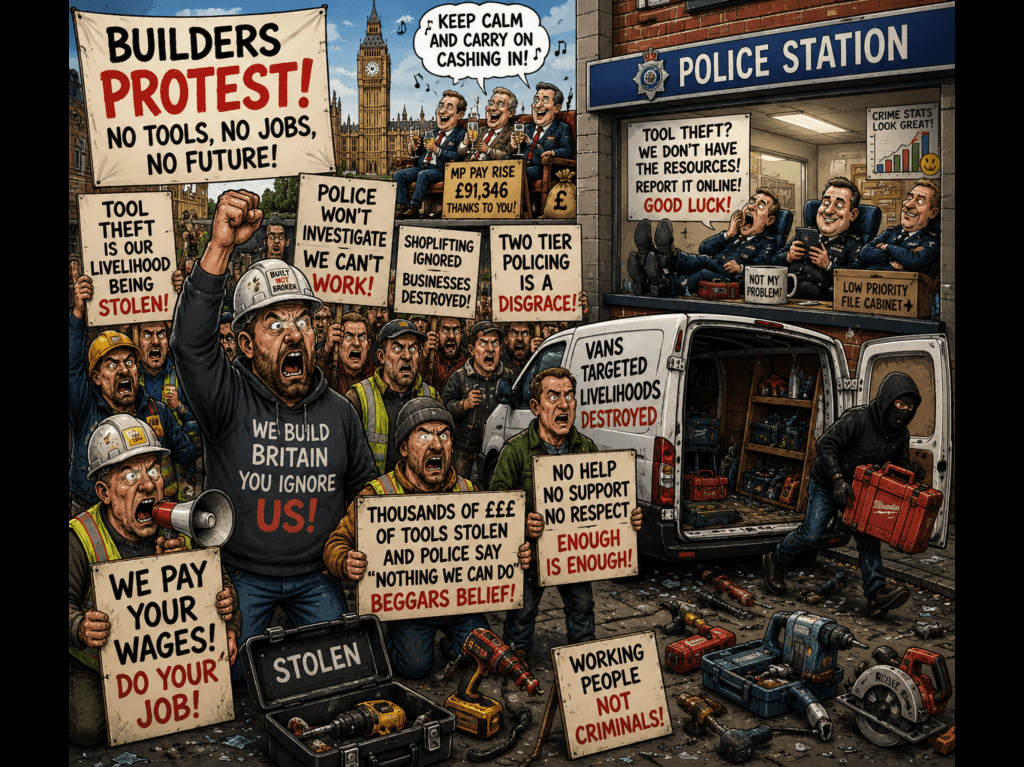
For years, builders have been told to work harder, pay more tax, absorb rising costs, and keep Britain’s economy moving.
Now many are asking a simple question:
What exactly are they getting in return?
Across the country, tradespeople report having thousands of pounds worth of tools stolen from vans, sites, and lockups, only to feel that little is done to investigate the crime or recover their property.
When your livelihood is sitting in the back of a van, theft isn’t an inconvenience.
It’s unemployment by another name.
🔧 No Tools, No Work, No Income
Imagine turning up to work on Monday morning and finding your office gone.
Your computer gone.
Your equipment gone.
Your ability to earn a living gone.
That’s the reality many builders face after a tool theft.
Yet many claim the response they receive is little more than a crime reference number and a polite shrug.
The irony is hard to miss.
The people laying bricks, fitting kitchens, wiring homes, and building Britain’s infrastructure are the same people whose taxes help fund public services, government departments, and the salaries of those making the decisions.
They don’t have the luxury of carrying on regardless when their tools disappear.
No tools means no work.
No work means no wages.
No wages means bills don’t get paid.
🚨 The Growing Anger
This is why growing numbers of tradespeople are talking about protests and demanding greater action.
Their frustration isn’t simply about stolen drills, saws, and generators.
It’s about a feeling that everyday working people are being left to shoulder the cost of crime while criminals operate with little fear of consequences.
Whether fair or not, the perception among many builders is that theft has become so common that some offenders no longer expect to be caught.
And when public confidence in law enforcement begins to erode, everyone should be concerned.
Because if people stop believing crimes will be investigated, faith in the system itself starts to crack.
🏗️ The People Who Keep Britain Running
Builders don’t ask for special treatment.
They ask for protection.
They ask for accountability.
They ask for the basic expectation that when thousands of pounds worth of equipment is stolen, somebody will take it seriously.
That shouldn’t be controversial.
That should be the minimum standard.
🔥 Challenges 🔥
Should tool theft be treated as a higher policing priority given its impact on people’s livelihoods?
Are tradespeople being let down by the system, or are police forces simply stretched beyond capacity?
💬 Tell us what you think in the blog comments.
👇 Like, comment and share if you believe working people deserve better protection from crime.
🏆 The best comments will be featured in the next issue of the magazine.


 Chameleon Magazine
Leave a comment