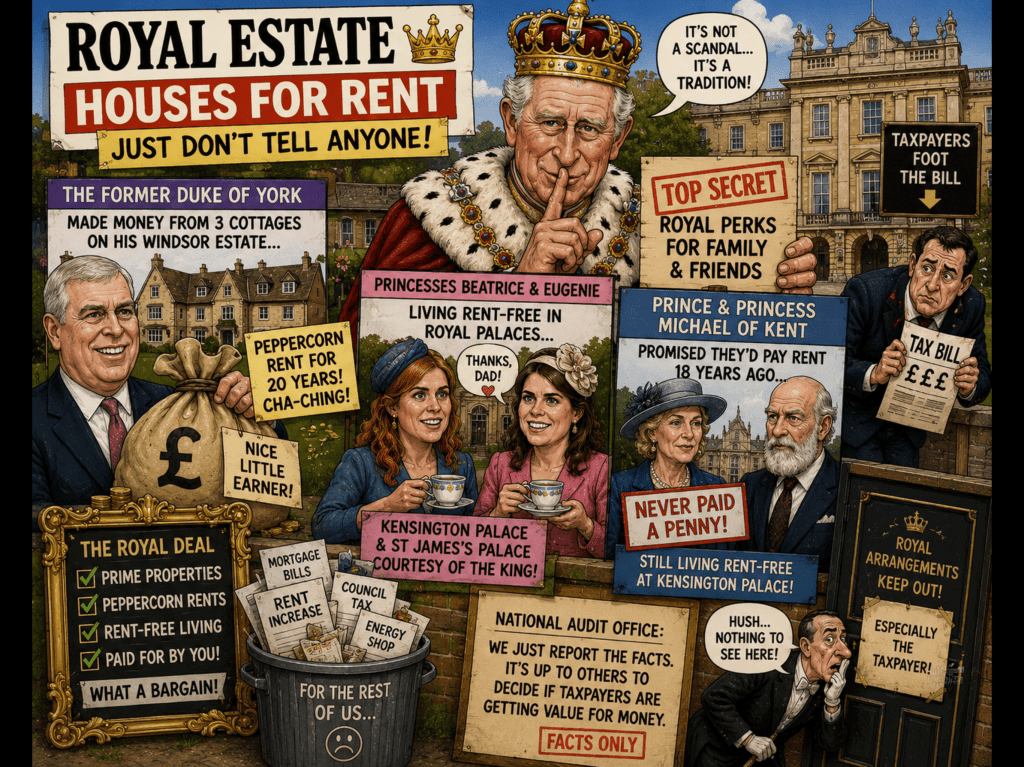
Just when you thought the royal soap opera couldn’t possibly produce another eyebrow-raising episode, along comes a fresh revelation from the National Audit Office.
And this one has taxpayers wondering whether they’re funding a monarchy or Britain’s most exclusive housing association. 🏰💷
According to the report, the former Duke of York, Prince Andrew, managed to generate income from three cottages on his Windsor estate while paying little more than a symbolic peppercorn rent for around two decades.
Meanwhile, his daughters, Princess Beatrice and Princess Eugenie—neither of whom are working royals—continue to enjoy accommodation linked to royal estates courtesy of the King.
And if that wasn’t enough to get the nation’s tea cups rattling, it has also emerged that Prince and Princess Michael of Kent have reportedly never been required to pay their own rent at Kensington Palace despite previous public assurances that they would.
🏰 Britain’s Most Exclusive Housing Benefit Scheme? 🏰
Imagine explaining this to the average family.
“Sorry, your rent is going up.”
“Your mortgage payments have increased.”
“Energy bills are through the roof.”
But don’t worry—some of the wealthiest and best-connected people in the country appear to have access to housing arrangements that ordinary people can only dream about.
Most Britons spend decades working to pay off a mortgage.
Others apparently spend decades living in royal properties while someone else picks up the tab.
It’s enough to make even the most loyal royalist choke on their scone. ☕😲
💰 The Peppercorn That Cost a Fortune💰
The phrase “peppercorn rent” sounds charming.
Almost quaint.
Like something from a period drama involving horse-drawn carriages and gentlemen named Reginald.
But taxpayers might reasonably ask whether symbolic rents and subsidised accommodation remain appropriate in an era when millions are struggling with housing costs.
Particularly when some of the beneficiaries are not carrying out official royal duties.
The National Audit Office isn’t making accusations.
It’s simply laying out the facts.
The awkward questions come later.
🎭 One Rule For Them? 🎭
Critics argue that the monarchy’s greatest challenge isn’t scandal.
It’s perception.
Every time the public hears stories of free accommodation, discounted leases, and privileged arrangements, it reinforces the belief that Britain still operates under two separate systems.
One for ordinary people.
And another for those fortunate enough to have a title attached to their name.
Supporters will argue these are longstanding arrangements connected to historic property holdings.
Critics will ask why taxpayers should continue subsidising non-working royals at all.
And that’s where the real debate begins.
🔥 Challenges 🔥
Should non-working royals be paying full market rent for royal properties?
Should all royal accommodation arrangements be made fully transparent?
Or are these simply traditional benefits that come with centuries of constitutional history?
Tell us what you think.
💬 Leave your comments on the blog.
👍 Like the article.
🔄 Share it with friends and family.
The best comments will be featured in the next issue of the magazine. 📰🔥


 Chameleon Magazine
Leave a comment