The future has arrived.
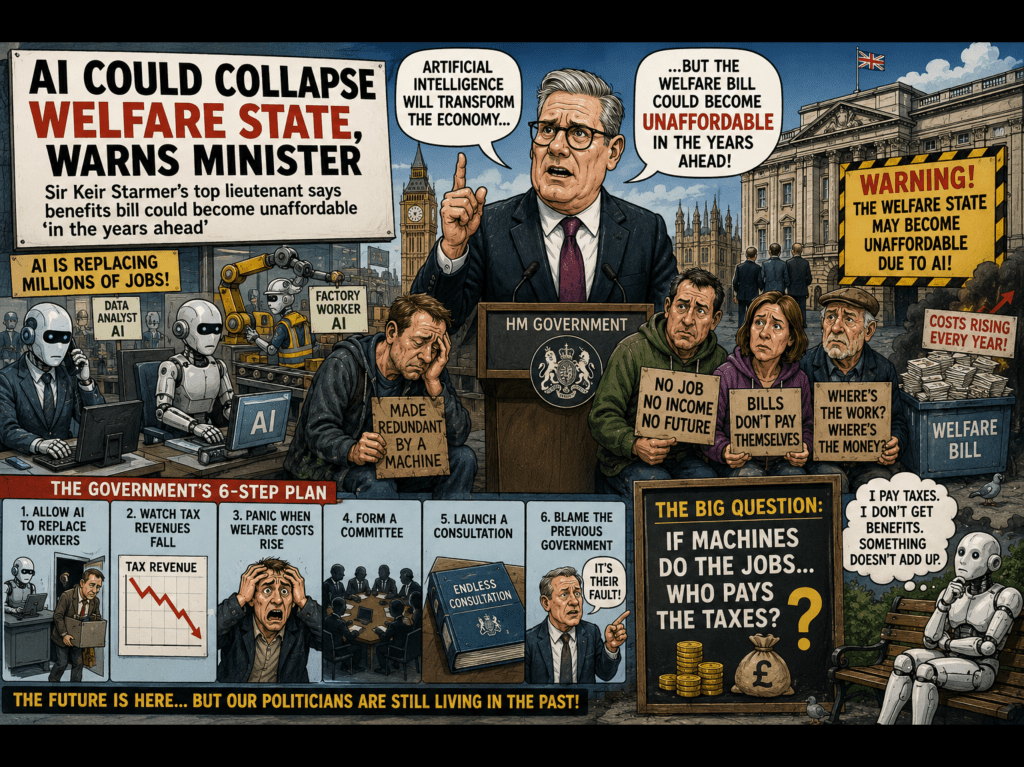
Apparently, artificial intelligence is about to transform the workplace, eliminate millions of jobs, revolutionise entire industries, and potentially make large chunks of the welfare state unaffordable.
At least that’s the warning now emerging from the upper reaches of government.
Sir Keir Starmer’s senior allies are reportedly warning that the benefits bill could become impossible to sustain in the years ahead as AI reshapes the economy and the labour market. 💻📉
Which raises an awkward question.
If machines are doing the jobs, who’s paying the taxes?
🤔 The Government’s Brilliant New Plan 🤔
Step One:
Allow AI to replace workers.
Step Two:
Watch tax revenues fall.
Step Three:
Panic when welfare costs rise.
Step Four:
Form a committee.
Step Five:
Launch a consultation.
Step Six:
Blame the previous government.
It’s the sort of long-term strategic thinking that has become a hallmark of modern politics.
Workers are told to embrace technological change.
Businesses are told to automate.
Investors are told AI is the future.
Then everyone acts surprised when millions of people start wondering where their next pay cheque is coming from. 💸
💼 The Robot Revolution Nobody Planned For 💼
For years we’ve been promised that technology would make life easier.
Less work.
More leisure.
Greater prosperity.
Instead, many people fear the future looks more like this:
A robot writes the report.
An algorithm answers the phone.
A chatbot handles customer service.
A machine analyses the data.
And Dave, who’s worked for twenty years, is told to “upskill.”
Into what exactly?
Robot maintenance?
Professional prompt engineering?
Full-time unemployment? 🤷♂️
🏛️ Who Pays For The Welfare State Then? 🏛️
The uncomfortable reality is that welfare systems rely on people working.
Workers pay taxes.
Taxes fund services.
Services support society.
It’s a fairly simple arrangement.
But if AI dramatically reduces the number of traditional jobs, governments may face a difficult choice:
Tax companies more.
Tax AI.
Create entirely new economic models.
Or explain to voters why public services are being cut while robots generate record profits.
None of those conversations sound particularly enjoyable.
Which is probably why politicians keep kicking the issue down the road like a can attached to a self-driving car. 🚗🤖
🎭 The Real Fear 🎭
The real concern isn’t that AI becomes smarter than humans.
It’s that politicians remain exactly the same.
Technology is advancing at breakneck speed.
Government policy often moves at the speed of a mobility scooter with a flat battery.
And that’s a dangerous combination.
Because while ministers debate, algorithms are already taking over tasks that once employed thousands.
The future isn’t coming.
It’s already here.
🔥 Challenges 🔥
If AI replaces millions of jobs, who should pay for the welfare state?
Should robots be taxed?
Should companies using AI contribute more?
Or are warnings about mass unemployment being wildly exaggerated?
Tell us what you think.
💬 Comment on the blog.
👍 Like the article.
🔄 Share it with friends.
The best comments will be featured in the next issue of the magazine. 📰🔥


 Chameleon Magazine
Leave a comment