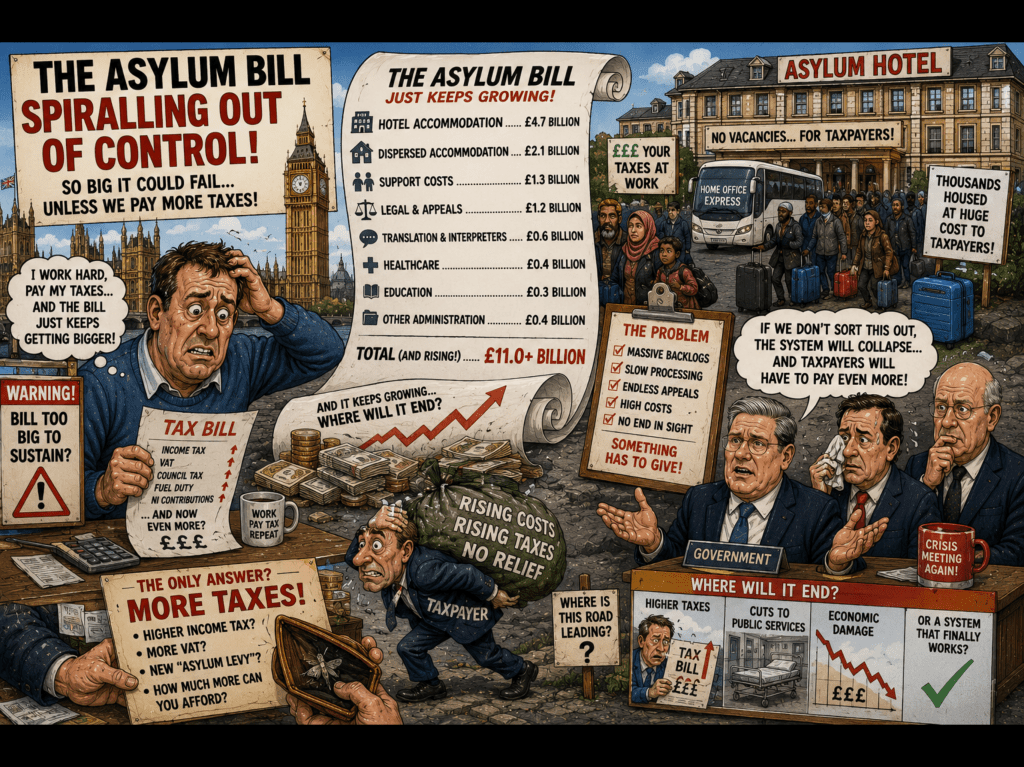
Every year, the cost appears to rise.
More accommodation.
More administration.
More legal costs.
More support services.
And now an uncomfortable question is starting to emerge:
How much can the country afford before the system reaches breaking point? 💸
As concerns grow about the rising cost of the asylum system, critics are warning that taxpayers could eventually be asked to shoulder an even bigger financial burden if reforms fail to bring costs under control.
For millions of working people already struggling with rising household bills, that prospect is about as welcome as a parking ticket on payday.
🏨The Hotel Britain Strategy🏨
For years, headlines have been dominated by stories of asylum seekers being housed in hotels and temporary accommodation while claims work their way through an overloaded system.
The result?
A growing backlog.
Rising costs.
And increasing public frustration.
Many taxpayers are asking a simple question:
If government departments struggle to balance their books, how can a system with ever-increasing costs continue indefinitely?
💰The Taxpayer’s Dilemma💰
Most people don’t object to helping genuine refugees fleeing war or persecution.
What they do object to is inefficiency.
When billions are being spent, the public naturally wants answers.
Where is the money going?
Why are cases taking so long?
Why does the bill keep increasing?
And most importantly:
Who ultimately pays?
The answer, critics argue, is always the same.
The taxpayer.
The person getting up at six in the morning.
The person paying income tax, council tax, fuel duty, VAT and a hundred other charges before they’ve even bought a loaf of bread.
⚠️The Warning Signs Are Flashing⚠️
Supporters of the current system argue that Britain has legal and humanitarian obligations that must be honoured.
Critics counter that a system which becomes financially unsustainable ultimately helps nobody.
Because when costs spiral out of control, pressure grows for higher taxes, spending cuts elsewhere, or both.
And that’s when voters start asking difficult questions.
Questions politicians often seem reluctant to answer.
🎭The Real Debate🎭
This isn’t simply an argument about immigration.
It’s an argument about affordability.
How much should Britain spend?
How should that money be managed?
And can the public continue funding a system that many believe is struggling to cope?
Those are the questions that will dominate the debate in the years ahead.
🔥Challenges🔥
Do you think the asylum system is financially sustainable?
Should the government spend more to speed up processing and reduce backlogs?
Or should there be tougher controls to reduce costs?
Tell us what you think.
💬 Comment on the blog.
👍 Like the article.
🔄 Share it with friends and family.
The best comments will be featured in the next issue of the magazine. 📰🔥


 Chameleon Magazine
Leave a comment