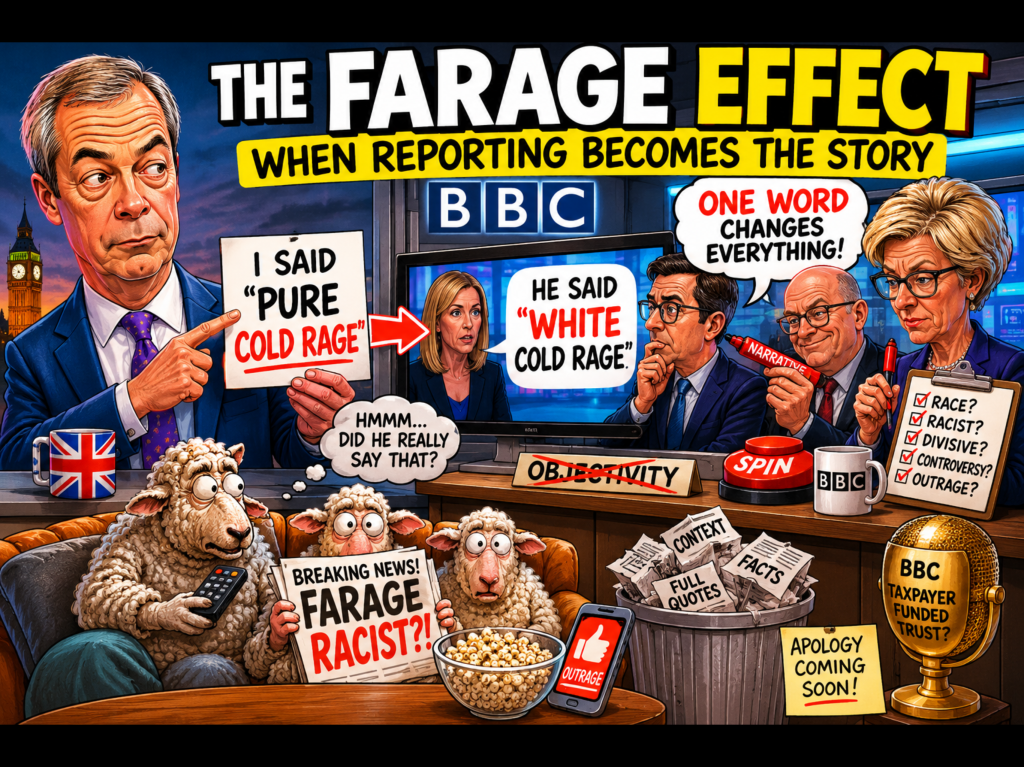
Nigel Farage has spent years claiming that parts of Britain’s media establishment don’t simply report on him — they interpret him first.
His critics have always dismissed that argument.
Then came the BBC’s latest apology.
A Newsnight discussion repeatedly changed Farage’s phrase “pure cold rage” into “white cold rage.”
One extra word.
One completely different meaning.
One national broadcaster forced into a public apology.
The BBC withdrew the programme, but for many viewers the real question wasn’t how the mistake happened.
It was why it happened at all.
🎓 These Are Supposed To Be The Experts
Whenever controversies like this occur, the public is told that mistakes happen.
Of course they do.
But this isn’t a local Facebook group or a late-night pub conversation.
This is the BBC.
An organisation employing highly trained journalists, editors, researchers and producers whose entire job is accuracy.
These people are well educated, well paid and surrounded by multiple layers of editorial oversight.
If anyone should be capable of accurately repeating a short, simple quote from a major political figure, it should be them.
So when errors of this scale occur, many viewers no longer see them as minor slip-ups.
They see professional standards failing in plain sight.
🚨 Why Do The Errors Always Seem To Point The Same Way?
The bigger question is one the BBC rarely seems willing to address.
Why do so many controversial mistakes appear to produce the same result?
When Farage discusses immigration, the story often becomes racism.
When he criticises institutions, the focus often shifts to his character rather than his argument.
When corrections eventually arrive, the original narrative has usually travelled much further than the truth.
Perhaps every incident has an innocent explanation.
But the public is increasingly noticing that the explanations always seem to come after the damage has been done.
🏛️ The Trust Problem
The greatest threat to the BBC isn’t Nigel Farage.
It’s the growing belief that Britain’s most powerful broadcaster applies different standards to different people.
Whether that perception is fair or not almost becomes irrelevant once enough people believe it.
Trust is the BBC’s most valuable asset.
Every correction weakens it.
Every apology damages it.
Every avoidable error raises another uncomfortable question.
If a publicly funded broadcaster with vast resources cannot accurately report a simple quote, what else is it getting wrong?
And once viewers start asking that question, the broadcaster itself becomes the story.
🔥 Challenges 🔥
Should the public accept these incidents as honest mistakes?
Or should highly trained, highly paid media professionals be held to a much higher standard than everyone else?
💬 Tell us what you think in the blog comments.
👍 Like it. 🔄 Share it. 🗣️ Challenge it.
The best comments will be featured in the next issue of the magazine. 🏆📝


 Chameleon Magazine
Leave a comment