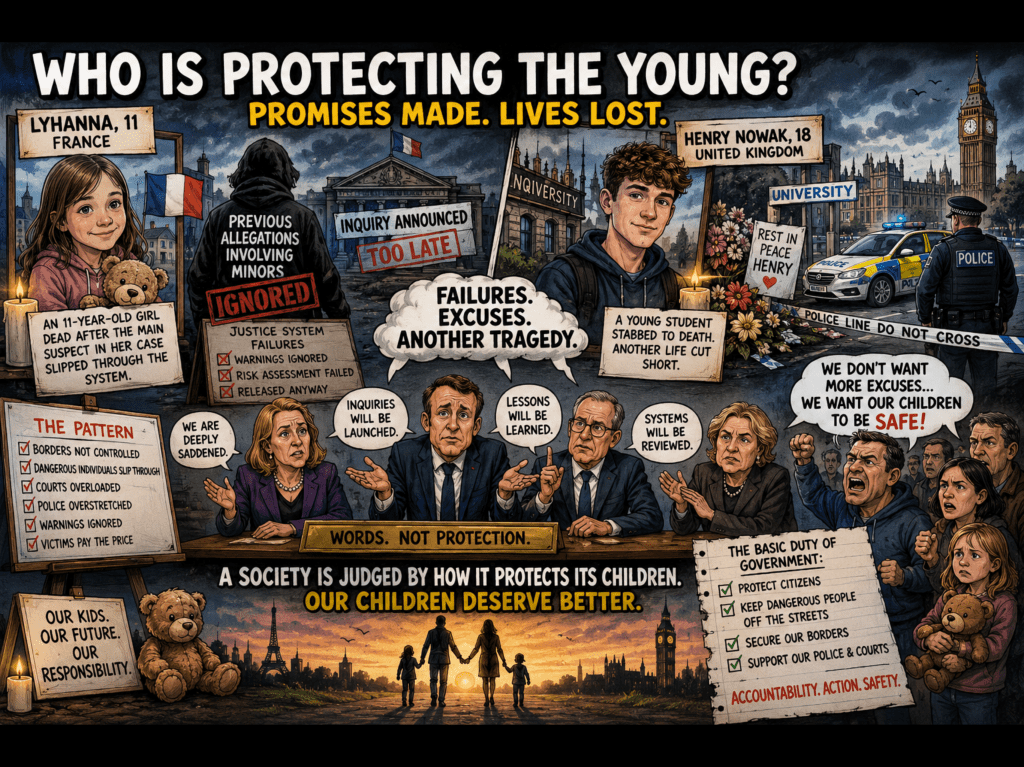
An 11-year-old girl in France is dead.
A young student, Henry Nowak, is dead.
Two different countries.
Two different tragedies.
Yet both leave behind the same haunting question:
Who is protecting the next generation?
Every time one of these horrific stories emerges, politicians rush to the microphones. We hear promises of inquiries, reviews, lessons learned and systems improved.
Then another tragedy happens.
And another.
And another.
At some point, the public stops believing these are isolated failures and starts wondering whether the system itself is failing.
⚠️ The Questions Nobody Wants Asked
The political class prefers to discuss statistics.
Parents think about their children.
That’s the difference.
Ordinary people don’t spend their evenings debating policy papers and government frameworks. They want to know whether their children can walk home safely, travel safely, study safely and live safely.
That isn’t an unreasonable expectation.
It’s the most basic responsibility of any government.
Yet across Europe, public confidence is crumbling.
People see overstretched police forces, overloaded courts, porous borders and growing concerns about criminality, and they ask a simple question:
If governments cannot keep children and young adults safe, what exactly is their first priority?
🌍 The Immigration Debate Won’t Go Away
The moment anyone raises concerns about migration, the argument usually descends into accusations and slogans.
But the reality is simpler.
Most people are not claiming that migrants are responsible for every crime.
Nor are they claiming that every migrant is a danger.
What they are asking is whether governments have lost control of systems that are supposed to protect the public.
Who enters?
Who stays?
Who should be removed?
Who is being monitored?
Who is slipping through the cracks?
These questions aren’t extreme.
They’re common sense.
And every time a preventable tragedy occurs, more people start asking them.
🏛️ Leadership Means Accountability
When something goes wrong, politicians often talk about complexity.
The public talks about responsibility.
Because grieving families don’t care which agency failed.
They don’t care whether the breakdown occurred in immigration, policing, social services, the courts or government departments.
They care that someone failed to act.
And that a young life was lost as a result.
The truth is brutally simple.
A society is judged by how well it protects its children.
Not by how many statements are issued afterwards.
💔 A Generation Deserves Better
The deaths of young people should never become political footballs.
But neither should they be quietly filed away as unfortunate statistics.
Every tragedy should force difficult questions.
Were warnings missed?
Were opportunities ignored?
Were systems working as intended?
And if they were, is the system good enough?
Because the public is growing tired of hearing that everything is under control while reading headlines that suggest otherwise.
🔥 Challenges 🔥
Have European governments lost control of the systems designed to keep citizens safe?
Are concerns about policing, border security and public safety being taken seriously enough?
Or are politicians failing to address the questions ordinary people are already asking?
💬 Join the debate in the blog comments.
👍 Like it. 🔄 Share it. 🗣️ Challenge it.
The best comments will be featured in the next issue of the magazine. 🏆📝


 Chameleon Magazine
Leave a comment