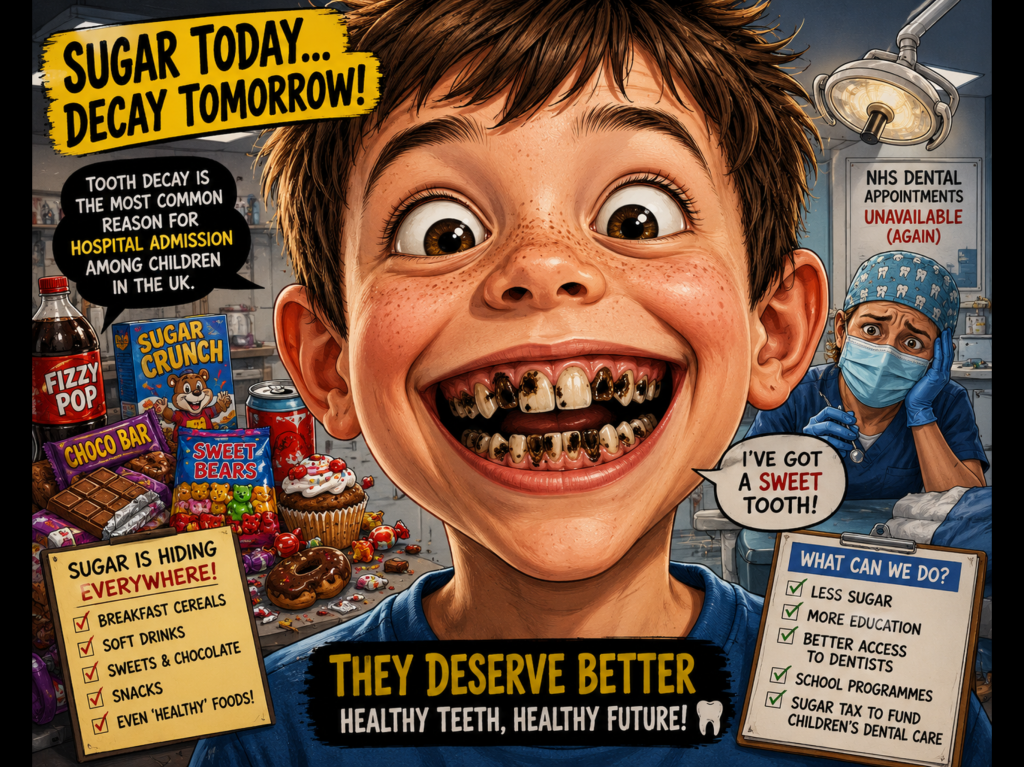
For a country that prides itself on having one of the world’s most advanced healthcare systems, Britain has an embarrassing problem hiding in plain sight.
Our children’s teeth.
Every year thousands of children end up in hospital suffering from tooth decay—an entirely preventable condition that should barely exist in a modern developed nation.
Yet here we are.
Children having teeth extracted.
Parents unable to find NHS dentists.
Dentists warning of a growing crisis.
And governments responding with the urgency of a sloth on a tea break. ☕🐌
🍬 The Sugar Mountain We Pretend Not To See
Let’s be honest.
Children are surrounded by sugar.
Breakfast cereals loaded with it.
Soft drinks packed with it.
Sweets at supermarket checkouts.
Chocolate promotions at every turn.
Even products marketed as “healthy” can contain shocking amounts.
Parents are fighting a battle against an industry that spends millions encouraging children to consume more sugar while dentists spend their days dealing with the consequences.
Then we act surprised when tooth decay becomes one of the leading causes of hospital admissions among children.
It’s like pouring water into a boat and wondering why it’s sinking.
🏥 Where Are The Dentists?
Even when parents want help, many can’t get it.
Across Britain, NHS dental appointments can feel rarer than a polite argument on social media.
Families are travelling miles for treatment.
Some cannot register with a dentist at all.
Others face long waiting lists while problems worsen.
By the time many children receive treatment, a small cavity has become a major problem.
That’s not prevention.
That’s crisis management.
💰 Should Sugar Be Taxed Even More?
The obvious answer is yes.
And no.
A tax alone won’t solve the problem.
People rightly point out that families are already struggling with the cost of living.
The last thing they need is another government hand reaching into their pockets.
But there is also a strong argument that products specifically targeted at children and loaded with excessive sugar should carry a financial penalty.
After all, society already pays the price through NHS treatment costs.
The real question is what happens to the money.
If sugar taxes simply disappear into government coffers, parents will see it as another stealth tax.
If every penny were ring-fenced for children’s dentistry, school brushing programmes and dental access, the public might view it very differently.
🦷 Prevention Is Cheaper Than Repair
The truth is that this problem isn’t complicated.
Children need fewer sugary products.
Parents need better information.
Schools need stronger education programmes.
Dentists need proper funding.
And governments need to stop treating dental care as the forgotten corner of healthcare.
Because once teeth are damaged, fixing them is far more expensive than preventing the damage in the first place.
🇬🇧 A First-World Country Should Do Better
No child should be losing healthy teeth because they cannot access a dentist.
No parent should be waiting months for basic dental treatment.
And no developed country should accept widespread tooth decay as normal.
Britain can build aircraft carriers.
Launch satellites.
Develop world-class medicines.
Surely we can stop children needing teeth pulled out because of preventable decay.
Because when children are ending up in hospital for rotten teeth, something has gone badly wrong.
And pretending otherwise won’t make the problem disappear.
🔥 Challenges 🔥
Should Britain introduce tougher measures on sugary products aimed at children?
Would a dedicated children’s dental tax help solve the crisis—or simply punish families already struggling with rising costs?
And why has children’s dentistry become such a low political priority?
💬 Tell us what you think in the blog comments.
👍 Like it. 🔄 Share it. 🗣️ Challenge it.
The best comments will be featured in the next issue of the magazine. 🏆📝


 Chameleon Magazine
Leave a comment