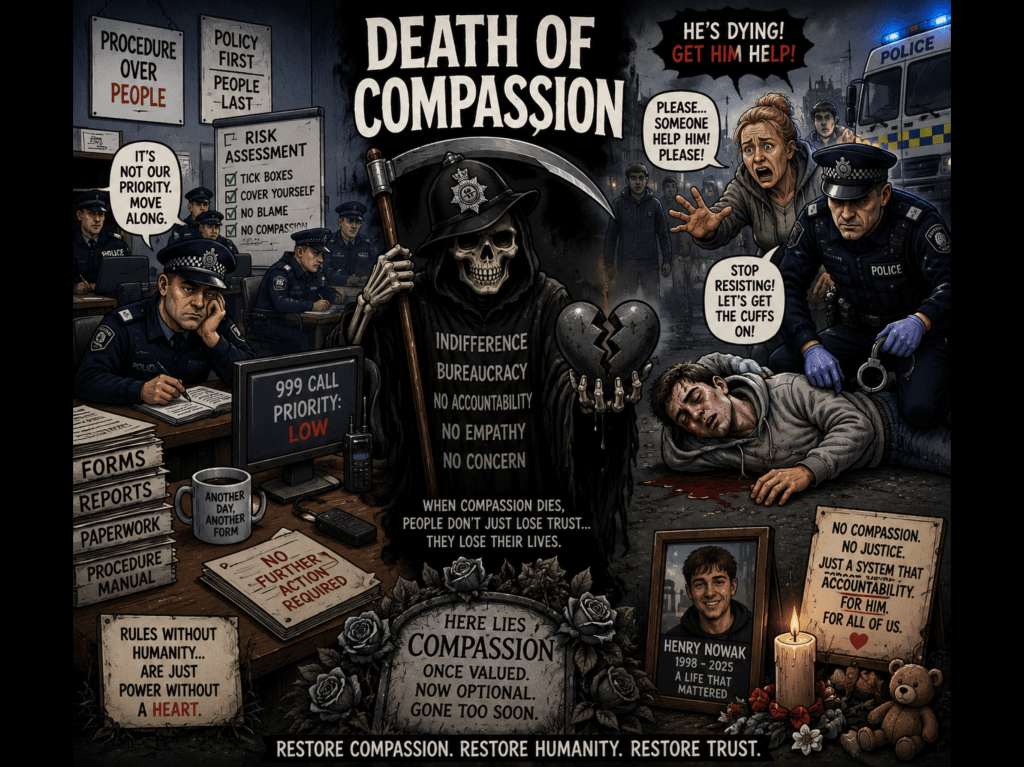
A young man is dead.
The public watched disturbing footage.
Questions are being asked.
And yet the overwhelming feeling from many watching isn’t confidence.
It’s disbelief.
Because where is the outrage?
Where is the anger?
Where is the Prime Minister standing at a podium demanding answers on behalf of the public?
Instead, many people are left wondering whether those in power have become so detached from ordinary concerns that they no longer recognise when the nation expects them to speak with moral clarity. 🚨
💔 A Dying Man and a Missing Sense of Humanity
The debate surrounding Henry Nowak’s death is not simply about procedure.
It’s about priorities.
It’s about compassion.
It’s about whether the institutions that exist to protect life still remember that protecting life comes first.
Whatever someone’s background.
Whatever accusations may exist.
Whatever mistakes they may have made.
The first duty when a person is in medical distress should be preserving life.
That principle shouldn’t be controversial.
It should be instinctive.
Yet many people who watched the footage were left with an uncomfortable feeling that procedure appeared to take precedence over humanity.
And that’s what has struck such a nerve across the country.
👮 When Did Compassion Become Optional?
The British public has traditionally supported its police because officers were seen not merely as enforcers of the law but as protectors of the public.
There was an understanding that behind the uniform stood a human being capable of judgement, empathy and common sense.
So many people are asking the same question:
When did compassion become optional?
When did paperwork become more important than people?
When did procedure start drowning out basic human concern?
One of the most powerful moments reported by witnesses was a woman trying to speak up for the man in distress.
A voice calling for humanity.
A voice urging compassion.
Yet many watching felt that voice disappeared beneath officialdom and indifference.
Whether or not that perception is entirely fair, it is clearly how many members of the public now feel.
And perceptions matter because trust matters.
🔥 The Leadership Britain Wants To See
People often talk about leadership as if it’s about speeches, press conferences and carefully managed headlines.
It isn’t.
Leadership is about knowing when something is wrong and saying so.
It’s about standing up and demanding answers when the public feels ignored.
It’s about showing the same passion for ordinary citizens that politicians show during election campaigns.
Many have pointed to figures such as Nigel Farage because, agree with him or not, he rarely hides his emotions when discussing issues he believes matter.
The frustration some voters express is not necessarily that they agree with every word he says.
It’s that they wish they saw the same visible conviction, urgency and willingness to confront uncomfortable questions from those currently governing the country.
Because leadership without passion can start to look like management.
And management is not what people seek when trust is breaking down. 🇬🇧
🚨 The Bigger Question
The investigation will determine the facts.
But the wider question already exists.
Do Britain’s institutions still put people first?
Do they still possess the compassion that once underpinned public trust?
Or have they become so focused on procedure, policy and public relations that they sometimes forget the human being standing right in front of them?
A society can survive mistakes.
It struggles to survive indifference.
🔥 Challenges 🔥
Should compassion always come before procedure when someone appears to be in medical distress?
Has public trust in policing been damaged by a growing perception that rules now matter more than people?
And where was the visible anger from Britain’s leaders when the public was demanding answers?
💬 Share your thoughts in the blog comments below.
👇 Like, comment and share if you believe public institutions should always put humanity before bureaucracy.
🏆 The best comments will be featured in the next issue of the magazine.


 Chameleon Magazine
Leave a comment