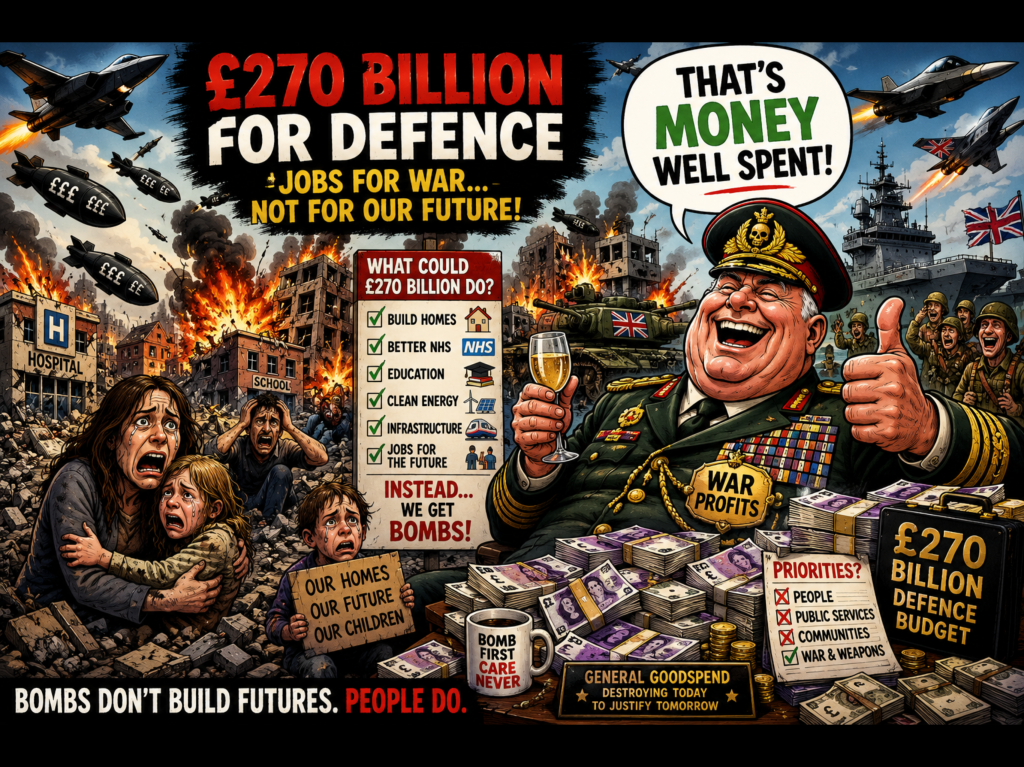
Britain is preparing to spend a staggering £270 billion on defence during this Parliament.
That’s £270 billion.
Not million.
Not a rounding error buried in a government spreadsheet.
Two hundred and seventy billion pounds.
Enough money to make taxpayers spill their tea and economists reach for the smelling salts. ☕😳
The question isn’t whether Britain needs a military.
Of course it does.
The real question is whether politicians have become better at preparing for war than preparing for the future.
🚀 Jobs for Conflict or Jobs for Prosperity?
Supporters argue that defence spending creates jobs.
And they’re right.
Shipyards employ workers.
Factories manufacture equipment.
Military bases support local economies.
Defence contracts create thousands of skilled positions across the country.
But there is another question that rarely gets asked.
What if the same money was invested in industries designed to generate wealth rather than prepare for destruction?
Imagine £270 billion invested in:
🏗️ New infrastructure
⚡ Energy innovation
🤖 Advanced manufacturing
💻 Artificial intelligence
🔬 Scientific research
🚄 Transport networks
🏡 Housing
🎓 Skills and education
The kind of projects that don’t just create jobs for a decade but potentially create industries for generations.
💣 The Politics of Fear
Defence spending is one of the easiest political sells in the world.
Point to a hostile regime.
Point to a global conflict.
Point to a security threat.
Then announce another spending package.
Few politicians want to be accused of leaving the nation vulnerable.
Yet fear can become a powerful justification for almost any expenditure.
Governments often find it easier to convince voters they need protection from enemies abroad than explain why roads are crumbling, productivity is stagnating, and young people can’t afford homes.
One argument wins elections.
The other requires difficult conversations.
⚖️ Security Versus Prosperity
Of course, there is a counter-argument.
Without security, prosperity cannot exist.
A nation unable to defend itself eventually loses the ability to decide its own future.
History provides plenty of examples.
A strong economy needs security.
But security also needs a strong economy.
And that’s where the debate becomes interesting.
Are we investing enough in the industries that will generate tomorrow’s wealth to support tomorrow’s military?
Or are we slowly consuming the seed corn while congratulating ourselves on protecting the farm?
🌾⚠️🎭 Westminster’s Favourite Hobby: Spending Other People’s Money
The frustrating part for many taxpayers is that politicians rarely frame these decisions as choices.
Everything is presented as essential.
Everything is urgent.
Everything must happen immediately.
The defence budget rises.
The debt rises.
Taxes rise.
The bill rises.
And somehow the taxpayer is expected to applaud while reaching for their wallet.
At some point somebody has to ask the obvious question:
If £270 billion can be found for defence, why is it so difficult to find money for the investments that might make Britain richer, more productive and more competitive in the first place?
🔥 Challenges 🔥
Should Britain prioritise spending £270 billion on defence?
Or should more of that money be directed towards industries that create long-term prosperity and economic growth?
Can a nation remain secure without investing heavily in its future?
And if taxpayers are expected to fund both, where exactly is the money supposed to come from?
💬 Tell us what you think in the blog comments below.
Would you spend £270 billion preparing for threats abroad, or building opportunities at home?
👇 Like, comment and share if you think Britain needs a serious debate about whether we’re investing in our future—or merely preparing for our fears.
🏆 The best comments will be featured in the next issue of the magazine.


 Chameleon Magazine
Leave a comment