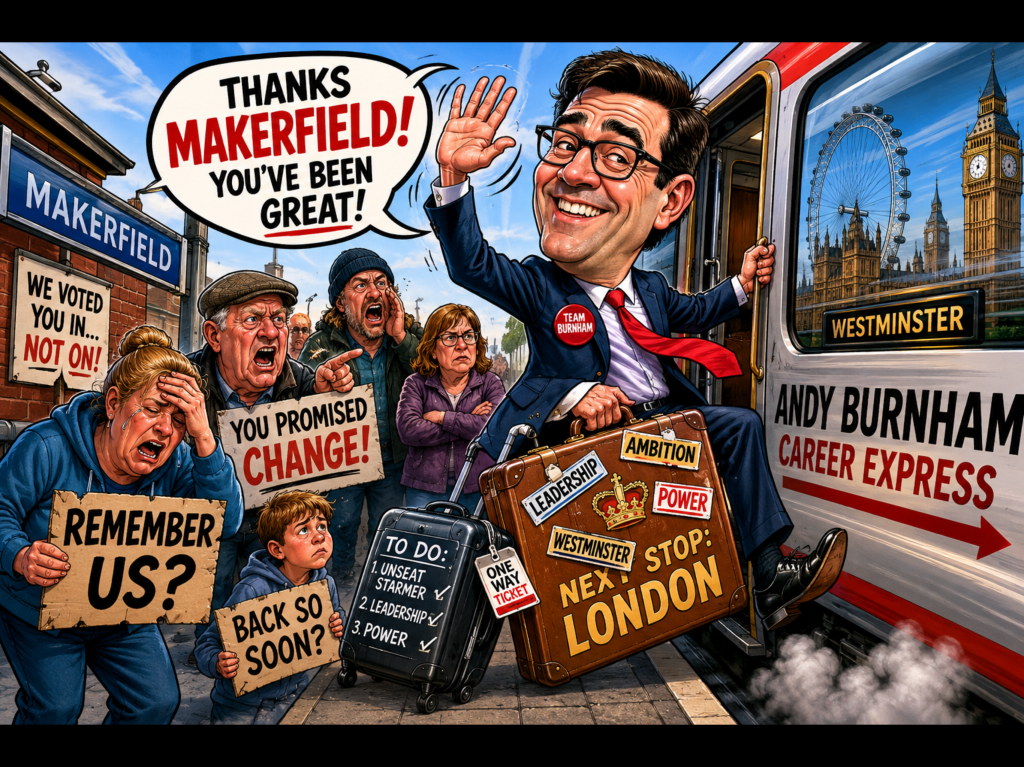
What was supposed to be a routine by-election has somehow mutated into something far bigger: a national mood check, a political stress test, and possibly the most uncomfortable mirror Westminster has looked into for years.
🔥 One Constituency, A Thousand Frustrations 🔥
Makerfield isn’t just choosing an MP.
It has become the place where years of public frustration are being squeezed into a single ballot box. 📦🗳️
Across Britain, people are increasingly asking the same questions. Why does it feel as though ordinary voices only matter when politicians need votes? Why do concerns over immigration, the cost of living, crime, public services and economic security seem to disappear into a bureaucratic black hole the moment polling stations close?
Whether those perceptions are entirely fair is almost beside the point.
Politics runs on trust. And trust, once cracked, is much harder to repair than a pothole after an election leaflet photoshoot. 🚧📸
The death of Henry Nowak has become wrapped up in that wider sense of unease, and many believe the people of Makerfield now have an opportunity to send a message to politicians that they care about cases like Henry’s and the questions that remain unanswered.
For those voters, a vote for Reform represents more than support for a political party. It is a way of expressing dissatisfaction with the political establishment and signalling that they believe change is needed.
The case has sparked strong emotions, fierce debate and lingering questions. People hold different views on the circumstances, but one thing is difficult to ignore: many feel they have not received satisfactory answers and want greater accountability from public institutions.
Dismissing those concerns as mere outrage would be a mistake.
When people stop believing institutions are listening, they eventually start shouting louder. 📢
Then there’s Andy Burnham.
One of Labour’s biggest political names has entered the contest, instantly raising the stakes. Critics argue that Makerfield risks becoming a stepping stone in a larger political career, and that local voters could find themselves forgotten once Westminster comes calling again.
Supporters, of course, see things differently.
Fair or unfair, that debate has become part of the conversation.
And here’s where the political plot thickens.
The person who may be watching this result most nervously might not be Burnham at all.
It could be Prime Minister Keir Starmer. 👀
Because a strong Burnham performance would inevitably reignite Westminster’s favourite pastime: leadership speculation. British politics loves nothing more than discussing who might replace someone before they’ve even unpacked their office.
It’s the political equivalent of browsing estate agents’ websites while you’re still unpacking the moving boxes. 📦🏠
Makerfield now sits at the crossroads of several powerful forces: public frustration, political trust, institutional accountability and Labour’s future direction.
That’s a lot of baggage for one constituency.
Will the result fix Britain’s problems?
Of course not.
The national debt won’t vanish overnight. Public services won’t suddenly become efficient. Political divisions won’t disappear in a cloud of patriotic confetti. 🎊
But the result could tell us something equally important.
It could reveal whether those in power still understand the mood of the people they are supposed to represent.
And that is why so many eyes are fixed on Makerfield.
Not because it is merely another by-election.
But because it may become a verdict on whether Westminster is still listening—or simply waiting for the next election to pretend it is. 🎭
⚡ Challenges ⚡
Is Makerfield really a local contest anymore, or has it become a national referendum on trust in politics?
Has Westminster lost touch with ordinary voters, or are politicians unfairly taking the blame for deeper problems facing the country?
Drop your thoughts in the blog comments and join the debate. 💬🔥
👇 Like, comment and share if you think Makerfield has become about far more than a single parliamentary seat.
The best comments, strongest arguments and sharpest observations will be featured in the next issue of the magazine. 📝🎯


 Chameleon Magazine
Leave a comment