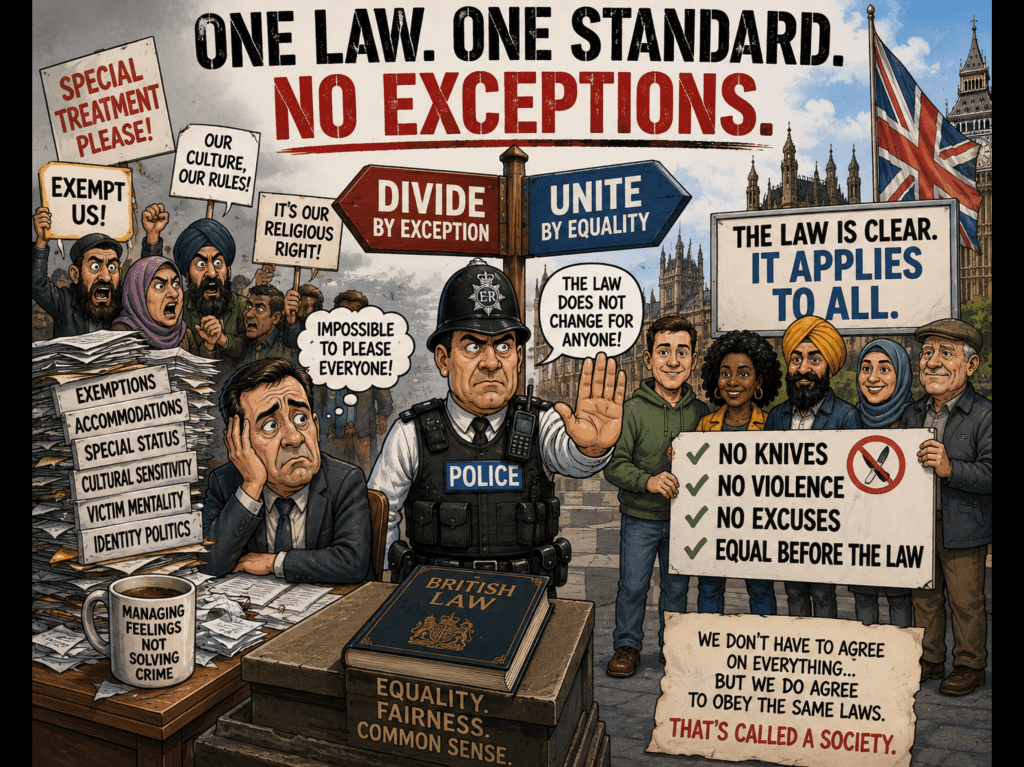
A society begins to fracture when people believe the rules no longer apply equally to everyone. No matter how diverse a country becomes, public trust depends on a simple expectation: that the law is enforced fairly, consistently and without favour. When that principle is weakened, questions about fairness, privilege and unequal treatment quickly follow.
A successful society doesn’t require everyone to think the same way, worship the same way or live the same way. What it does require is a shared understanding that the law applies equally to everyone.
That principle matters because once exceptions begin to multiply, people inevitably start asking who gets special treatment and why.
If Parliament decides that carrying certain types of blades in public is prohibited, then that rule should apply consistently. If there are exemptions, they should be transparent, limited and capable of being justified to the wider public. Equality before the law cannot depend on which group has the loudest lobbyists or the greatest political influence.
The challenge facing Britain is not diversity itself. Most people have little interest in policing how their neighbours live their lives. The challenge is maintaining a sense of fairness while managing a society that has become increasingly diverse.
Many ordinary citizens feel that social change has been driven from the top down, often without meaningful public debate. They are then told that it is their responsibility to adapt to every new demand, expectation or sensitivity that emerges along the way.
That expectation creates resentment because no society can realistically accommodate every belief, every cultural practice and every competing demand simultaneously.
The answer is not to abandon multiculturalism, nor is it to demand cultural conformity.
The answer is a simple principle: equal rights, equal responsibilities and equal application of the law.
Anything less risks creating the perception that some people are more equal than others. A free and fair society can endure differences of culture, belief and background, but it cannot endure different standards of justice. One nation means one law, applied equally to everyone.


 Chameleon Magazine
Leave a comment