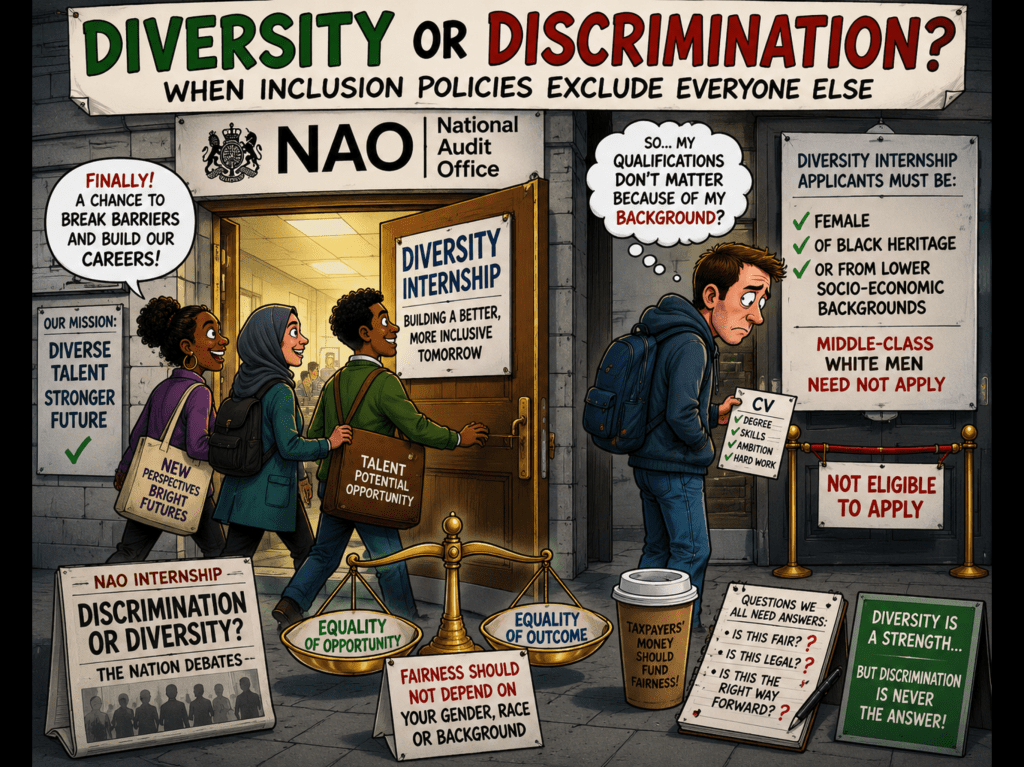
A taxpayer-funded internship designed to increase diversity has sparked accusations of discrimination after reports emerged that certain groups were effectively excluded from applying.
According to the job advert highlighted online, the National Audit Office (NAO) stated that applicants for its diversity internship programme must come from specific backgrounds, including women, people of Black heritage, or those from lower socio-economic backgrounds.
The goal, according to the advert, was to attract a more diverse pool of talent into the accounting and audit professions.
On paper, that sounds like a reasonable objective.
But critics argue that the policy raises a difficult question.
Can you fight discrimination by creating new forms of exclusion?
🚪 The Diversity Door That Doesn’t Open for Everyone
The controversy centres on who cannot apply.
If a white male applicant from a middle-class background possesses the same qualifications, ambition and potential as everyone else, should he be automatically excluded from consideration?
Supporters of targeted diversity programmes argue that historic inequalities continue to affect opportunities and representation in many professions. They see such schemes as corrective measures designed to level an uneven playing field.
Critics see something else.
They argue that public sector organisations funded by taxpayers should judge applicants on merit alone, regardless of race, sex or background.
To them, replacing one form of preference with another simply creates a new problem while claiming to solve an old one.
The result is a debate that quickly moves beyond internships and into a broader national conversation about fairness itself.
⚖️ Equality of Opportunity or Equality of Outcome?
This is where opinions sharply divide.
One side believes targeted programmes are necessary because traditional recruitment systems often favour those who already possess advantages.
The other believes that true equality means applying exactly the same standards to everyone.
No special treatment.
No exclusions.
No categories.
Just ability and merit.
The difficulty for policymakers is that both arguments contain elements many people find persuasive.
And that’s why these stories generate such strong reactions whenever they appear.
🤯 The Question Nobody Can Avoid
The real issue may not be the internship itself.
It may be whether modern diversity policies have become so focused on group identity that they sometimes overlook the individuals standing in front of them.
Most people support fairness.
Most people support opportunity.
Most people support widening access.
The disagreement begins when deciding how those goals should be achieved.
And that’s where the argument is unlikely to disappear anytime soon.
🔥 Challenges 🔥
Should publicly funded organisations ever restrict applications to specific demographic groups?
Does targeted recruitment create fairness, or does it simply shift discrimination from one group to another?
Drop your thoughts in the blog comments. 💬👇
Should jobs and internships be based solely on merit, or do diversity programmes still have an important role to play?
👍 Like, comment and share if you think this debate deserves more public scrutiny.
🏆 The best comments will be featured in the next issue of the magazine.


 Chameleon Magazine
Leave a comment