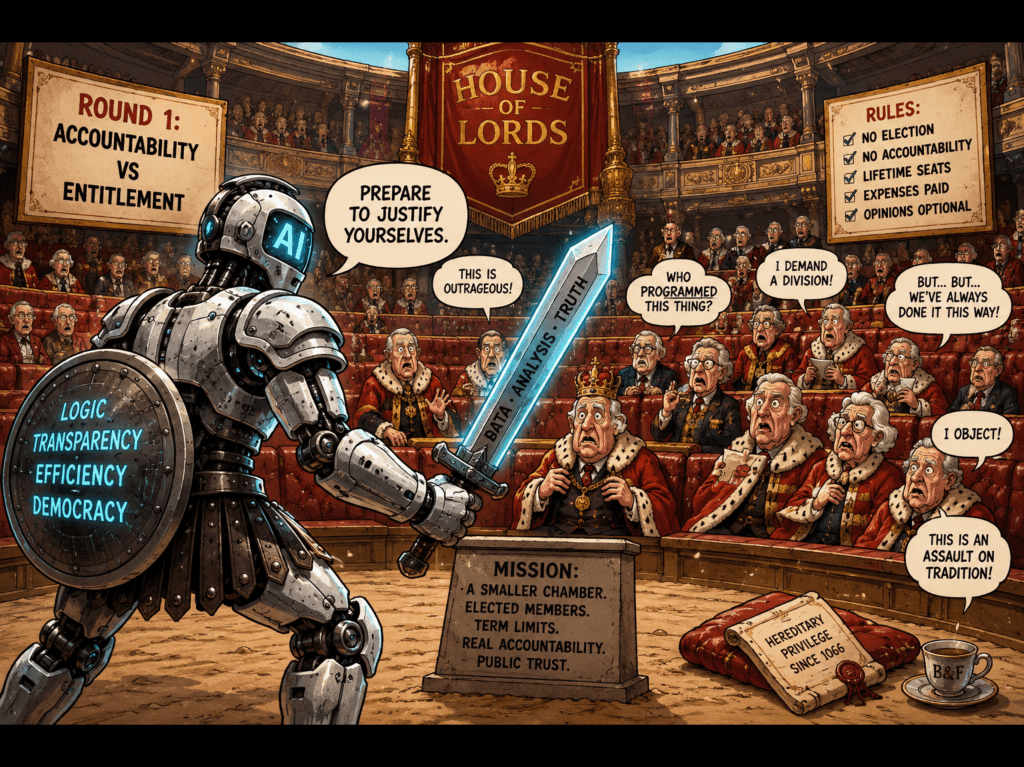
The Government keeps telling us artificial intelligence will revolutionise Britain. Better decisions. Better productivity. Better government. So someone finally gave AI a proper British challenge: examining the House of Lords without first being invited to join it. The result? A surprisingly polite demolition of one of Westminster’s oldest institutions. 🏛️💥
🎩 Hundreds of Lords Walk Into an Algorithm… The Algorithm Isn’t Impressed
For centuries, the House of Lords has operated on a fascinating principle: if enough time passes, people stop asking why something exists. 🤔
AI approached the institution like an accountant discovering a warehouse full of ornamental paperweights claiming travel expenses.
To be fair, it found genuine strengths. Many peers bring expertise from law, medicine, science, business and public service. They scrutinise legislation in detail and often focus on long-term consequences rather than whatever outrage is trending on social media this week. 📚⚕️⚖️
Then came the awkward bit.
The machine noticed that people helping shape laws for 68 million citizens are mostly people those citizens never elected.
No public vote.
No democratic removal.
No accountability at the ballot box.
Just a remarkable confidence that being appointed is basically the same thing as being chosen. 🎯
The AI then wandered into another constitutional minefield: size.
Britain’s second chamber contains hundreds upon hundreds of members. Some work hard. Some contribute occasionally. Some seem to operate under a rare parliamentary condition known as “professional attendance.” 💷🍽️
The question that kept surfacing was brutally simple:
How many lawmakers does Britain actually need?
Apparently fewer than currently required to fill what resembles the world’s most expensive alumni association.
Rather than calling for abolition, the AI proposed something Westminster fears almost as much as transparency: reform.
✅ Smaller chamber.
✅ Fixed membership.
✅ Retirement ages.
✅ Term limits.
✅ Transparent appointments.
✅ Democratic accountability.
In other words, keep the brains, lose some of the baggage.
The most uncomfortable finding wasn’t the conclusion itself. It was the method.
The AI had no party donors to please.
No political faction to protect.
No future peerage to collect.
No expense claims to defend.
It simply looked at the structure and asked whether it still made sense.
And suddenly one of Britain’s oldest institutions looked less like a pillar of democracy and more like a software update that never quite installed. 🔄🏛️
Perhaps that’s AI’s greatest threat to politics.
Not replacing politicians.
Not replacing democracy.
Just forcing people to explain systems they’ve stopped questioning decades ago.
That conversation may prove far more disruptive than any robot uprising. 🤖🔥
🔥 Challenges 🔥
If AI can identify obvious contradictions in institutions that have existed for centuries, why haven’t our political leaders done the same? Is the House of Lords a valuable safeguard, an outdated relic, or something in between?
Drop your thoughts in the blog comments. 💬
Would you keep it, reform it, elect it, shrink it—or scrap it altogether? Tell us what Westminster gets right, what it gets wrong, and what AI might spot next. 👇
🚨 Like, comment and share if you think government should be subjected to the same efficiency reviews as everyone else.
🏆 The best comments, hottest takes and sharpest observations will be featured in the next issue of the magazine.


 Chameleon Magazine
Leave a comment