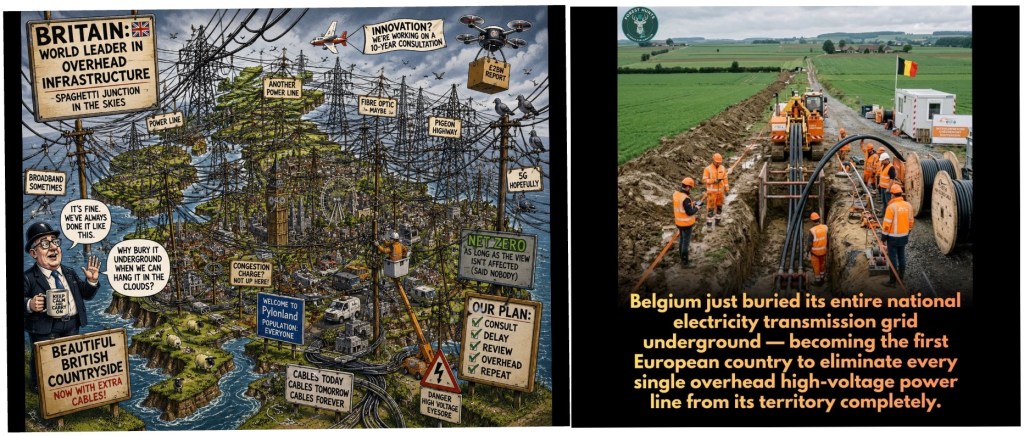
While other nations quietly modernise their infrastructure, Britain has perfected a different skill entirely: holding public consultations, commissioning reports, and then building things exactly the same way they were built fifty years ago.
Take electricity transmission.
Across Europe, countries are increasingly investing in underground power infrastructure, recognising that modern grids must balance reliability, resilience, environmental concerns, and public acceptance. Meanwhile, Britain continues to march steel pylons across countryside, farmland, villages and beauty spots as if the answer to every energy challenge is simply “build more towers.”
It’s a curious national habit.
We admire innovation.
We celebrate technological breakthroughs.
We host conferences discussing the future.
Then we install the future using methods that would be instantly recognisable to engineers from the last century. 🤔
🌍 Learning From Others? That’s Not Very British
The world’s most successful nations rarely become successful by assuming they already know everything.
They observe.
They adapt.
They copy what works.
They improve upon it.
That’s how technology advances.
Yet Britain often behaves as though every challenge requires a uniquely British solution, even when other countries have already solved the problem.
When nations invest in cleaner transport systems, smarter energy networks, advanced manufacturing, or modern infrastructure, the sensible response is to study the results and ask:
“What can we learn?”
Instead, we frequently ask:
“Why can’t we just carry on doing what we’ve always done?”
The answer, of course, is because the world isn’t standing still. 🌎⚡
🔌 The Sky Is Getting Crowded
Look across the British landscape and you’ll find an endless collection of cables, poles, pylons and transmission infrastructure stretching from horizon to horizon.
For decades this was accepted because there were few alternatives.
Today, technology has evolved.
Materials have improved.
Engineering has advanced.
Installation techniques are more sophisticated than ever.
Yet vast sections of new infrastructure planning still begin with the assumption that the cheapest short-term option automatically represents the best long-term solution.
The result?
Communities object.
Campaigns emerge.
Projects become delayed.
Costs escalate.
Arguments rage for years.
Everyone loses except the consultants writing another report. 📑💰
🚧 Cheap Today, Expensive Tomorrow
The real debate isn’t simply about burying cables underground.
It’s about national ambition.
Do we build infrastructure designed merely to survive the next election cycle?
Or do we build infrastructure designed to serve the next generation?
Politicians often focus on initial costs because those numbers fit neatly into headlines.
The public, however, lives with the consequences for decades.
A pylon lasts generations.
A transmission route shapes landscapes permanently.
Once built, these decisions become part of Britain’s physical identity.
Which raises an uncomfortable question:
Why are we so often willing to spend billions fixing yesterday’s problems, but reluctant to invest properly in tomorrow’s solutions?
🏗️⚡🌳
🏛️ Britain’s Real Infrastructure Problem
Perhaps Britain’s biggest infrastructure challenge isn’t engineering at all.
Perhaps it’s mindset.
Too often we approach technological change with caution bordering on paralysis.
We debate.
We review.
We consult.
We delay.
Then we wonder why other nations appear to move faster.
Learning from others isn’t weakness.
It’s intelligence.
Every technological breakthrough in human history has involved borrowing ideas, refining them, and making them better.
The countries that thrive are rarely those that insist on reinventing every wheel.
They’re the ones willing to recognise when somebody else has already built a better one. 🔄💡
⚡ The Future Doesn’t Hang Around
Britain faces enormous challenges in energy, transport, housing, digital connectivity and economic competitiveness.
Meeting those challenges will require more than speeches and strategy documents.
It will require a willingness to embrace the best ideas available—regardless of where they originate.
The rest of the world is experimenting, innovating and upgrading at remarkable speed.
The question is whether Britain intends to join them.
Or whether we’ll continue filling the skies with ever more pylons while wondering why everyone else seems to be building the future beneath their feet.
🔥 Challenges 🔥
Should Britain be investing more heavily in underground infrastructure and learning from successful projects abroad?
Are pylons a necessary reality of modern energy networks, or evidence that we’re still solving twenty-first-century problems with twentieth-century thinking?
We want your view.
💬 Comment below on the blog.
⚡ Like it if you agree.
📢 Share it if you think Britain needs to think bigger.
🔥 Challenge it if you think we’re completely wrong.
The best comments, strongest arguments and sharpest observations will be featured in the next issue of the magazine.


 Chameleon Magazine
Leave a comment