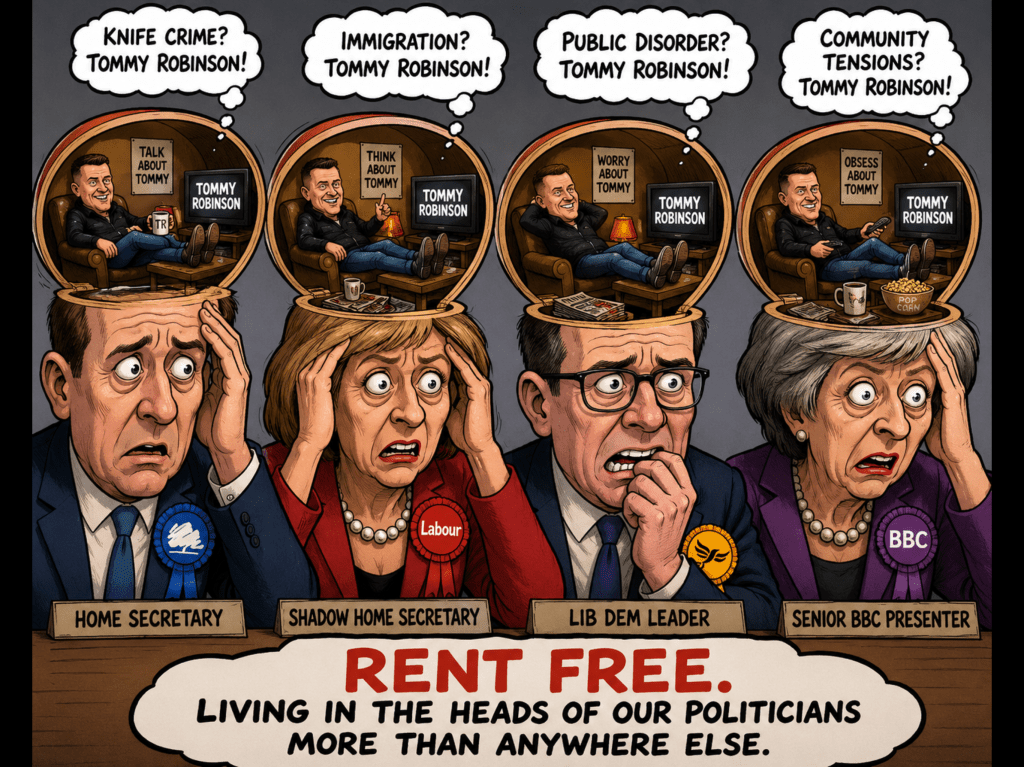
Apparently, Britain faces many challenges, but if you listen closely to parts of the political and media establishment, you’d be forgiven for thinking there’s only one name worth discussing: Tommy Robinson.
Knife crime surges? Tommy Robinson. Public disorder? Tommy Robinson. Community tensions? Tommy Robinson. Immigration concerns? Tommy Robinson.
The sheer versatility is remarkable. Forget detectives, criminologists, police forces, or courts. Why investigate actual offenders when one controversial activist can apparently be blamed for every social ill from Cornwall to Carlisle? 🤷♂️
🎪 Welcome to Britain’s Favourite Political Magic Show
The modern political debate increasingly resembles a stage performance.
A pensioner is attacked. A gang terrorises a neighbourhood. Someone is left fighting for their life after a violent assault. Yet somehow the conversation takes a scenic detour and ends up discussing the same individual yet again.
The way some politicians talk, you’d think Tommy Robinson personally committed every offence recorded in Britain over the last decade. Not the criminals. Not the gangs. Not the violent offenders actually standing in courtrooms. Just Tommy Robinson.
In fact, Tommy Robinson appears to live in the heads of our politicians more than he does anywhere else. 🧠🏛️ Every road somehow leads back to him. Every debate eventually lands on him. Every discussion about public safety seems to come with a compulsory reference to him. Meanwhile, the people actually committing crimes must be wondering how they managed to become supporting actors in a story where Tommy Robinson gets top billing.
Meanwhile, ordinary people are asking an awkward question that rarely seems to get answered:
“Can we talk about the people who actually committed the crime?”
Because regardless of what anyone thinks of Tommy Robinson, most people are generally more concerned about today’s violent offenders than a man who appears to occupy more space in political speeches than he does on the streets.
The whole thing increasingly feels like a magician’s trick. 🎩✨
“Don’t look over there,” says the performer, waving frantically at the distraction.
And while everyone is being instructed where to focus their attention, many are left wondering what might be happening behind the curtain.
The more politicians obsess over one controversial figure, the more people begin to suspect that the conversation politicians want to have is very different from the conversation the public wants to have.
That’s where the real tension lies.
Because people tend to notice when the issues they’re worried about are repeatedly replaced with discussions they’d never asked to have in the first place.
🔥 Challenges 🔥
Are politicians discussing the issues that concern ordinary people, or are they talking past them? 🤔
Why does public debate so often circle back to the same personalities instead of focusing on the individuals responsible for crimes and violence?
Has Britain become so distracted by political narratives that discussing actual offenders has become secondary to discussing political symbols?
💬 We want to hear your view. Is Tommy Robinson genuinely the centre of Britain’s problems, or has he simply become the go-to answer for politicians who’d rather avoid harder conversations?
👇 Like, comment, and share if you think public conversations should focus on the issues that matter most.
🏆 The best comments, observations, and counterarguments will be featured in the next issue of the magazine.


 Chameleon Magazine
Leave a comment