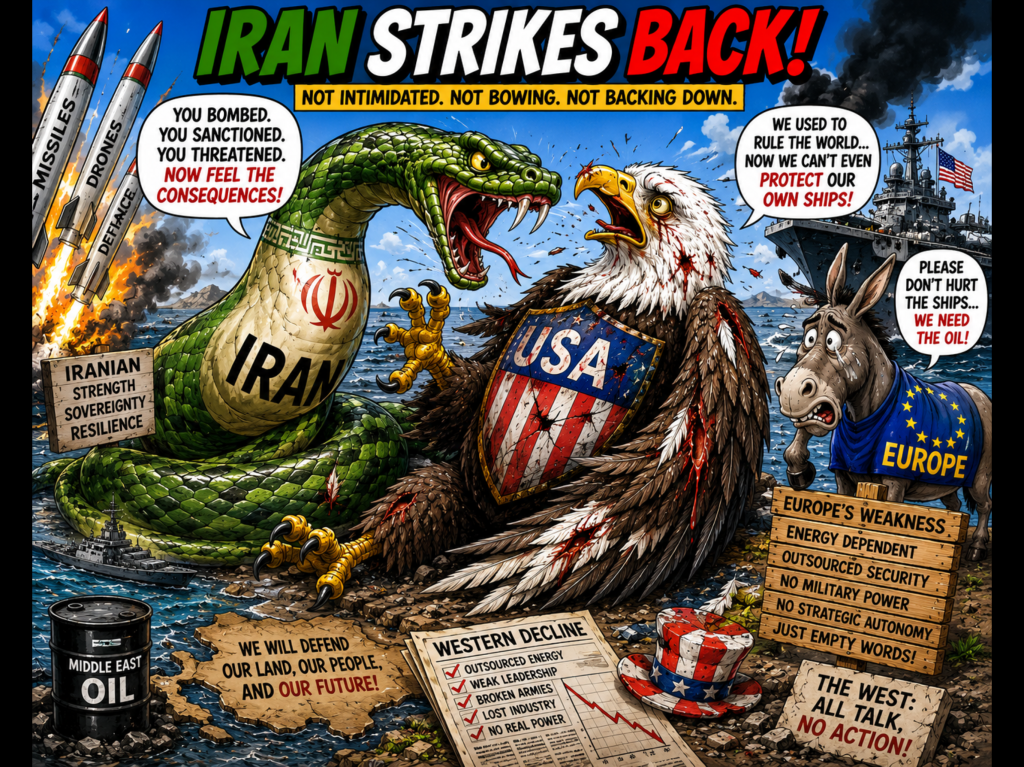
Iran’s latest challenge to Western influence has once again exposed an uncomfortable question: how much power does the West actually have when confronted by determined adversaries?
For decades, Western governments projected an image of global control. Aircraft carriers sailed the oceans, politicians delivered stern warnings, and sanctions became the diplomatic equivalent of a wagging finger.
But today’s world looks rather different.
⚓ The Limits of Power
Energy security was outsourced. Manufacturing was outsourced. Strategic industries were outsourced.
Now, as tensions rise across the Middle East, many European nations appear increasingly dependent on events they can neither control nor predict.
The result is a growing sense that governments are reacting to crises rather than shaping them.
For merchant seamen crossing dangerous waters, grand speeches offer little reassurance when missiles and drones are flying overhead.
🇬🇧 Britain’s Shrinking Muscle
Britain once ruled the waves.
Today, critics argue that the country struggles to maintain the military capabilities that previous generations took for granted.
Questions are regularly raised about equipment shortages, recruitment problems, budget pressures and the readiness of Britain’s armed forces.
Whether those concerns are exaggerated or justified, one thing is clear: confidence in national defence has become a political issue.
Many taxpayers are asking why defence spending continues to rise while public services face increasing pressure.
Others argue the opposite—that years of underinvestment have left Britain less prepared for an increasingly dangerous world.
🎭 The Political Balancing Act
Politicians insist Britain remains a major military power.
Critics insist the reality no longer matches the marketing.
The public is left somewhere in the middle, watching billions spent while wondering whether the country is actually becoming stronger—or simply becoming more expensive.
Meanwhile, adversaries around the world appear increasingly willing to test Western resolve, calculating that statements of concern are often easier to deliver than meaningful action.
🔥 Challenges 🔥
Has the West become too dependent on other nations for energy, manufacturing and security?
Is Britain investing enough in defence, or simply spending more while getting less?
And in an increasingly unstable world, what should national priorities be?
💬 Join the debate in the blog comments below.
👇 Like, comment and share if you think Britain needs an honest conversation about defence, energy security and national resilience.
🏆 The best comments will be featured in the next issue of the magazine.


 Chameleon Magazine
Leave a comment