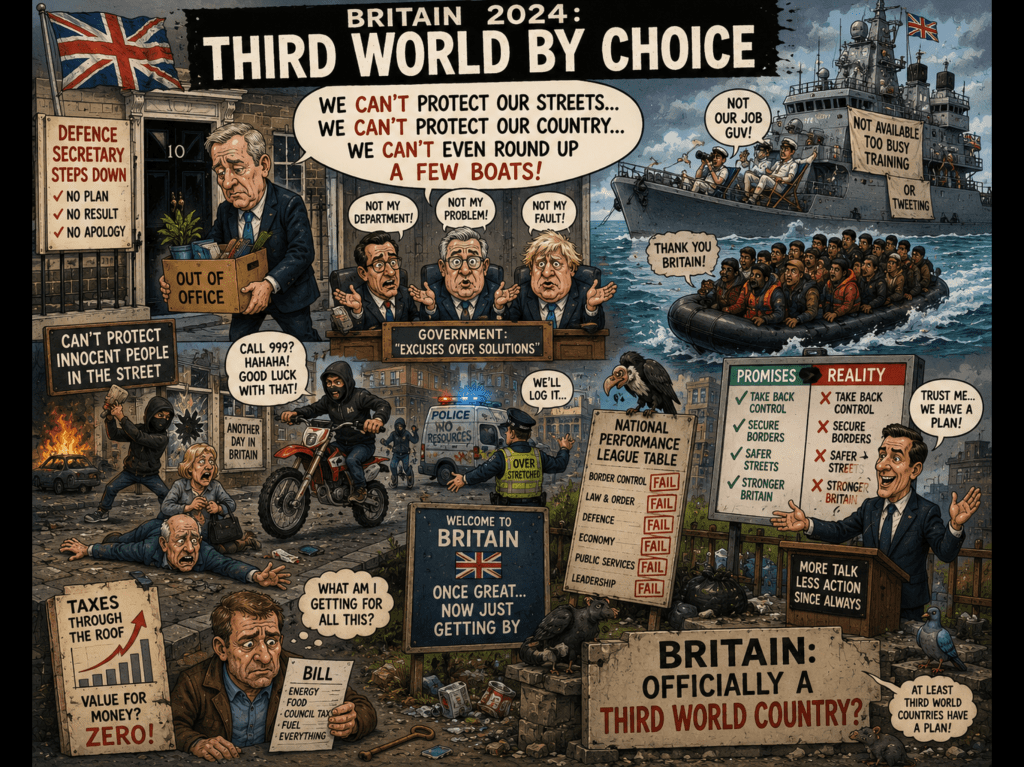
There was a time when Britain projected strength.
Whether you agreed with the decisions being made or not, there was at least a belief that the country could protect its borders, defend its interests and maintain basic order.
Today, many people are beginning to wonder whether Britain can organise a queue at a bus stop without commissioning a six-month consultation first.
The latest political drama sees yet another Defence Secretary stepping aside while the country continues to wrestle with problems that seem to grow faster than politicians can produce excuses for them.
The public looks around and sees streets where people no longer feel as safe as they once did. They see illegal migration continuing to dominate headlines year after year.
They see small boats crossing the Channel despite endless promises that the situation is under control.
Most of all, they see politicians repeatedly announcing plans, strategies, frameworks and taskforces while the problems themselves stubbornly refuse to disappear.
And that’s where the frustration comes from.
Britain isn’t suffering from a shortage of speeches.
Britain isn’t suffering from a shortage of press conferences.
Britain isn’t suffering from a shortage of politicians congratulating themselves.
What many people believe Britain is suffering from is a shortage of results.
Every government arrives promising action.
Every minister promises control.
Every department promises reform.
Then somehow the public ends up exactly where it started—except poorer, more frustrated and listening to a different politician explain why none of it is their fault.
The immigration debate perfectly captures the problem.
For years, the public has been told that measures are being taken, systems are improving and progress is being made. Yet every year the issue returns, dominating political debate once again.
At some point people stop listening to promises and start judging outcomes.
And the outcomes are what many voters find increasingly difficult to defend.
The uncomfortable question hanging over Westminster is this:
What exactly are taxpayers receiving in return for one of the largest tax burdens in modern British history?
Because people can see public services under pressure.
They can see infrastructure struggling.
They can see defence budgets being debated.
They can see politicians arguing.
What they struggle to see is competence.
That may sound harsh, but it reflects a growing mood among many voters who increasingly feel that Britain excels at managing decline while pretending it’s delivering progress.
The country that once built ships, industries and institutions now seems trapped in endless discussions about why things cannot be done.
We can’t do that.
We can’t afford this.
We can’t stop that.
We can’t change this.
The word “can’t” has become the unofficial slogan of modern government.
And that is why the phrase “third world Britain” is gaining traction in some political discussions—not because Britain literally resembles a developing nation, but because many people feel the standards they were promised no longer match the reality they experience.
When citizens lose confidence that their leaders can solve basic problems, frustration inevitably follows.
The real danger isn’t opposition criticism or newspaper headlines.
The real danger is public resignation.
The moment people stop believing problems can be fixed is the moment trust begins to collapse.
And trust, once lost, is far harder to rebuild than any policy announcement, government strategy or ministerial reshuffle.
🔥 Challenges 🔥
Do Britain’s political leaders spend too much time managing headlines and not enough time delivering results?
Has public confidence in government competence reached a new low?
And what single issue do you think best symbolises the decline—or resilience—of modern Britain?


 Chameleon Magazine
Leave a comment