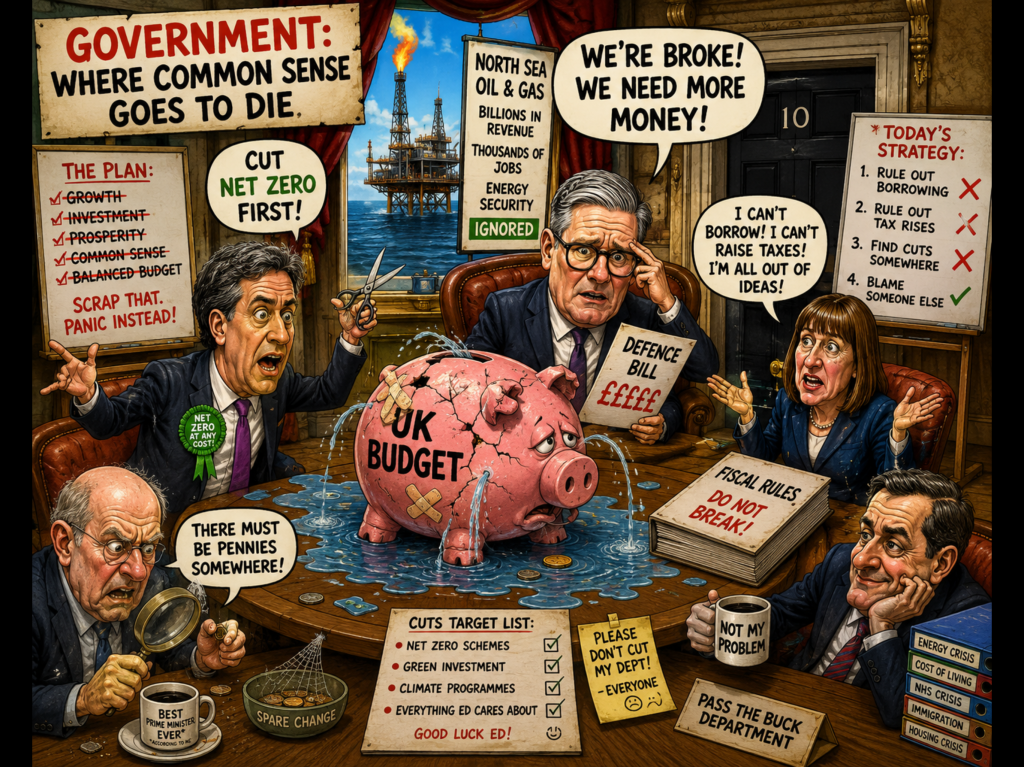
💥🏛️Labour promised stability, competence and a fresh start. Instead, Westminster is beginning to resemble a family argument over Christmas dinner, except nobody knows who’s paying the bill and the turkey has already been sent to Ukraine. 🍽️💸
As pressure mounts to increase defence spending, reports suggest tensions between Sir Keir Starmer and Ed Miliband have reached boiling point. With departments ordered to find fresh savings and net zero budgets reportedly first in the firing line, Labour’s carefully choreographed unity is starting to look more like a cabinet-wide cage fight. 🥊⚡
🔥 The Treasury’s Great Money Hunt: Searching Down the Sofa While Sitting on an Oil Field🔥
One minute ministers are promising growth, investment and national renewal. The next, they’re rifling through departmental budgets looking for spare change to plug a defence spending hole. 🛋️💰
The Prime Minister reportedly wants departments to find capital spending cuts of at least 1 per cent. Sounds simple enough—until every minister insists their spending is essential while somebody else’s is a waste of taxpayers’ money.
Enter Ed Miliband. 🌍⚡
Having spent years presenting net zero as Britain’s great economic mission, he now finds himself watching those same green programmes reportedly line up for the chopping block. Nothing says cabinet solidarity quite like discovering your flagship policy has become the Treasury’s emergency cash machine.
Meanwhile, Rachel Reeves appears trapped in a financial escape room designed by her own fiscal rules. Borrowing? No. Tax rises? Apparently not. Spending cuts? Politically painful. Somewhere in Whitehall, a senior official is probably trying to fund Britain’s defence budget with Clubcard points and a forgotten Costa loyalty card. ☕🎟️
Of course, there is one rather awkward question hanging over the entire debate: if Britain is so desperate for revenue, why is the government refusing to fully embrace the resources sitting beneath its own waters? 🛢️🇬🇧
Supporters of North Sea oil and gas expansion argue that opening new fields could generate billions in investment, create thousands of jobs, boost energy security and deliver substantial tax revenues that could help fund defence, public services and infrastructure projects. Instead, ministers seem determined to search every departmental cupboard for loose coins while ignoring one of the country’s most valuable potential sources of income.
It’s a bit like pawning the television because you’ve decided never to open the safe in the next room. 📺🔨
The whole spectacle raises an uncomfortable question. If borrowing is forbidden, taxes cannot rise, spending cannot be cut and domestic energy resources remain off limits, exactly where is the money supposed to come from?
A hidden vault beneath Downing Street? A National Lottery jackpot? The proceeds from selling ministerial promises on eBay? 🎰🤔
What began as rumours of cabinet disagreement is rapidly starting to resemble a full-scale ideological war. On one side sits Miliband’s green agenda. On the other sits the harsh reality that governments eventually have to pay for the promises they make.
And as ministers wrestle over shrinking budgets, voters may be wondering whether anyone actually has a plan beyond moving money from one crisis to another. 📉🚨
💬 Challenges 💬
Should Britain expand North Sea oil and gas production to generate extra revenue and strengthen energy security?
Should net zero spending be protected at all costs, or should defence take priority in an increasingly dangerous world?
And perhaps most importantly: why does it feel like ordinary taxpayers are always expected to tighten their belts while Westminster searches for ever more creative ways to avoid difficult decisions?
🔥 Tell us what you think in the blog comments.
👇 Hit comment, hit like and hit share.
🎯 The sharpest observations, funniest put-downs and strongest arguments will be featured in the next issue of the magazine.


 Chameleon Magazine
Leave a comment