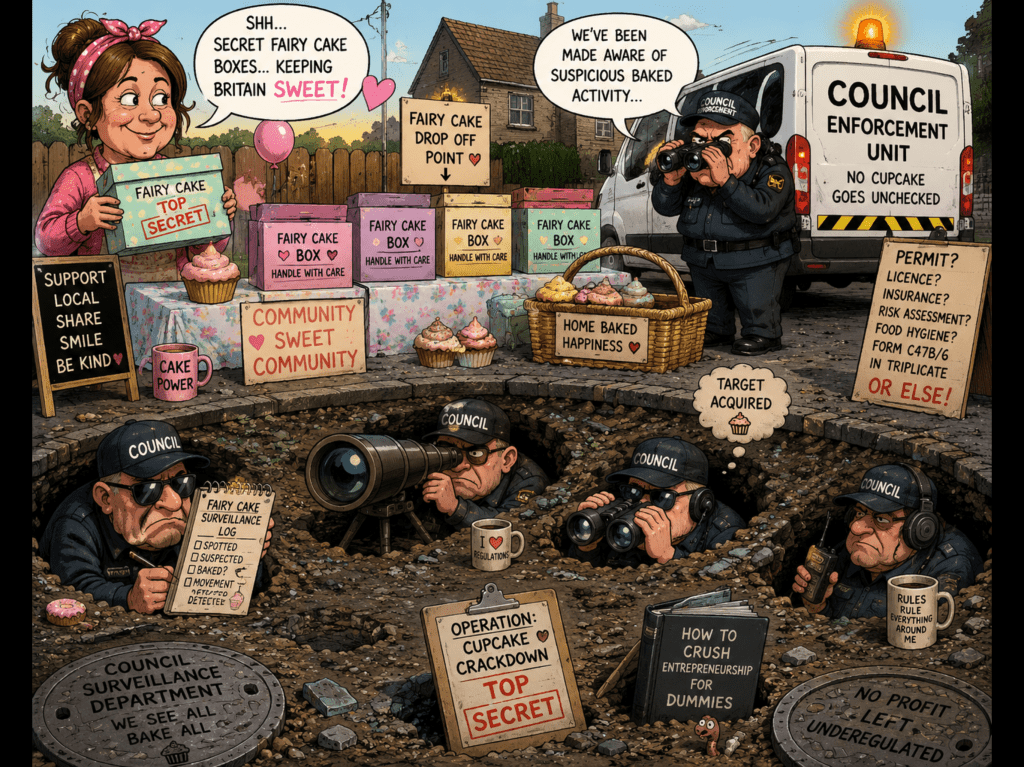
🚔🍰There was a time when Britain’s success story began with little more than a kitchen table, a bright idea and somebody willing to work harder than everyone else. The local bakery wasn’t born from a council committee. The family business didn’t emerge from a government strategy document. The successful entrepreneur didn’t begin their journey after attending a three-day compliance seminar hosted by a local authority.
They started small.
They started with courage.
And most importantly, they started without asking permission from half a dozen bureaucrats who had never risked a penny of their own money.
Fast forward to modern Britain and it feels as though the moment somebody attempts to earn an honest extra pound, the community-killer councils descend like a scene from a low-budget mafia movie.
Some poor soul decides to sell a few fairy cakes to help with the bills and suddenly the council mafia reacts as though they’ve uncovered the headquarters of an international criminal organisation. Somewhere, a clipboard is being polished. Somewhere, a high-visibility jacket is being zipped up with excitement. Somewhere, an official who couldn’t organise a raffle at a church fête is preparing to explain why your homemade cupcakes represent a serious threat to public order.
The absurdity would be hilarious if it wasn’t so familiar.
What makes people angry isn’t simply the bureaucracy itself. It’s the fact that the bureaucracy always seems to appear when ordinary people start showing signs of independence.
Councils can spend months ignoring problems that genuinely affect communities. Potholes become archaeological landmarks. Empty shops become permanent features of the high street. Antisocial behaviour gets treated like an unsolvable mystery. Yet let somebody start a small side hustle and suddenly the machinery of officialdom roars into life with astonishing efficiency.
That is why more and more people are looking for ways to support one another directly, using technology, community networks and local connections to help small enterprises grow without being smothered under endless layers of interference. If councils are unwilling to encourage entrepreneurship, people will inevitably find ways to encourage each other.
After all, councils have hardly demonstrated a masterclass in management themselves. Across the country many authorities are drowning in debt. Streets suffer from litter problems that never seem to improve. Residents complain about missed collections, neglected services and declining town centres. Yet despite these failures, there never seems to be a shortage of time, resources or enthusiasm when it comes to inserting themselves into somebody else’s attempt to earn an honest living.
And that is where the resentment comes from.
The people baking the cakes are taking the risks.
The people baking the cakes are putting in the hours.
The people baking the cakes are creating something from nothing.
The council isn’t.
Yet somehow it is always the entrepreneur who ends up under the microscope.
When did we become a country where initiative is treated with suspicion and bureaucracy is treated as a virtue?
Because for many people, the behaviour of modern local government increasingly feels less like public service and more like a protection racket. Make it difficult to dispose of waste, then complain about fly-tipping. Allow problems to build for years, then charge taxpayers even more to solve them. Create obstacles, then offer to remove those same obstacles for a fee.
It is little wonder that so many people have become cynical.
The fairy cakes were never really the issue.
The issue is control.
The issue is interference.
The issue is a system that appears far more comfortable managing decline than encouraging independence.
And every time a council swoops in on a tiny enterprise while larger problems continue unchecked, more people are left wondering whether Britain’s entrepreneurs are being treated as an asset to be encouraged—or a threat to be contained.
🔥Challenges🔥
Have councils become champions of local enterprise, or obstacles to it?
Why does it often feel easier to navigate a maze than a local authority?
And how many future businesses never get off the ground because somebody decides the bureaucracy simply isn’t worth the trouble?
💬 Tell us your thoughts in the blog comments.
👇 Like, comment and share.
🏆 The best comments will be featured in the next issue of the magazine.


 Chameleon Magazine
Leave a comment