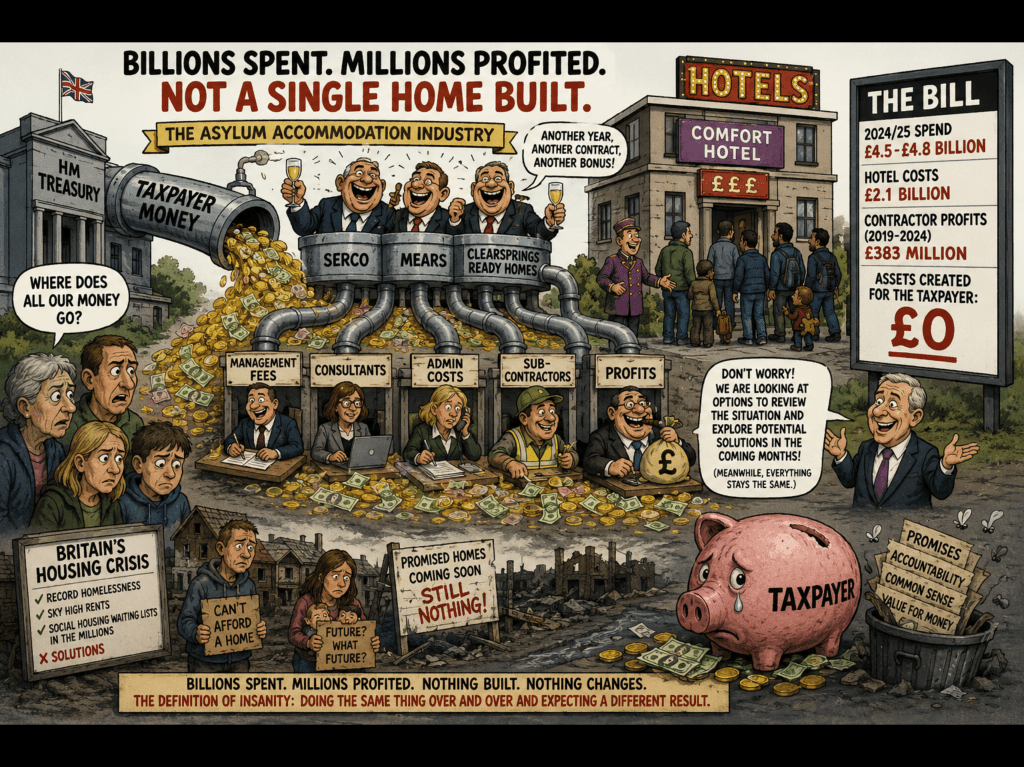
🏨💸🏗️Britain has pulled off a feat so spectacular it deserves a place in the history books. Not for innovation. Not for efficiency. Not even for competence. No, Britain has somehow mastered the art of spending billions of pounds while ending up with virtually nothing to show for it.
The money has certainly gone somewhere. Hotels have been filled. Contractors have been paid. Consultants have consulted. Managers have managed. Administrators have administrated. Everyone involved seems to have found a comfortable seat at the table.
Everyone except the taxpayer.
The very people who paid for the feast are now standing outside the restaurant, peering through the window, wondering where their money actually went. 🍽️💷
🚧The Invisible Housing Development of Doom
Imagine hiring a builder to construct your dream home.
Five years later he arrives wearing a fluorescent jacket, carrying a clipboard, and smiling proudly.
“Good news,” he says. “Every penny has been spent.”
“Fantastic,” you reply. “Where’s the house?”
There is no house.
“What assets do I own?”
None.
“What exactly did I pay for?”
Everyone got paid.
At this point most people would contact the police.
Westminster calls it policy. 🤷♂️🏛️
The truly astonishing part is that this arrangement continues to be presented as perfectly rational governance. Britain has spent housing-level money without creating housing-level housing. Instead of building publicly owned homes that could serve communities for decades, we’ve effectively rented a national headache at premium rates.
It’s the political equivalent of leasing umbrellas forever rather than repairing the leaking roof. ☔🏚️
Every year the same assurances arrive wrapped in fresh packaging.
The accommodation is temporary.
The costs are temporary.
The crisis is temporary.
Yet this “temporary” solution has now outlasted some marriages, television careers, football managers, and government ministers. 📺😂
Meanwhile the housing shortage remains.
The backlog remains.
The bills remain.
The taxpayer remains.
Only the money disappears. 💸🎩
Now let’s be fair. Profit isn’t the villain here. Businesses exist to make money. Nobody is shocked when contractors earn a return.
The real question is far simpler.
Why has so much public money produced so little public value?
Had billions been invested in constructing homes, Britain would at least possess something tangible today. New housing stock. New community infrastructure. New public assets for future generations.
Instead, we’ve managed the remarkable achievement of spending reservoir money on bottled water. 🍼💰
And that’s where the debate becomes awkward.
This isn’t really a left-wing question.
It isn’t really a right-wing question.
It’s a value-for-money question.
If a family budget worked this way, relatives would stage an intervention.
If a business operated this way, shareholders would demand resignations.
Yet governments somehow glide past the most obvious question of all:
After spending billions of pounds…
What exactly do we own?
Because if the answer remains “almost nothing,” then perhaps the greatest mystery isn’t the asylum accommodation system itself.
It’s how an entire nation was convinced that spending billions while building nothing should be considered a success. 🎭💸
🔥Challenges🔥
Here’s the question many politicians seem desperate to avoid:
If billions have been spent, where is the lasting legacy? 🏗️
What should taxpayers reasonably expect after funding a system year after year? More temporary accommodation? More emergency contracts? More assurances that next year will finally be different?
We want to hear your view.
Should Britain have invested differently?
Should public spending create permanent assets?
Or is the current approach justified?
💬 Drop your thoughts in the blog comments below and join the debate.
👍 Like it.
🔄 Share it.
💥 Challenge it.
📝 Comment on it.
The sharpest comments, hottest takes, and most thought-provoking arguments could be featured in the next issue of the magazine. 🎯🔥


 Chameleon Magazine
Leave a comment