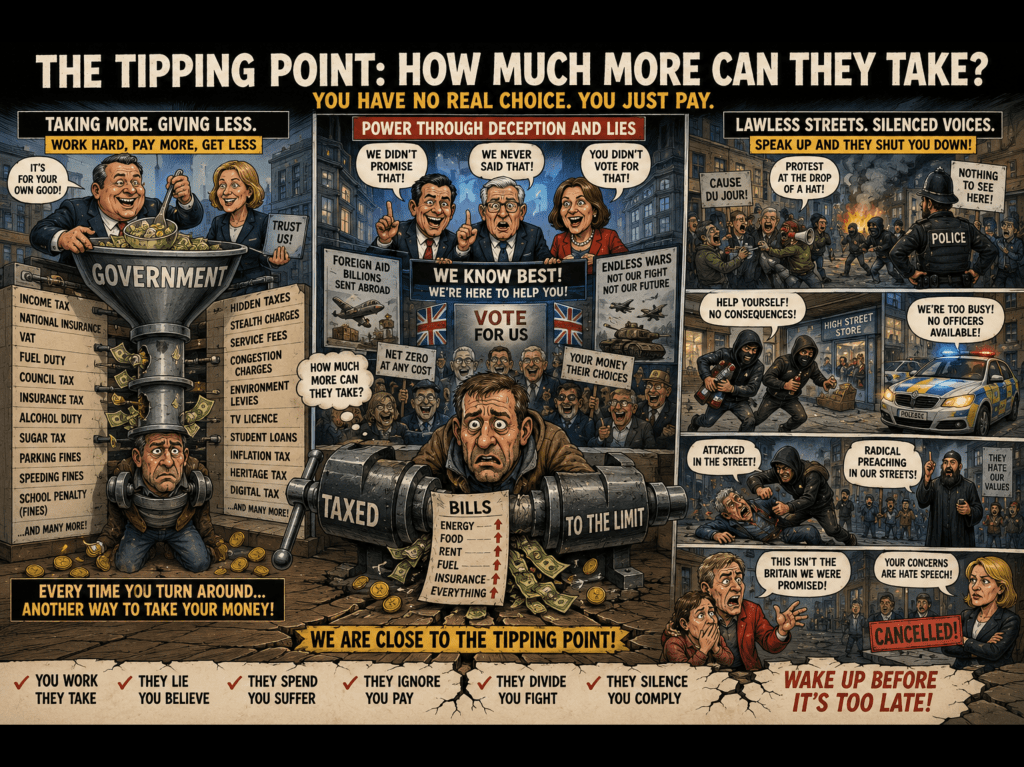
💷🔥Are you one of the millions of people working hard, paying your bills, paying your taxes and doing your best to stay afloat while watching politicians spend your money on priorities you never asked for and never voted for?
The political class constantly tells us we live in a democracy. They tell us elections matter. They tell us governments are accountable to the people. Yet increasingly, many voters look around and struggle to recognise the country they were promised.
Policies appear from nowhere.
Commitments are made that never appeared in election campaigns.
Billions are spent on projects, schemes and foreign commitments that many taxpayers feel they were never consulted about.
Then, when people question where their money is going, they’re often told they simply don’t understand the bigger picture.
The problem facing Britain today is that government is approaching what many people see as a tipping point.
Not a political tipping point.
A financial tipping point.
For decades governments have found new ways to extract more money from the public. Income tax. National Insurance. VAT. Fuel duty. Council tax. Insurance premium tax. Alcohol duties. Tobacco duties. Sugar taxes. Environmental levies. Parking fines. Speeding fines. Congestion charges. School attendance penalties.
The list never seems to get shorter.
Every year another charge appears.
Every year another fee is introduced.
Every year another explanation arrives telling us why it is absolutely necessary.
Politicians like talking about taxation as though it only exists on a payslip.
Most people know better.
The modern taxpayer is taxed when they earn money, taxed when they spend money, taxed when they save money and often taxed again when they try to pass anything on to their family.
Eventually a question begins to emerge.
How much is enough?
Because there comes a point where governments simply run out of people’s money.
Families can only absorb so many increases before something breaks.
Businesses can only tolerate so much pressure before investment dries up.
Workers can only watch their earnings disappear before they start questioning what exactly they are receiving in return.
And that brings us to another growing source of public frustration.
People don’t just see rising taxes.
They see declining confidence.
They see city centres where crime appears increasingly visible.
They see retail theft becoming so commonplace that videos of people walking out of shops with armfuls of goods barely make headlines anymore.
They see overstretched police forces struggling to respond to incidents that would once have received immediate attention.
They see protests, demonstrations and public disorder dominating the news cycle while ordinary residents feel their own concerns are pushed to the back of the queue.
Whether those perceptions are entirely accurate or not, they are increasingly shaping how people view the country around them.
Because citizens are generally willing to contribute when they believe the system is working.
The trouble begins when they feel they are paying more and receiving less.
More taxes.
More charges.
More regulation.
More promises.
But fewer results.
That is why so many people talk about a tipping point.
Not because Britain is about to collapse overnight.
But because trust, once eroded, becomes incredibly difficult to rebuild.
Governments can always introduce another tax.
They can always create another policy.
They can always make another promise.
What becomes much harder is convincing people that those sacrifices are delivering the country they were told they were paying for.
🔥Challenges🔥
Have governments reached the limit of what taxpayers are willing to tolerate?
Do you feel public services reflect the amount of money people contribute?
And what issue most makes you feel Britain has reached a tipping point?
💬 Tell us your thoughts in the blog comments.
👇 Like, comment and share.
🏆 The best comments will be featured in the next issue of the magazine.


 Chameleon Magazine
Leave a comment