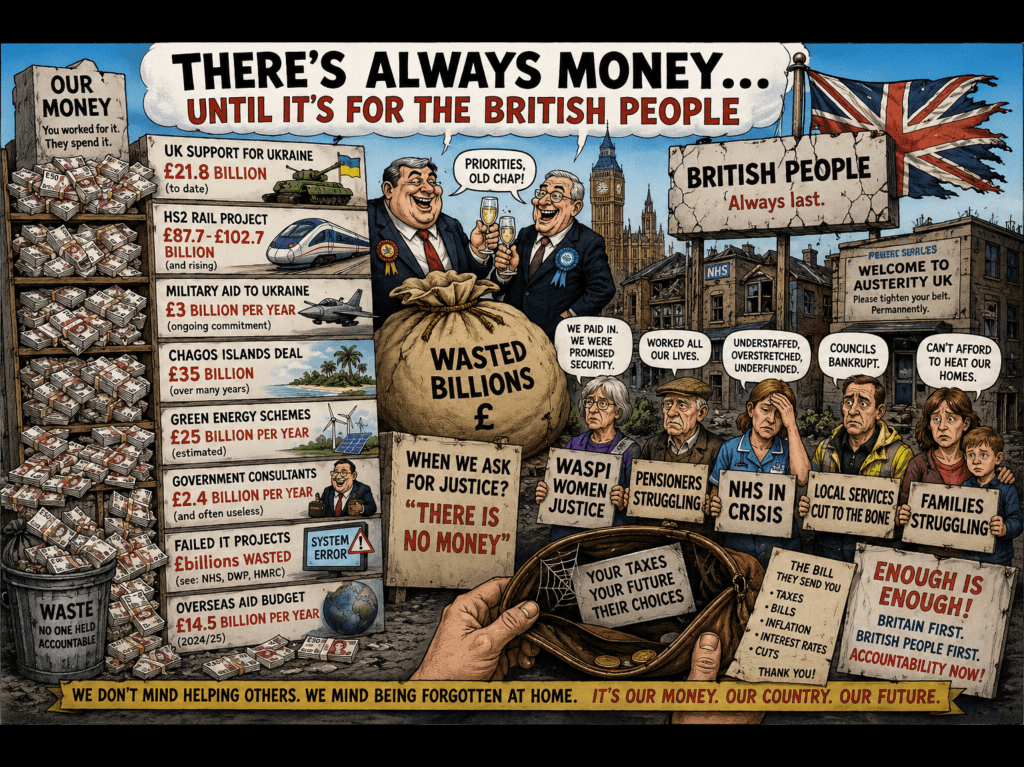
💷🇬🇧Every time British taxpayers ask for better public services, pension justice, functioning infrastructure, or compensation for government failures, they are met with the same response:
“There is no money.”
No money for this.
No money for that.
No money for the people who paid into the system all their lives.
Yet somehow, billions always seem available elsewhere.
💸
Let’s Talk About The Numbers
According to the UK Government and Parliament, Britain has committed up to £21.8 billion in support for Ukraine since 2022. Military, humanitarian and financial support continue to be pledged. (GOV.UK)
Meanwhile, the HS2 project, originally sold at around £32.7 billion, is now expected to cost between £87.7 billion and £102.7 billion, with completion delayed by many years. Government ministers themselves have described the project as suffering from years of mismanagement. (GOV.UK)
The UK has also committed £3 billion per year in military aid to Ukraine going forward, alongside additional funding arrangements and loans. (GOV.UK)
These are not small numbers.
They are measured in billions.
🎪The Curious Definition of “Unaffordable”
When governments spend £21.8 billion abroad, it is called leadership.
When a rail project exceeds £100 billion, it is called a challenge.
When procurement contracts overrun, it is called complexity.
When consultants, contractors, and failed schemes consume billions, it is called governance.
But when ordinary citizens ask for justice?
Suddenly every penny matters.
Every pound must be scrutinised.
Every request becomes “unaffordable.”
Funny how affordability only seems to appear when ordinary people are asking for something.
🇬🇧What Did We Actually Vote For?
Many voters are increasingly asking a simple question:
At what point do British citizens become the priority?
Not because international events do not matter.
Not because infrastructure does not matter.
But because governments appear capable of mobilising extraordinary sums of money when political will exists.
The argument is not that Britain should spend nothing abroad.
The argument is that taxpayers are entitled to ask why there always seems to be funding available for government priorities while basic domestic concerns are met with excuses.
📊A Few Comparisons
- Ukraine support committed: £21.8 billion. (GOV.UK)
- HS2 projected cost: up to £102.7 billion. (GOV.UK)
- Ongoing military aid commitment to Ukraine: £3 billion annually. (GOV.UK)
Yet citizens are repeatedly told:
❌ There is no money.
❌ Budgets are stretched.
❌ Tough choices must be made.
The public is left wondering why those tough choices always seem to fall on them.
🔥Challenges🔥
Do you believe government spending reflects the priorities of ordinary British taxpayers?
Are politicians spending money on the things voters actually care about?
What projects, policies, or commitments do you think represent the biggest waste of public money?
Tell us in the blog comments. No spin. No slogans. Just facts, figures, and your opinion. 💬⚡
👇 Like, comment, and share if you believe taxpayers deserve greater transparency about where their money goes.
🏆 The best comments will be featured in the next issue of the magazine.


 Chameleon Magazine
Leave a comment