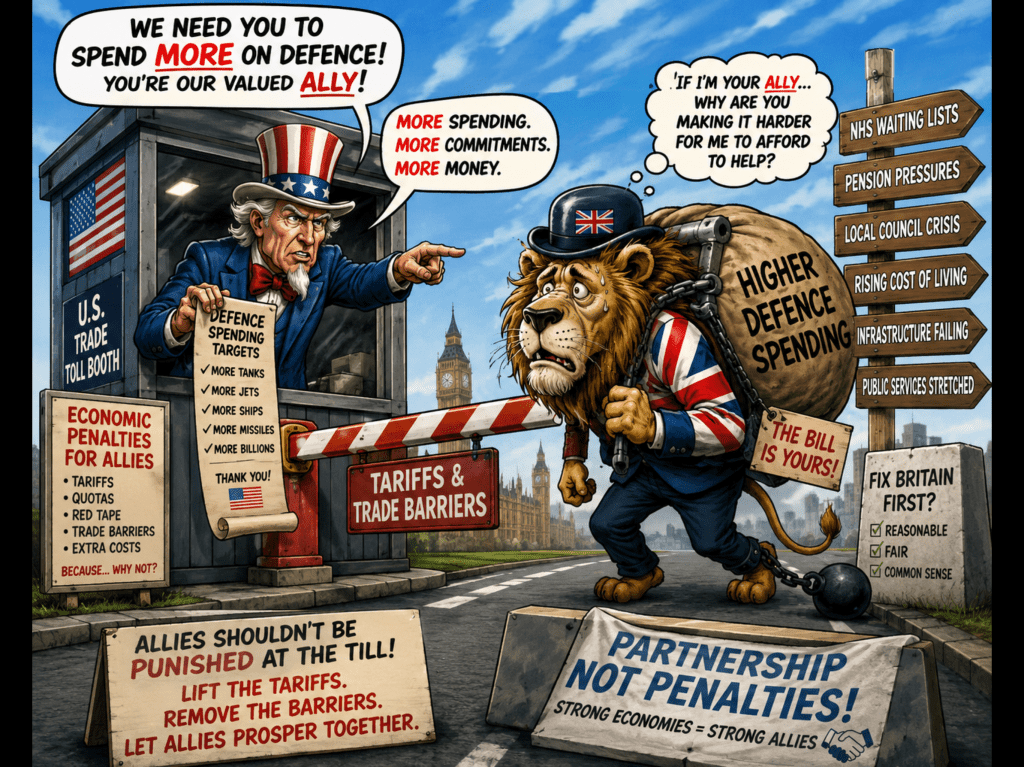
America regularly tells Britain and other European allies that defence spending must increase to meet growing global threats. Fair enough, many voters accept that strong defence matters. But if we’re truly partners, there is a question becoming harder to ignore:
Why are allies being asked to spend more while simultaneously being hit with tariffs, trade barriers, and economic measures that make growth harder?
🤝 The Curious Case of the Ally Who Gets the Bill Anyway 💰
Imagine inviting your mate round for dinner.
You tell him he’s part of the team. A trusted friend. A valued partner.
Then you hand him the shopping list, charge him admission at the door, and send him an invoice for dessert.
That’s increasingly how some taxpayers view the relationship.
Britain is told it needs to spend more on defence.
More ships.
More aircraft.
More military commitments.
More money.
Yet at the same time, British businesses can face tariffs, trade restrictions, and economic obstacles from the very country demanding bigger defence budgets.
It’s a strange definition of partnership.
“You’re our closest ally.”
“Excellent. Can we have freer trade then?”
“No.”
“Can we remove some of the barriers hurting economic growth?”
“Also no.”
“But you still want us to spend billions more?”
“Absolutely.” 😂💸
Most people aren’t objecting to having armed forces.
They’re asking a simple question of fairness.
If allies are expected to strengthen their militaries, shouldn’t allies also help each other prosper economically?
After all, stronger economies create stronger defence budgets.
It’s difficult to spend more on national security when growth is being squeezed from the other side.
Many voters look at struggling public services, stretched local councils, infrastructure problems, rising costs, and NHS pressures and wonder why every conversation starts with spending more abroad before fixing problems at home.
The frustration isn’t anti-American.
It’s pro-common sense.
If Britain is genuinely a valued ally, perhaps the first step isn’t another lecture about spending targets.
Perhaps it’s removing the economic barriers that make paying for those targets harder in the first place. 🇬🇧⚖️
🔥 Challenges 🔥
If Britain is expected to spend more on defence, should allies also be expected to support each other’s economic growth?
Can you call someone your closest ally while simultaneously putting obstacles in their way?
Tell us what you think in the blog comments below. Agree, disagree, or bring your sharpest political observations. 💬🔥
👇 Like, comment, and share if you think partnerships should work both ways.
🏆 The best comments will be featured in the next issue of the magazine.


 Chameleon Magazine
Leave a comment