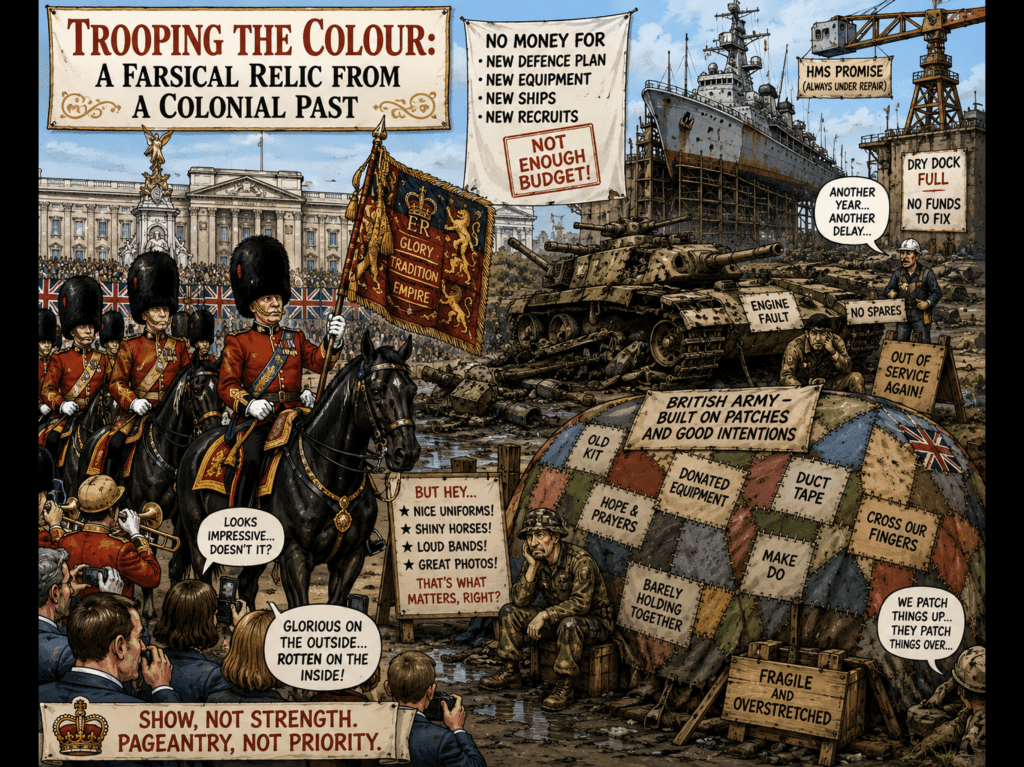
As the bands march, the horses parade, and the cameras roll, many taxpayers may find themselves asking a rather uncomfortable question:
What exactly are we celebrating?
🎖️ Ceremonial Splendour in an Age of Empty Coffers 💷
Britain is being told the world is more dangerous than ever.
We’re told defence spending must rise.
We’re told the armed forces need more investment.
We’re told there isn’t enough money.
Yet somehow there always seems to be enough money for another grand display of uniforms, medals, carriages, and military pageantry.
Meanwhile, some naval vessels spend lengthy periods tied up awaiting repairs. Recruitment struggles continue. Equipment programmes face constant budget pressures. Defence chiefs repeatedly warn about funding gaps.
The public is told every penny counts.
Apparently, except on parade day.
Trooping the Colour remains a spectacular piece of theatre. The uniforms shine. The bands play. The crowds cheer.
But increasingly it can feel like Britain is staging a historical re-enactment while struggling to fund the future.
For many critics, the event represents a lingering relic of an imperial and colonial era—a celebration of symbolism over substance.
The question isn’t whether tradition should exist.
The question is whether tradition should be immune from scrutiny.
If the country genuinely faces major security challenges, shouldn’t the focus be on military capability rather than ceremonial spectacle?
After all, enemies are unlikely to be deterred by a particularly well-ironed tunic. 🎺😂
Perhaps the greatest irony is that while politicians warn of hard choices ahead, taxpayers are still expected to applaud displays that seem increasingly disconnected from modern realities.
When public services are stretched, defence budgets are under pressure, and households are counting every penny, some voters inevitably wonder whether Britain is preserving history—or simply avoiding difficult conversations about the present.
🔥 Challenges 🔥
Has Trooping the Colour become an important national tradition worth preserving?
Or is it an expensive symbol of a bygone age that no longer reflects modern Britain?
Drop your views in the comments below. Agree, disagree, or march straight into the debate. 💬🔥
👇 Like, comment, and share.
🏆 The best comments will be featured in the next issue of the magazine.


 Chameleon Magazine
Leave a comment