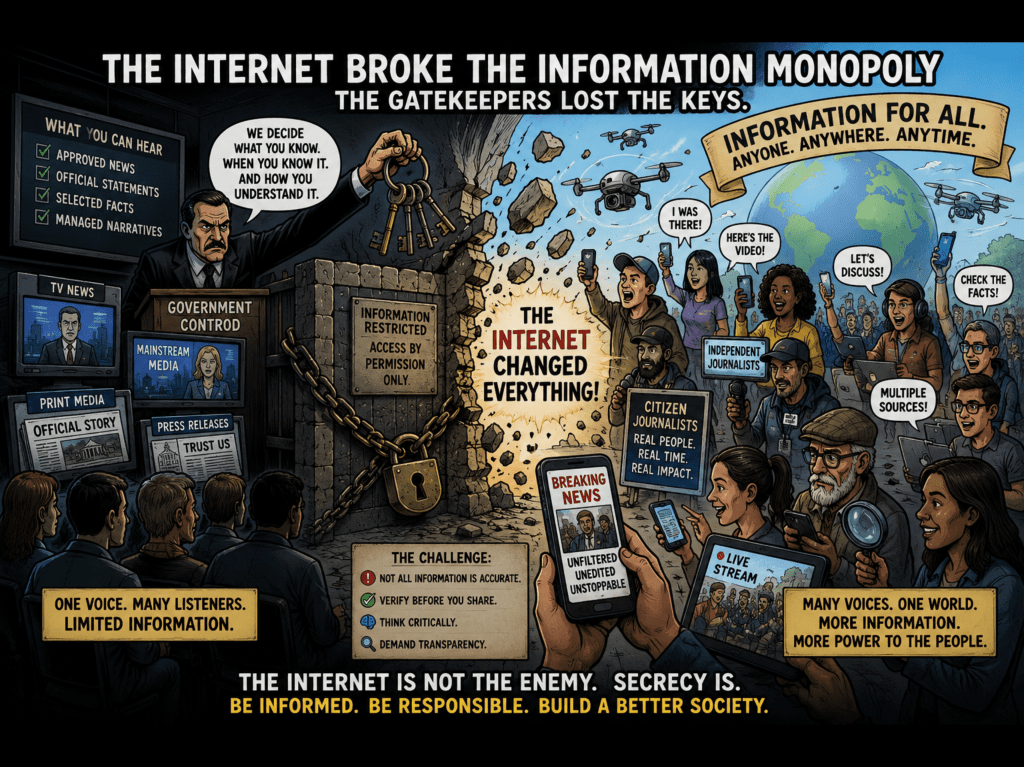
For centuries, governments, institutions, and media gatekeepers enjoyed a near-exclusive privilege: deciding what information reached the public and when. Whether through newspapers, broadcasters, official statements, or carefully managed press conferences, the flow of information moved in one direction. The public listened. The authorities spoke.
Then somebody plugged the world into the internet. ⚡
Today, a witness with a smartphone can publish breaking news before a government spokesperson has finished drafting a press release. Citizens can compare reports from multiple countries, watch events unfold live, and challenge official narratives in real time. The old information toll booths have been bypassed, and the gatekeepers are discovering that the gates no longer control the road.
📱 The Age of Citizen Journalists Has Arrived
The internet has transformed ordinary people into reporters, investigators, commentators, and publishers.
When something significant happens, thousands of individuals can upload videos, photographs, documents, and eyewitness accounts within minutes. Governments and traditional media outlets are no longer the sole narrators of events.
That’s both a triumph and a headache.
On one hand, information can no longer be easily buried, delayed, or filtered. On the other, not every citizen journalist has training in verification, source checking, or legal standards. The result is an information landscape that is often faster than ever—but not always more accurate.
It’s a bit like replacing a carefully managed orchestra with ten thousand drummers all playing at once. 🥁🎺📢
The truth is in there somewhere, but finding it can take some effort.
🎭 Governments Versus Reality
Many governments still behave as if they are operating in the age of three television channels and tomorrow’s newspaper.
Information strategies are often built around controlling announcements, limiting access, shaping narratives, and deciding which facts deserve public attention.
The problem?
The internet doesn’t wait for permission.
Attempts to suppress discussion frequently achieve the opposite effect. Stories that might once have faded away can explode across social media platforms, discussion forums, podcasts, and independent websites.
The public increasingly notices not only what is being reported—but also what appears to be missing.
And when people sense gaps in the story, they start filling those gaps themselves.
Sometimes they fill them accurately.
Sometimes they don’t.
🤝 A Smarter Approach: Work With the Internet, Not Against It
Rather than viewing the internet as a threat, governments could see it as the most powerful public communication tool ever created.
The public does not expect perfection. What they increasingly expect is transparency.
Provide information quickly.
Correct mistakes openly.
Release evidence when possible.
Answer legitimate questions.
Treat citizens like adults.
When governments communicate honestly and promptly, they reduce the vacuum that rumours and speculation rush to occupy.
Silence creates conspiracy theories.
Transparency creates trust.
The internet is not going away, and neither is the public’s ability to compare information from countless sources around the world.
The choice facing governments is simple:
Fight the flow of information and watch public trust erode further.
Or embrace open communication and become part of the conversation.
🔥Challenges🔥
Has the internet made society more informed—or simply louder?
Do governments still try to shape what citizens hear, or has that become impossible in the digital age?
Most importantly, would public trust improve if governments embraced transparency instead of treating information like a state-controlled resource?
Drop your thoughts in the blog comments below. 💬🔥
👇 Like, comment, and share if you believe the internet has changed the balance of power between citizens and institutions.
🏆 The most insightful comments will be featured in the next issue of the magazine.


 Chameleon Magazine
Leave a comment