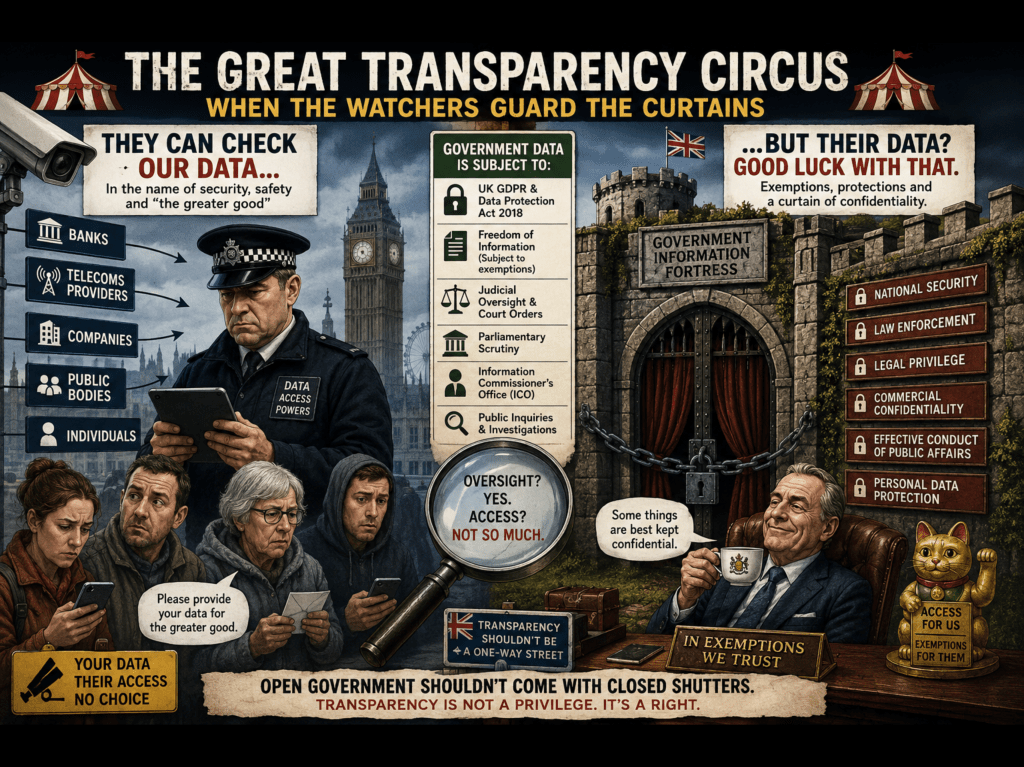
The British public is often told that government bodies need extensive powers to access information from banks, telecoms providers, businesses, and ordinary citizens in order to keep society safe, efficient, and compliant. Fair enough—at least in principle.
But when curious citizens ask for a peek behind the government curtain, they quickly discover the transparency door has more locks than a medieval castle. 🏰🔐
🕵️♂️ Open Government… Terms and Conditions Apply
Technically, government-held information isn’t untouchable. There are laws, regulators, parliamentary committees, public inquiries, courts, and Freedom of Information requests all designed to shine a light into the corridors of power.
Sounds wonderful. Almost inspiring. 🇬🇧✨
Then comes the small print.
National security? Exemption.
Law enforcement? Exemption.
Legal privilege? Exemption.
Commercial confidentiality? Exemption.
Effective conduct of public affairs? Exemption.
Personal data? Exemption.
By the time the exemptions finish marching past, the transparency parade resembles a ghost town. 👻
Citizens are frequently reminded that data sharing is essential for the greater good, while governments reserve the right to explain that their own records must remain confidential for reasons that are, unfortunately, confidential.
It’s a bit like being told your house requires floor-to-ceiling windows while the authorities operate from a fortified bunker with blackout curtains and a moat. 🏠➡️🏰
To be fair, government information isn’t completely shielded. There are genuine oversight mechanisms and legal safeguards in place. But many people can’t help noticing that the balance often feels slightly tilted.
One side gets access requests.
The other side gets exemption requests.
And somewhere in the middle sits the average taxpayer wondering whether transparency is a two-way mirror. 🤔🪞
🔥 Challenges 🔥
If government bodies can request vast amounts of information about citizens, where should the line be drawn when citizens request information about government decisions?
Should transparency apply equally to everyone, or are some secrets genuinely necessary for effective government?
Drop your thoughts in the blog comments below. We want the sharpest takes, the funniest observations, and the toughest questions. 💬⚡
👇 Like, comment, and share if you’ve ever felt that “open government” sometimes arrives with the shutters firmly closed.
🏆 The best comments, critiques, and truth bombs will be featured in the next issue of the magazine.


 Chameleon Magazine
Leave a comment